SailPoint Interview Questions And Answers
Prepare with the top SailPoint interview questions and answers covering IdentityIQ, IdentityNow, RBAC, certifications, salary, and India career insights.
★★★★★
4.9/5 rated by 1329+ students · Google Verified
Table of Contents
SailPoint Interview Questions And Answers: The Complete 2026 Guide
This guide compiles the most important SailPoint interview questions and answers for 2026, spanning IdentityIQ, Identity Security Cloud (IdentityNow), certification, advanced, and scenario-based topics. Alongside the questions, it covers SailPoint roles, salaries in India, essential skills, and a career roadmap — everything you need to prepare confidently for an identity and access management interview.
Identity has become the new security perimeter. As enterprises move to the cloud and manage thousands of human and machine identities, the people who can govern who has access to what are among the most sought-after professionals in cybersecurity — and SailPoint expertise sits right at the center of that demand. If you are preparing for an interview, this curated set of SailPoint interview questions and answers is designed to take you from fundamentals to advanced, real-world scenarios.
SailPoint is the global leader in identity governance and administration (IGA), the discipline of managing digital identities and controlling their access across an organization. Its two flagship platforms — the on-premises IdentityIQ and the SaaS Identity Security Cloud (formerly IdentityNow) — power identity programs at many of the world’s largest banks, hospitals, and technology firms.
Why are SailPoint skills so valuable? Because identity security is no longer optional. Regulations such as SOX, HIPAA, GDPR, and PCI DSS demand demonstrable access controls, while Zero Trust strategies make identity the foundation of enterprise defense. That combination has created a persistent shortage of skilled SailPoint engineers, developers, and administrators.
For India specifically, the opportunity is significant. India is a major global hub for IAM delivery, with product companies, system integrators, and enterprise security teams all hiring SailPoint talent across Hyderabad, Bangalore, Pune, and Chennai. If you want to build these skills from the ground up, structured SailPoint Certification Training in Hyderabad can give you the hands-on foundation that interviewers look for. Let’s start with the fundamentals before diving into the questions.
SailPoint Interview Questions And Answers
What is SailPoint?
SailPoint is an identity security company whose platform gives organizations visibility and control over every identity — employee, contractor, partner, or machine — and the access each one holds. Rather than focusing on the login itself, SailPoint’s identity security platform governs the entire lifecycle of access: how it is requested, granted, reviewed, and revoked.
Founded in 2005, SailPoint went public in 2017, was taken private by Thoma Bravo in 2022, and returned to the Nasdaq (ticker: SAIL) in February 2025 as a cloud-first SaaS business. Its product family centers on two platforms: IdentityIQ, the customizable on-premises IGA solution, and Identity Security Cloud, the multi-tenant SaaS platform built on the Atlas foundation. Understanding both is essential for modern SailPoint interviews.
Why SailPoint Professionals Are in High Demand
Demand for SailPoint professionals is driven by forces that are only intensifying
- Rising cyber threats. Compromised identities are behind a large share of breaches, making identity governance a board-level priority.
- Regulatory pressure. Compliance frameworks require provable, auditable access controls — exactly what SailPoint delivers.
- Cloud and hybrid complexity. Multi-cloud environments and remote work multiply the identities that must be governed.
- Specialized skill scarcity. SailPoint blends IAM concepts with hands-on platform skills, and that combination is genuinely hard to find.
The result is a job market where certified, hands-on SailPoint engineers command strong salaries and enjoy considerable mobility.
SailPoint Career Opportunities in India
India’s identity security job market is thriving. Global capability centers, IT services giants, and product firms all maintain large IAM practices, and SailPoint is one of the most widely deployed platforms among them. Typical openings include IAM Engineer, SailPoint Developer, SailPoint Administrator, Identity Governance Analyst, and IAM Consultant, with senior tracks leading to Identity Security Architect.
Cities such as Hyderabad, Bangalore, Pune, Chennai, and Gurugram concentrate the bulk of these roles, often within BFSI, IT services, and consulting. Because SailPoint skills transfer across industries, professionals enjoy flexibility to move between domains as their careers grow.
Industries Using SailPoint
SailPoint is industry-agnostic, but adoption is heaviest where compliance and access risk are greatest
- Banking and financial services (BFSI) — strict Segregation of Duties and SOX requirements.
- Healthcare and life sciences — HIPAA-driven controls over patient data.
- Technology and SaaS — fast-changing teams and many internal applications.
- Retail and e-commerce — high workforce turnover demanding automated provisioning.
- Government and public sector — stringent access governance and auditability.
Top Companies Hiring SailPoint Professionals
SailPoint talent is recruited by a broad mix of employers: global system integrators and IT services firms that implement SailPoint for clients; large enterprises in banking, insurance, healthcare, and manufacturing that run in-house identity programs; cybersecurity consultancies; and SailPoint itself, which maintains engineering and support teams in India. Because so many organizations standardize on SailPoint for governance, experienced professionals rarely struggle to find their next role.
SailPoint Roles and Responsibilities
While titles vary, most SailPoint roles fall into a few patterns
- SailPoint Developer — builds and customizes the platform: writing rules and BeanShell, configuring connectors, designing workflows, and integrating applications.
- SailPoint Administrator — operates and maintains the deployed environment: managing aggregations, certifications, upgrades, and day-to-day support.
- IAM Engineer — works across the wider identity stack, of which SailPoint is one component.
- Identity Governance Analyst — focuses on policies, certifications, and compliance reporting.
- IAM/Identity Security Architect — designs the overall identity strategy and solution architecture.
SailPoint Salary in India
SailPoint salaries in India reflect the platform’s specialized skill set and rising demand. The figures below are indicative annual ranges; actual compensation varies by city, employer, skills, and certification. For a deeper, location-specific breakdown, see our guide to SailPoint salary in Hyderabad.
|
Experience Level |
Indicative Salary Range (per year) |
|
Fresher (0–2 years) |
₹4.5 – ₹8 LPA |
|
Mid-Level (3–5 years) |
₹8 – ₹16 LPA |
|
Senior (6–10 years) |
₹16 – ₹28 LPA |
|
Architect / Lead (10+ years) |
₹28 LPA and above |
Essential Skills for SailPoint Professionals
Interviewers consistently probe a blend of conceptual and hands-on skills. Strong candidates demonstrate
- IGA fundamentals — identity lifecycle, RBAC, access certifications, provisioning, and compliance.
- Platform skills — IdentityIQ configuration or Identity Security Cloud administration, connectors, workflows, and aggregation.
- Programming — Java and BeanShell for IdentityIQ rules; transforms and APIs for Identity Security Cloud.
- Supporting tech — XML, SQL, LDAP, REST, and an understanding of directories like Active Directory.
- Soft skills — clear communication, troubleshooting discipline, and the ability to translate compliance needs into configuration
SailPoint IdentityIQ Interview Questions And Answers
-
What is SailPoint IdentityIQ?
IdentityIQ is SailPoint’s on-premises identity governance and administration platform. It centralizes identity lifecycle management, access requests, provisioning, certifications, and policy enforcement, giving organizations visibility and control over access while supporting compliance. Detailed product behavior is documented in the official SailPoint IdentityIQ documentation.
-
What is an Identity Cube in IdentityIQ?
An Identity Cube is the aggregated, 360-degree profile of a single identity. It combines attributes from authoritative sources with all the accounts, entitlements, and roles that identity holds across connected applications, giving a unified view used for certifications, policy checks, and provisioning. -
What is the difference between a role and an entitlement?
An entitlement is the most granular unit of access — a group membership or permission in an application. A role is a logical bundle that groups entitlements (IT roles) or job functions (business roles) so access can be requested and granted in meaningful, manageable units rather than one permission at a time. -
What are the types of certifications in IdentityIQ?
IdentityIQ supports several certification types, including manager certifications (a manager reviews their reports’ access), application owner certifications, role composition and role membership certifications, and entitlement owner certifications. These periodic reviews confirm that access remains appropriate and produce audit evidence. -
What are rules and BeanShell in IdentityIQ?
Rules are units of custom logic that extend IdentityIQ’s behavior — for example, building an account attribute, correlating accounts, or customizing provisioning. They are typically written in BeanShell, a lightweight Java scripting language, which is why solid Java knowledge is valuable for developer roles. -
What is aggregation, and what is a connector?
A connector is the integration that links IdentityIQ to a target application or directory. Aggregation is the process of pulling account and entitlement data from those connected sources into IdentityIQ so identity cubes stay accurate. Account aggregation reads accounts; group aggregation reads entitlements and groups. -
What is provisioning and deprovisioning in IdentityIQ?
Provisioning is the automated creation or modification of access — for instance, granting accounts when a role is assigned. Deprovisioning removes access, such as disabling accounts when someone leaves or changes roles. IdentityIQ builds a provisioning plan and executes it through connectors or manual work items.
SailPoint IdentityNow Interview Questions And Answers
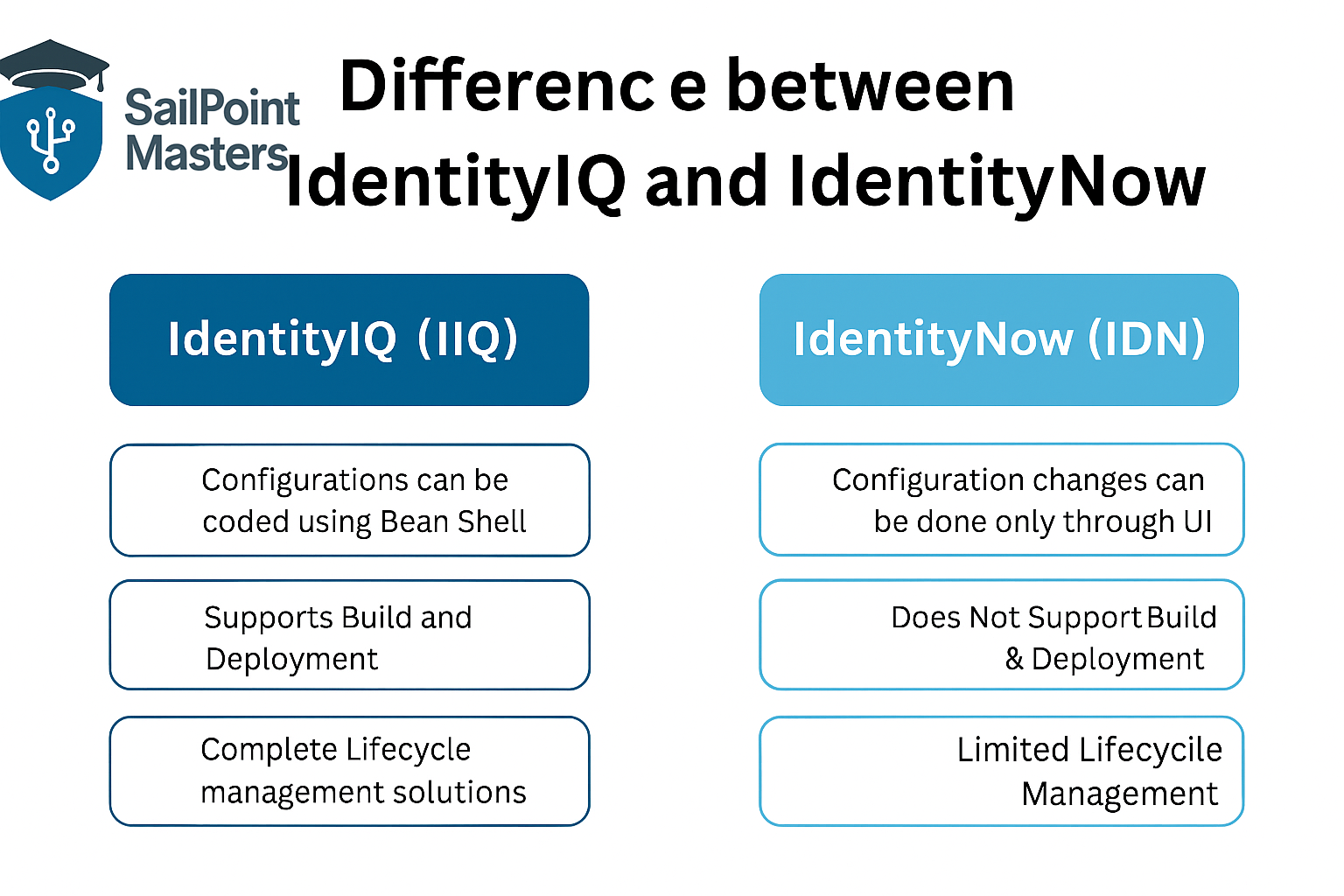
IdentityNow — now part of SailPoint Identity Security Cloud — is the SaaS side of the portfolio, and cloud questions appear more often every year. To see how the platforms compare in depth, our breakdown of SailPoint IIQ and IdentityNow is a useful companion.
-
What is SailPoint Identity Security Cloud (IdentityNow)?
It is SailPoint’s cloud-delivered, multi-tenant SaaS identity governance platform. SailPoint hosts and maintains it, so organizations get faster deployment, automatic updates, and lower operational overhead compared with running software on-premises. Developer guidance lives at the SailPoint Developer Community.
-
How does IdentityNow differ from IdentityIQ?
IdentityIQ is on-premises and highly customizable but requires you to manage infrastructure and upgrades. Identity Security Cloud is SaaS — faster to deploy and maintenance-light — with configuration favored over deep code customization. The choice depends on an organization’s customization needs, compliance posture, and cloud strategy. -
What is a Virtual Appliance (VA) in IdentityNow?
A Virtual Appliance is a lightweight, SailPoint-provided component deployed inside the customer’s network. It acts as a secure gateway, letting the cloud tenant communicate with on-premises sources such as Active Directory without exposing them directly to the internet. -
What are sources and identity profiles in IdentityNow?
A source is a connected system that provides account data, similar to an application in IdentityIQ. An identity profile defines how identities are created and mapped from an authoritative source, including attribute mappings and the lifecycle states that drive access. -
What is a transform in Identity Security Cloud?
A transform is a reusable, configurable rule for manipulating attribute data — for example, formatting names or generating usernames — without writing custom code. Transforms are a cloud-friendly alternative to many of the BeanShell rules used in IdentityIQ.
SailPoint Certification Interview Questions
-
What SailPoint certifications are available?
SailPoint offers role-based certifications across its platforms, including IdentityIQ engineer-level credentials and Identity Security Cloud certifications spanning associate, professional, and architect levels. Current paths and exam details are published on SailPoint University.
-
Which certification should a beginner pursue?
Beginners usually start with an engineer or associate-level certification aligned to the platform their target employers use. The credential validates core skills — lifecycle management, certifications, and provisioning — and signals commitment to hiring managers. -
How do certifications help your career?
Certifications shorten the trust gap in hiring, often correlate with higher pay, and structure your learning around the skills employers actually test. Paired with hands-on project experience, they make a resume stand out in a competitive field.
Advanced SailPoint Interview Questions And Answers
-
Explain the end-to-end provisioning flow.
A trigger — such as a role assignment or access request — generates a provisioning plan describing the required account and entitlement changes. The plan passes through policy checks (including SoD), routes for any approvals, and is then executed through connectors or assigned as manual work items, with results written back to the identity cube. -
What is the difference between birthright and access-request provisioning?
Birthright provisioning grants baseline access automatically based on identity attributes the moment someone joins — email, VPN, intranet. Access-request provisioning grants additional access only when explicitly requested and approved. Together they balance day-one productivity with least privilege. -
How does Segregation of Duties (SoD) work in SailPoint?
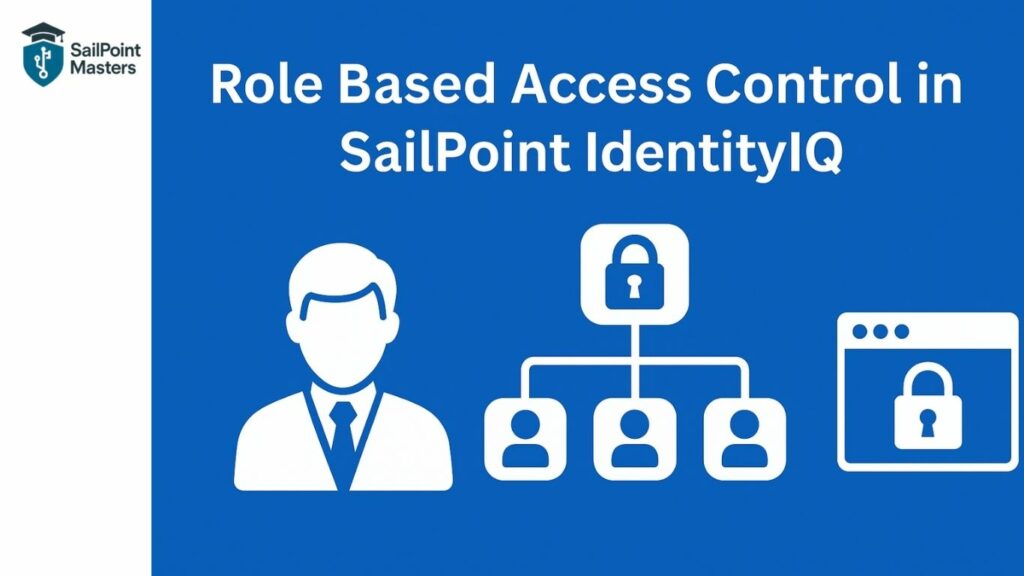
SoD policies define toxic combinations of access — for example, creating a vendor and approving its payments. IdentityIQ evaluates these policies during access requests and certifications, raising violations that must be remediated or formally accepted as documented exceptions with compensating controls. RBAC makes this enforceable at the role level; our guide to role-based access control in IdentityIQ covers it in detail.
-
What is a workflow in IdentityIQ?
A workflow is a configurable, multi-step process — built from steps, approvals, and logic — that orchestrates activities such as access requests, lifecycle events, and certifications. Developers customize workflows to match an organization’s approval routing and business rules. -
How would you troubleshoot a failed or slow aggregation?
Check the task results and logs for errors, verify connector configuration and credentials, confirm source-system availability and network paths, review filters and rules that may be processing excess data, and tune partitioning or scheduling for large sources. Methodical isolation of the failing layer is what interviewers want to hear.
Scenario-Based SailPoint Interview Questions
-
A user changed departments but kept their old access. How do you handle it?
This is access creep. The attribute change should trigger a lifecycle (mover) event that re-evaluates role assignments, removing access tied to the old role and granting the new one. A targeted certification can clean up residual entitlements, and reviewing why automation did not catch it prevents recurrence. -
An auditor needs evidence that access reviews happened. What do you show?
You provide completed certification campaigns with reviewer decisions and timestamps, policy violation reports and their remediation, and the audit trail of access changes. This demonstrates that least-privilege controls are not just defined but actively enforced. -
How would you onboard a new application into SailPoint?
Identify the right connector, configure connectivity and credentials, run account and group aggregation, correlate accounts to identities, model the relevant entitlements and roles, define certification and SoD requirements, and test provisioning before promoting to production.
SailPoint vs Okta, CyberArk, and Related Comparisons
Interviewers often test whether you understand where SailPoint fits in the wider identity landscape. These comparisons summarize the distinctions clearly.
SailPoint vs Okta
|
Aspect |
SailPoint |
Okta |
|
Primary focus |
Identity Governance & Administration (IGA) |
Access Management (SSO, MFA) |
|
Core question answered |
“Who should have access, and is it compliant?” |
“Is this the right user logging in?” |
|
Strength |
Certifications, roles, provisioning, audit |
Authentication and seamless login |
|
Typical use |
Governance and compliance programs |
Workforce and customer authentication |
SailPoint vs CyberArk
|
Aspect |
SailPoint |
CyberArk |
|
Primary focus |
Identity governance for all users |
Privileged Access Management (PAM) |
|
Scope |
Broad workforce access lifecycle |
High-risk privileged and admin accounts |
|
Key strength |
Access certification and provisioning |
Credential vaulting and session control |
|
Relationship |
Often deployed together — governance plus privileged protection |
|
SailPoint IdentityIQ vs Identity Security Cloud
|
Aspect |
IdentityIQ |
Identity Security Cloud (IdentityNow) |
|
Deployment |
On-premises (customer-managed) |
SaaS (SailPoint-hosted) |
|
Customization |
Deep, via rules and BeanShell |
Configuration-first, transforms and APIs |
|
Maintenance |
Customer manages upgrades |
Automatic, vendor-managed updates |
|
Best for |
Complex, highly customized needs |
Fast deployment and lower overhead |
IAM Engineer vs SailPoint Developer
|
Aspect |
IAM Engineer |
SailPoint Developer |
|
Scope |
Broad identity stack (multiple tools) |
SailPoint platform specifically |
|
Focus |
Architecture, integration, operations |
Rules, workflows, connectors, customization |
|
Key skills |
IAM concepts, multiple vendors, scripting |
IdentityIQ/ISC, Java, BeanShell, APIs |
SailPoint Developer vs SailPoint Administrator
|
Aspect |
SailPoint Developer |
SailPoint Administrator |
|
Main responsibility |
Build and customize the platform |
Operate and maintain it |
|
Day-to-day |
Coding rules, workflows, integrations |
Aggregations, certifications, support, upgrades |
|
Skill emphasis |
Development and design |
Operations and troubleshooting |
SailPoint Career Roadmap
A clear progression helps you target the right skills at each stage. Use this roadmap as a guide from your first role to architect level.
|
Level |
Skills to Learn |
Career Goal |
|
Beginner |
IAM and IGA fundamentals, identity lifecycle, RBAC basics, Java/SQL |
Junior IAM Engineer / SailPoint Trainee |
|
Intermediate |
IdentityIQ/ISC configuration, certifications, provisioning, connectors, BeanShell |
SailPoint Developer / Administrator |
|
Advanced |
Workflows, custom rules, SoD, integrations, performance tuning |
Senior SailPoint Engineer / Consultant |
|
Expert |
Solution architecture, identity strategy, governance design, leadership |
IAM / Identity Security Architect |
For more on what comes next once you are certified, see our guide on what to do after SailPoint certification.
Future Scope of SailPoint Careers in India
The outlook is strong. The global identity and access management market was valued at roughly USD 22–27 billion in 2025 and is projected to grow at a double-digit annual rate toward USD 40 billion and beyond by the early 2030s, according to analysts at firms such as Grand View Research. Asia-Pacific, including India, is among the fastest-growing regions.
Several trends reinforce this: the spread of Zero Trust architectures, the explosion of non-human and machine identities, tightening privacy regulation, and the integration of AI into identity governance for smarter access reviews and anomaly detection. Each of these increases — not decreases — the value of professionals who understand SailPoint deeply.
How to Start a Career in SailPoint
Breaking in is very achievable with a focused plan
- Learn the fundamentals of IAM and IGA — identities, roles, certifications, provisioning, and compliance.
- Get hands-on with IdentityIQ and Identity Security Cloud through guided labs; practical reps matter more than theory.
- Build supporting skills in Java, BeanShell, XML, and SQL.
- Earn a certification aligned to your target platform to validate your skills.
- Practice interviews using question sets like this one and real scenarios.
A structured program accelerates every step. Reviewing the SailPoint course syllabus is a good way to see exactly which skills a job-ready curriculum should cover, and quality SailPoint training in Hyderabad combines those concepts with the hands-on labs interviewers expect.
Why SailPoint Is One of the Best Cybersecurity Careers in India
Few cybersecurity specializations combine demand, pay, and longevity as well as SailPoint and identity governance
- Growing identity security needs. As identity becomes the primary attack surface, governance skills are central to enterprise defense.
- Enterprise demand. Banks, hospitals, and global firms run large, ongoing SailPoint programs that need continuous staffing.
- Career growth potential. Clear progression from engineer to architect, with consulting and leadership branches.
- Strong salary prospects. Specialized skills command premiums, with senior and architect roles paying well above general IT.
- Long-term relevance. Compliance and Zero Trust are durable drivers, so the skills remain valuable for years.
Market Demand and Industry Insights
A few data points put the opportunity in context. Identity governance is one of the fastest-growing segments within the larger IAM market, propelled by cloud migration, regulatory compliance, and rising breach costs. Authoritative guidance on the underlying security principles — such as digital identity assurance and Zero Trust — is published by NIST, and these frameworks increasingly shape how enterprises design their identity programs.
For hiring, the practical takeaway is consistency of demand: even in cautious markets, organizations continue investing in identity security because the regulatory and risk drivers do not pause. That makes SailPoint a resilient skill set to build a career around.
Key Takeaways
- SailPoint leads IGA. IdentityIQ (on-prem) and Identity Security Cloud (SaaS) are the two platforms to master.
- Interviews span breadth and depth. Expect questions on identity cubes, roles vs entitlements, certifications, provisioning, workflows, rules/BeanShell, connectors, and SoD.
- Scenario questions matter. Be ready to reason through access creep, troubleshooting, audits, and application onboarding.
- Strong, growing pay in India. Ranges run from ₹4.5–8 LPA for freshers to ₹28 LPA+ for architects.
- Durable demand. A double-digit-growth IAM market and Zero Trust adoption keep SailPoint skills highly valuable.
Conclusion
Preparing well is the difference between knowing SailPoint and proving it in the room. This collection of SailPoint interview questions and answers spans the full arc an interviewer will explore — from IdentityIQ fundamentals and Identity Security Cloud concepts to certifications, advanced provisioning, and the scenario-based judgment that separates strong candidates from the rest.
Behind every one of those questions is the same theme: governing identity well is now core to enterprise security and compliance. That is precisely why SailPoint skills remain in such demand, why salaries are strong, and why the career has staying power as Zero Trust and AI-driven governance reshape the field.
If you take one action from this guide, make it this: pair your study with hands-on practice and a recognized certification. Learn the platforms deeply, rehearse these questions until the answers are second nature, and you will be ready to launch — or level up — a rewarding career in identity and access management.
FAQ
-
Is SailPoint a good career in 2026?
Yes. SailPoint leads identity governance, and the IAM market is growing at double-digit rates. Skilled professionals are in demand across IT, banking, healthcare, and consulting, with attractive salaries and clear paths to architect and lead roles. -
What are the most common SailPoint interview questions?
They cover the identity cube, roles versus entitlements, access certifications, provisioning and deprovisioning, lifecycle events, workflows, rules and BeanShell, connectors and aggregation, and Segregation of Duties — plus scenario questions on troubleshooting and audits. -
Do I need coding skills for a SailPoint job?
For developer roles, yes — IdentityIQ uses Java and BeanShell, and Identity Security Cloud uses transforms and APIs. Administrator and analyst roles need less coding, but Java, XML, and SQL knowledge helps across the board. -
What is the salary of a SailPoint developer in India?
Freshers typically earn around ₹4.5–8 LPA, mid-level professionals ₹8–16 LPA, senior engineers ₹16–28 LPA, and architects ₹28 LPA and above. Pay varies by city, employer, skills, and certification. -
What is the difference between SailPoint IdentityIQ and IdentityNow?
IdentityIQ is the on-premises, highly customizable platform; IdentityNow (now part of Identity Security Cloud) is the SaaS, vendor-hosted platform. IdentityIQ offers deeper customization, while Identity Security Cloud offers faster deployment and lower maintenance. -
Which SailPoint certification is best for beginners?
Start with an engineer or associate-level certification aligned to the platform your target employers use. It validates core skills in lifecycle management, certifications, and provisioning, and strengthens an entry-level resume. -
How long does it take to learn SailPoint?
With focused, hands-on training, most learners become job-ready in roughly two to four months. Prior IAM, Java, or SQL knowledge shortens the curve, and lab practice matters more than memorizing theory. -
What roles can I apply for after learning SailPoint?
IAM Engineer, SailPoint Developer, SailPoint Administrator, Identity Governance Analyst, IAM Consultant, and — with experience — Identity Security Architect. Demand spans product companies, system integrators, and enterprise security teams. -
Is SailPoint better than Okta or CyberArk?
They solve different problems: SailPoint leads governance, Okta focuses on access management (SSO/MFA), and CyberArk specializes in privileged access. Enterprises frequently use them together rather than choosing one. -
What skills make a strong SailPoint candidate?
A blend of IGA fundamentals and hands-on platform skills — lifecycle, RBAC, certifications, provisioning, workflows, connectors — plus Java, BeanShell, XML, SQL, knowledge of compliance frameworks, and good communication and troubleshooting ability.
SailPoint Trainer
SailPoint Masters Editorial Team | 15+ Articles Published
We specialize in SailPoint Certification Training in Hyderabad, helping aspiring professionals and IT experts develop in-demand Identity and Access Management (IAM) skills. Our training covers SailPoint IdentityIQ, Identity Security Cloud, certification preparation, real-world projects, and career guidance to support success in cybersecurity and identity governance careers.
Share