
CyberArk vs BeyondTrust: Which PAM Platform Should You Choose in 2026?
CyberArk (now rebranded Idira under Palo Alto Networks) and BeyondTrust are both leading Privileged Access Management (PAM) platforms. CyberArk/Idira is known for deep vault security and enterprise-scale credential protection; BeyondTrust is known for unifying infrastructure PAM with endpoint privilege management and secure remote access. Neither is universally “better” — the right choice depends on architecture, scale, and use case.
★★★★★
4.9/5 rated by 1329+ students · Google Verified
Table of Contents
Introduction
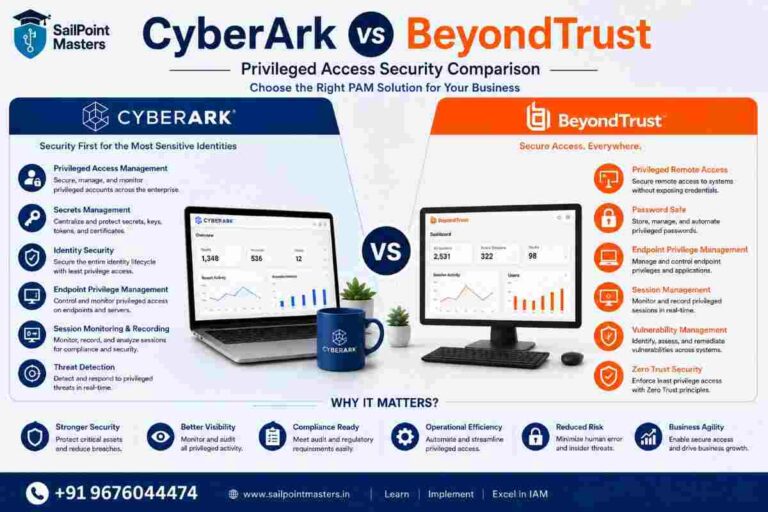
Privileged accounts — domain admins, root credentials, service accounts, cloud keys — are the accounts attackers want most, because a single compromised privileged credential can lead to full infrastructure takeover. Privileged Access Management (PAM) exists to close that gap: it vaults credentials, monitors privileged sessions, enforces least privilege, and increasingly governs non-human and AI-agent identities too.
When enterprises evaluate PAM, the CyberArk vs BeyondTrust comparison comes up almost immediately, because both platforms are consistently named PAM market leaders. Before going further, one fact matters for accuracy: CyberArk was acquired by Palo Alto Networks in a deal that closed in February 2026, and the platform was rebranded to Idira in May 2026 (confirmed on CyberArk’s own press page: https://www.cyberark.com/press/cyberark-shareholders-approve-the-companys-acquisition-by-palo-alto-networks/). The underlying technology, component names (Vault, PSM, CPM, PVWA), and skill set are unchanged — only the branding and go-to-market have shifted, and “CyberArk” is still the term most job postings, recruiters, and practitioners use during this transition. This article uses “CyberArk (Idira)” to stay accurate while matching how the market currently searches and hires.
BeyondTrust, headquartered in Johns Creek, Georgia, has taken a different path: rather than one dominant vault product, it has built a unified Universal Privilege Management platform spanning credential vaulting (Password Safe), endpoint least privilege (Privilege Management), and secure remote/vendor access (Privileged Remote Access) — all reporting into a single BeyondInsight console.
Large regulated enterprises, mid-market companies scaling their first PAM program, and organizations with heavy third-party or remote-vendor access all have reasons to prefer one platform over the other. This guide breaks down the CyberArk vs BeyondTrust comparison across architecture, features, deployment, pricing, and career opportunities so you can make an informed call. We put this together at SailPoint Masters, Hyderabad’s SailPoint certification training institute (https://sailpointmasters.in/), where PAM tools like CyberArk (Idira) and BeyondTrust regularly come up alongside SailPoint as the identity governance layer — so IAM/PAM learners here understand where each skill set fits into a real enterprise identity stack.
CyberArk vs BeyondTrust
What is CyberArk (Idira)?
CyberArk built its reputation as the PAM category’s vault specialist. Its core architecture centers on
- The Digital Vault — an isolated, encrypted store for privileged credentials with automatic password rotation, so a stolen credential expires quickly.
- Privileged Session Manager (PSM) — proxies and records every privileged connection and can terminate sessions showing anomalous behavior in real time.
- Central Policy Manager (CPM) — automates credential rotation policies across the estate.
- Conjur / Secrets Manager — secrets management for CI/CD pipelines, containers, and applications.
- Endpoint Privilege Manager (EPM) — removes standing local admin rights on workstations and servers.
Under Palo Alto Networks, the Idira platform extends this foundation toward Zero Standing Privilege — granting elevated access only for the exact duration a task requires — and adds governance for machine identities and autonomous AI agents, reflecting where the broader identity security market is heading. Existing CyberArk customers keep using the platform as before; the rebrand primarily changes packaging, branding, and how it’s positioned inside Palo Alto Networks’ wider security portfolio. If you want a structured, hands-on breakdown of these components, our CyberArk Training in Hyderabad page covers the full curriculum: https://sailpointmasters.in/cyberark-training-in-hyderabad/
What is BeyondTrust?
BeyondTrust’s PAM platform, marketed as Universal Privilege Management, is built around three pillars that report into one BeyondInsight console
- Password Safe — credential vaulting, automatic rotation, and session monitoring for infrastructure accounts.
- Privileged Remote Access (PRA) — secure, auditable remote access for internal admins and third-party vendors, without VPNs or shared passwords.
- Privilege Management (Endpoint) — removes local admin rights from Windows, macOS, and Linux endpoints while allowing policy-based application elevation.
BeyondTrust’s differentiator is treating infrastructure PAM and endpoint privilege as one connected problem rather than two separate products — the logic being that an attacker who can’t escalate privilege on an endpoint can’t pivot into the vault-protected infrastructure layer in the first place. It also has a long-standing strength in secure remote support and vendor access, a use case many large enterprises manage separately from core PAM. BeyondTrust discusses its own 2026 direction, including AI agent discovery and VPN-free access, on its official site: https://www.beyondtrust.com/webinars/pam-for-2026-ai-identity-control-vpn-free-access-zero-standing-privileges
CyberArk vs BeyondTrust: Key Differences
|
Area |
CyberArk (Idira) |
BeyondTrust |
|
Core strength |
Vault security depth, session isolation, enterprise scale |
Unified infrastructure + endpoint privilege, remote access |
|
Architecture |
Isolated Digital Vault + component-based (PSM, CPM, PVWA) |
BeyondInsight console unifying Password Safe, PRA, Privilege Mgmt |
|
Endpoint privilege |
Available via EPM, often deployed alongside core vault |
Deeply integrated as a first-class capability |
|
Remote/vendor access |
Supported, historically less of a specialty |
A core strength, purpose-built for third-party access |
|
Legacy/mainframe credential rotation |
More mature |
Less mature by comparison |
|
Machine & AI-agent identity |
Expanding under Idira’s roadmap |
Growing via Identity Security Insights and non-human identity discovery |
|
Best fit |
Large, complex enterprise environments, deep legacy estates |
Windows-heavy environments, zero-trust endpoint initiatives, heavy remote/vendor access |
Both platforms enforce the same fundamentals — vaulting, rotation, session recording, just-in-time access, least privilege — but they emphasize different parts of the privileged access surface.
CyberArk vs BeyondTrust Features Comparison
|
Category |
CyberArk (Idira) |
BeyondTrust |
|
Primary Focus |
Enterprise PAM, deep vault security |
Unified PAM + endpoint privilege + remote access |
|
Credential Vaulting |
Digital Vault, automatic rotation |
Password Safe, automatic rotation |
|
Session Management |
PSM — proxy, record, terminate |
Session monitoring within Password Safe/PRA |
|
Endpoint Privilege Management |
Available (EPM) |
Deeply integrated, historically a core strength |
|
Remote Access |
Supported |
Purpose-built (Privileged Remote Access) |
|
Secrets Management |
Conjur / Secrets Manager |
DevOps Secrets Safe |
|
Cloud Support |
Cloud and hybrid, expanding under Idira |
Cloud, hybrid, and on-premises |
|
Hybrid Deployment |
Strong |
Strong |
|
Integrations |
Broad enterprise ecosystem (AD, SIEM, ITSM, DevOps) |
Broad enterprise ecosystem (AD, SIEM, ITSM, DevOps) |
|
Automation |
Policy-driven rotation and JIT access |
Smart rules, policy-based elevation |
|
Scalability |
Proven at very large enterprise scale |
Strong, especially for endpoint-heavy environments |
|
Best-Suited Organizations |
Large, complex, regulated enterprises with deep legacy estates |
Mid-to-large enterprises prioritizing endpoint and remote-access risk |
CyberArk vs BeyondTrust for Privileged Access Management
Both platforms cover the same PAM fundamentals — privileged credentials, administrative and service accounts, SSH keys, secrets, and privileged sessions — but with a different center of gravity.
CyberArk (Idira) is built outward from the vault: the assumption is that if you control the credential, you control the risk. Just-in-time access and least privilege are enforced primarily through the vault and session layer, with Zero Standing Privilege as the direction of travel under Idira.
BeyondTrust is built outward from the endpoint and the access path: the assumption is that removing standing admin rights on the machine, plus tightly controlling how anyone — internal admin or external vendor — reaches a privileged session, closes more of the actual attack surface most organizations face day to day. Both approaches map cleanly to Zero Trust principles; they simply start from different layers of the stack.
CyberArk vs BeyondTrust: Security Capabilities
For credential protection, threat detection, and session recording, both platforms are considered PAM market leaders and offer comparable core capability. Where they diverge
- Insider risk and privilege elevation: BeyondTrust’s endpoint-first model gives it an edge in stopping local privilege escalation before it starts. CyberArk’s vault-first model gives it an edge in protecting the credential itself, even if an endpoint is compromised.
- Third-party access: BeyondTrust’s Privileged Remote Access is purpose-built for external vendor and contractor access with full session recording and automatic expiry — a common gap in vault-only deployments.
- Cloud workloads and machine identity: Both are investing heavily here; CyberArk (Idira) is extending coverage to AI-agent identities as part of the Palo Alto Networks roadmap, while BeyondTrust’s Identity Security Insights maps and manages the growing population of non-human identities. Note that PAM tools secure and rotate machine credentials, which is a different job from governing machine identity ownership and lifecycle — our SailPoint Machine Identity Security guide covers that governance side in depth: https://sailpointmasters.in/sailpoint-machine-identity-security/
CyberArk vs BeyondTrust: Deployment Options
Both platforms support SaaS/cloud, on-premises, and hybrid deployment models. A few practical considerations
- CyberArk’s component architecture (separate Vault, PSM, CPM, PVWA) gives fine-grained control but historically means more infrastructure to plan for in large on-prem deployments.
- BeyondTrust’s BeyondInsight console consolidates policy management for Password Safe, PRA, and Privilege Management, which can simplify administration once configured, though the underlying products were originally separate acquisitions.
- Migration planning matters for both: existing CyberArk customers moving toward Idira’s newer capabilities should expect a phased rollout rather than a forced re-platform, while BeyondTrust deployments benefit from planning Password Safe and endpoint Privilege Management rollout together rather than sequentially.
CyberArk vs BeyondTrust: Integrations
Both platforms integrate broadly across the identity and security stack: Active Directory, Microsoft Entra ID, SIEM platforms, ITSM tools, DevOps pipelines, major cloud providers, databases, and network devices. For organizations that already run a dedicated Identity Governance and Administration (IGA) layer such as SailPoint, PAM tools typically complement rather than replace it — PAM secures the high-risk privileged layer, while IGA governs the full identity lifecycle and access certification across the workforce. Our complete guide to SailPoint IGA explains that governance layer in depth (https://sailpointmasters.in/sailpoint-iga/), and our SailPoint vs CyberArk for Identity Governance comparison covers exactly how the two categories fit together
https://sailpointmasters.in/sailpoint-vs-cyberark-for-identity-governance/
For Microsoft-centric environments, Entra ID’s own privileged access controls (Privileged Identity Management) are often deployed alongside third-party PAM for Azure-native roles: https://learn.microsoft.com/en-us/entra/id-governance/privileged-identity-management/
CyberArk vs BeyondTrust: Ease of Use
CyberArk’s component-based architecture rewards administrators who invest in deep platform expertise — configuration and policy management are powerful but come with a real learning curve, particularly for legacy on-prem deployments. BeyondTrust’s unified BeyondInsight console is generally regarded as more approachable for teams standing up their first PAM program, though the console still requires care when integrating Password Safe and Privilege Management policies consistently. Neither platform is “plug and play” — both require structured onboarding and training regardless of which you choose.
CyberArk vs BeyondTrust: Pricing
Neither vendor publishes fixed public pricing, and actual cost depends on
- Number of users and privileged accounts
- Modules selected (vaulting only vs. vaulting + endpoint + remote access)
- Deployment model (SaaS vs. self-hosted)
- Number of managed endpoints
- Support tier and contract length
Both are subscription-based in most current deployments, generally priced per user, per asset, or per managed endpoint. Enterprises should request a scoped quote from each vendor based on actual account and endpoint counts rather than relying on published estimates, which vary widely by region and negotiated terms.
CyberArk vs BeyondTrust: Pros and Cons
CyberArk (Idira)
- Pros: Deep vault security, strong session isolation, proven at very large enterprise scale, mature legacy/mainframe credential support.
- Cons: More components to deploy and manage; steeper learning curve for administrators; brand transition to Idira may create short-term confusion in vendor comparisons and contracts.
BeyondTrust
- Pros: Strong unified endpoint + infrastructure PAM story, purpose-built remote/vendor access, generally considered easier to administer day to day.
- Cons: Password Safe and Privilege Management were historically separate products with less seamless integration than a platform built from a single architecture; less mature than CyberArk for some legacy/mainframe scenarios.
CyberArk vs BeyondTrust for Enterprises
Organizations with large, complex IT environments, deep legacy infrastructure, and strict compliance requirements (financial services, government, critical infrastructure) often lean toward CyberArk (Idira) for its vault depth and scale track record. Organizations with large Windows estates, significant third-party vendor access, or an active zero-trust endpoint initiative often lean toward BeyondTrust for its unified endpoint and remote-access model. Many large enterprises with hybrid cloud architecture and complex identity infrastructure evaluate both platforms against the same shortlist before deciding — this is exactly why the two are compared so frequently.
CyberArk vs BeyondTrust for Different Use Cases
- Enterprise PAM at scale: Both qualify; CyberArk (Idira) has a longer track record at very large scale.
- Endpoint privilege management: BeyondTrust’s integrated approach is typically the stronger fit.
- Remote privileged access / vendor access: BeyondTrust’s PRA is purpose-built for this.
- Secrets management for DevOps: Both offer dedicated modules (Conjur/Secrets Manager vs. DevOps Secrets Safe); evaluate based on existing pipeline tooling.
- Compliance-heavy regulated industries: Both meet common regulatory requirements; CyberArk (Idira) has deeper legacy/mainframe coverage where that matters.
- Zero Trust security programs: Both map to Zero Trust principles; CISA’s Zero Trust Maturity Model is a useful independent reference when scoping either platform against your architecture: https://www.cisa.gov/zero-trust-maturity-model
CyberArk vs BeyondTrust: Which One Should You Choose?
There’s no universal winner in the CyberArk vs BeyondTrust decision — the right platform depends on your architecture, existing technology investments, and security priorities
- Best for complex enterprise PAM environments with deep legacy estates: CyberArk (Idira)
- Best for organizations prioritizing endpoint privilege management: BeyondTrust
- Best for heavy remote/third-party access requirements: BeyondTrust
- Best for organizations already invested in the Palo Alto Networks security stack: CyberArk (Idira), given the Idira integration roadmap
- Best choice ultimately depends on: architecture, security requirements, budget, existing vendor relationships, and implementation goals — not brand reputation alone
Career Opportunities and Where to Build These Skills
Privileged Access Management remains one of the highest-demand specializations inside IAM/cybersecurity, and roles span both platforms: CyberArk (Idira) Administrator/Engineer, PAM Consultant, BeyondTrust Administrator/Engineer, Privileged Access Management Analyst, and IAM/PAM Security Engineer. In India, banking, IT services, healthcare, and government sectors are actively hiring for both skill sets as enterprises expand identity security programs.
Because we already maintain dedicated, regularly updated pages on CyberArk career paths, we won’t repeat that detail here — for role-by-role breakdowns, syllabus, and current salary bands, see
- CyberArk Jobs: https://sailpointmasters.in/cyberark-jobs/
- CyberArk Salary: https://sailpointmasters.in/cyberark-salary/
- CyberArk Course Syllabus: https://sailpointmasters.in/cyberark-course-syllabus/
- CyberArk Interview Questions: https://sailpointmasters.in/cyberark-interview-questions/
- CyberArk Training in Hyderabad: https://sailpointmasters.in/cyberark-training-in-hyderabad/
The skills that transfer across both platforms — PAM fundamentals, Active Directory, Microsoft Entra ID, Windows/Linux administration, scripting, RBAC, least privilege, Zero Trust, and API integration — form a common foundation. Learners who understand both CyberArk (Idira) and BeyondTrust architecture patterns are better positioned for consulting and implementation roles, since most large enterprises run PAM alongside a governance layer like SailPoint. If you’re weighing a broader identity-security career path rather than a single-tool specialization, our IAM course with placement assistance covers this ground end to end: https://sailpointmasters.in/iam-course-with-job-guarantee/
PAM Career Stage and Salary Considerations in India
|
Experience Level |
Typical PAM Career Stage |
Relevant Roles |
Salary Considerations |
|
Fresher / 0–2 Years |
Entry Level |
PAM Support / Junior Security Engineer |
Varies by company, certification, and platform |
|
3–5 Years |
Mid Level |
PAM Engineer (CyberArk/Idira or BeyondTrust) |
Depends on platform specialization and hands-on project count |
|
6–10 Years |
Senior Level |
Senior PAM Engineer / Consultant |
Higher compensation tied to multi-platform expertise |
|
10+ Years |
Lead / Architect |
PAM Architect / Identity Security Lead |
Driven by architecture, governance, and leadership experience |
For India-specific, currently maintained salary figures by role and experience band, see our CyberArk Salary page: https://sailpointmasters.in/cyberark-salary/. Exact compensation depends on employer, city, and negotiated terms — treat the table above as a career-stage guide, not a guaranteed figure.
PAM Career Roadmap
|
Level |
Skills to Develop |
Recommended Focus |
|
Beginner |
Cybersecurity, IAM and PAM fundamentals |
Learn core concepts across both platform families |
|
Intermediate |
PAM administration and troubleshooting |
Hands-on work with CyberArk (Idira) or BeyondTrust console |
|
Advanced |
Integrations, automation, and architecture |
Handle complex, hybrid environments |
|
Expert |
Architecture, strategy, and security leadership |
Design enterprise PAM programs, often alongside IGA |
Future of Privileged Access Management
PAM is shifting fast, and both CyberArk (Idira) and BeyondTrust are racing toward similar destinations: Zero Standing Privilege, just-in-time access as the default rather than the exception, cloud-native PAM, and Identity Threat Detection and Response. Machine and AI-agent identities are the fastest-growing part of this picture — SailPoint’s own developer documentation outlines how governance extends to non-human identities: https://developer.sailpoint.com/docs/ . NIST’s least-privilege guidance remains a useful baseline for scoping any PAM program regardless of vendor: https://csrc.nist.gov/pubs/sp/800/53/r5/upd1/final
Why PAM Skills Are Valuable for Cybersecurity Careers
Professionals fluent in PAM concepts — regardless of which vendor tool they start with — build transferable expertise in IAM, cloud security, identity security, governance and compliance, and enterprise security architecture. Because privileged accounts sit at the center of nearly every serious breach investigation, PAM specialists are consistently in demand across sectors, and that demand is unlikely to soften as machine and AI-agent identities multiply.
Key Takeaways
- CyberArk was rebranded to Idira under Palo Alto Networks in May 2026 — same platform, new name and parent company.
- CyberArk (Idira) leads with vault depth and enterprise-scale session security; BeyondTrust leads with unified endpoint privilege and remote-access control.
- Neither platform is universally “better” — the right choice depends on your architecture, legacy estate, and risk priorities.
- Both platforms are frequently deployed alongside a dedicated IGA layer like SailPoint rather than as a replacement for it.
- PAM fundamentals transfer across vendors, making them a strong, durable specialization for IAM and cybersecurity careers in India.
Conclusion
The CyberArk vs BeyondTrust decision ultimately isn’t about picking a “winner” — both are recognized PAM leaders solving the same core problem from different architectural starting points. CyberArk (Idira) offers deep vault security proven at enterprise scale; BeyondTrust offers a unified approach to endpoint privilege and remote access that many organizations find easier to operationalize. Evaluate both against your actual environment: legacy footprint, endpoint risk, remote/vendor access needs, and existing vendor relationships.
What won’t change regardless of which platform an organization picks is the growing need for skilled identity security professionals — and most enterprise PAM implementations sit alongside a SailPoint IGA layer rather than replacing it. SailPoint Masters is Hyderabad’s dedicated SailPoint certification training institute, with hands-on IAM/IGA training and CyberArk training available side by side, plus placement assistance. Reach out on WhatsApp for a syllabus walkthrough
FAQ
- What is the difference between CyberArk and BeyondTrust?
CyberArk (now rebranded Idira under Palo Alto Networks) leads with deep vault security and session isolation at enterprise scale. BeyondTrust unifies infrastructure PAM with endpoint privilege management and purpose-built remote/vendor access. Both cover core PAM fundamentals; they differ in architecture and emphasis.
- Is CyberArk better than BeyondTrust?
Neither is universally better. CyberArk (Idira) tends to fit large, complex, legacy-heavy enterprises best; BeyondTrust tends to fit organizations prioritizing endpoint privilege and remote-access control. The right choice depends on your environment.
- Which is better for PAM, CyberArk or BeyondTrust?
Both are recognized PAM market leaders. CyberArk (Idira) is stronger for deep vault and legacy/mainframe scenarios; BeyondTrust is stronger for unified endpoint and remote-access scenarios.
- What does CyberArk (Idira) do?
It vaults and rotates privileged credentials, proxies and records privileged sessions, manages secrets for applications and pipelines, and is extending toward Zero Standing Privilege and machine/AI-agent identity governance under Palo Alto Networks.
- What does BeyondTrust do?
It provides Universal Privilege Management — credential vaulting, endpoint least privilege, and secure remote/vendor access — unified under a single BeyondInsight console.
- Is CyberArk a PAM solution?
Yes. CyberArk, now branded Idira, remains a Privileged Access Management platform; the rebrand changed the name and parent company, not the product category.
- Is BeyondTrust a PAM solution?
Yes, BeyondTrust is a dedicated PAM vendor, consistently ranked among the market leaders alongside CyberArk (Idira).
- Which is easier to learn, CyberArk or BeyondTrust?
BeyondTrust’s unified console is generally considered more approachable for newcomers. CyberArk’s component-based architecture has a steeper learning curve but is highly valued for large, complex deployments.
- Which has better career opportunities, CyberArk or BeyondTrust?
CyberArk (Idira) currently has a larger installed base and hiring volume in India, especially in enterprise and BFSI sectors. BeyondTrust roles are growing, particularly where endpoint privilege and remote-access programs are expanding.
- Should I learn CyberArk or BeyondTrust?
If you’re starting out, build strong PAM fundamentals first — vaulting, least privilege, session management, JIT access — since these transfer across both platforms. Many professionals learn CyberArk (Idira) first given its market share, then add BeyondTrust or another PAM tool as a second specialization.
SailPoint Trainer
SailPoint Masters Editorial Team | 15+ Articles Published
We specialize in SailPoint Certification Training in Hyderabad, helping aspiring professionals and IT experts develop in-demand Identity and Access Management (IAM) skills. Our training covers SailPoint IdentityIQ, Identity Security Cloud, certification preparation, real-world projects, and career guidance to support success in cybersecurity and identity governance careers.
Share