
SailPoint Machine Identity Security: The Complete Enterprise Guide
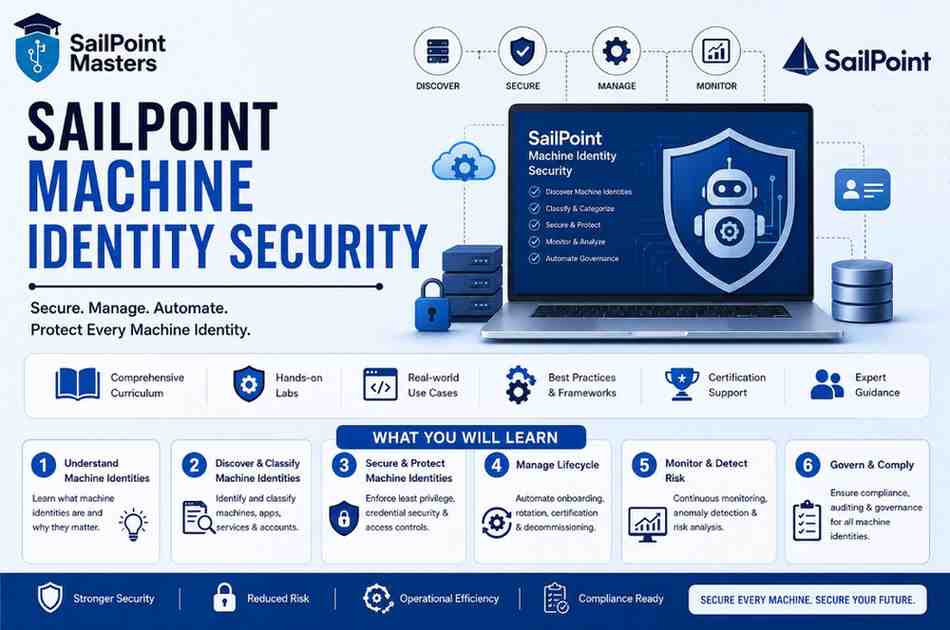
SailPoint Machine Identity Security is an Identity Security Cloud product that discovers, classifies, governs and retires non-human identities such as service accounts, bots, RPA processes and API credentials. Built on the SailPoint Atlas platform, it applies the same ownership, certification and lifecycle controls to machines that enterprises already apply to employees, closing a major visibility gap.
★★★★★
4.9/5 rated by 1329+ students · Google Verified
Table of Contents
Introduction
Walk into any enterprise data centre today and count the accounts. For every employee badge, there are dozens of quieter credentials doing the actual work: a service account running a nightly batch job, an API key connecting a payments gateway, a certificate authenticating one microservice to another, a robot process reconciling invoices at 3am. Nobody interviews these accounts. Nobody offboards them. Yet they hold real access to real data.
That imbalance is the reason machine identity has become one of the most urgent problems in security. Human identity governance matured over two decades, complete with joiner-mover-leaver processes and access reviews. Machine identity governance is barely a decade behind, and the gap is widening because machines multiply faster than headcount ever could. Practitioners moving from IdentityIQ into cloud-native governance notice this first-hand: machine accounts that once sat outside any review process now show up in the same certification campaigns as employee access, and the assurance-level thinking behind NIST’s Digital Identity Guidelines increasingly gets applied to non-human accounts too. Our comparison of IdentityIQ and IdentityNow covers how that governance model carried over as the platform moved to the cloud. It is quickly emerging as the foundation of modern identity security.
This guide explains what SailPoint Machine Identity Security does, how it works, where it fits in an enterprise architecture, and how teams roll it out without breaking the automation their business depends on.
SailPoint Machine Identity Security
What is SailPoint Machine Identity Security?
SailPoint Machine Identity Security is a dedicated product within SailPoint Identity Security Cloud, launched in October 2024 and built on the SailPoint Atlas platform. Its purpose is straightforward: bring machine accounts under the same governance umbrella that already covers human users.
Historically, identity governance tools were designed around people. They assumed an authoritative HR source, a manager who could approve access, and a termination date. Machine accounts break all three assumptions. They are created by engineers rather than HR, they often have no recorded owner, and they rarely have an end date. The result is that most organisations simply do not know how many machine accounts they have, let alone what those accounts can reach.
SailPoint’s approach is to treat a machine account as a first class identity. Each one gets discovered, classified, assigned a human owner, grouped logically by the application or service it supports, and then subjected to periodic review.If you’re already familiar with how SailPoint Identity Governance and Administration manages employee identities, you’ll find the same core principles apply—only the identities being managed are now machines instead of people. SailPoint publishes an overview of its approach on its non-human identity solutions page.
Why Machine Identity Security Matters
Strip away the terminology and the business case comes down to cost — what an ungoverned machine identity actually costs when something goes wrong, versus what governing it costs upfront.
Incident cost. A compromised service account rarely triggers the same alerts a compromised human login would, because its behaviour already looks automated. The average time to detect and contain this kind of breach runs longer than a typical human-credential incident, and every extra day in an attacker’s foothold adds to the eventual remediation bill.
Remediation cost. Fixing the problem after an audit finding or a breach means emergency discovery, emergency ownership assignment, and emergency access reviews — all done under deadline pressure, which is the most expensive way to do any of these three things.
Opportunity cost. Engineering time spent firefighting expired certificates or manually rotating credentials is time not spent shipping features. Automated lifecycle management converts that recurring tax into a one-time setup cost.
Insurance and audit cost. Cyber insurance providers and compliance auditors are placing greater emphasis on how organizations govern non-human identities. A documented programme changes that conversation from a red flag to a checked box.
Framed this way, machine identity governance is not a security nice-to-have — it is a cost-avoidance decision with a measurable return.
Understanding Machine Identities in Modern Enterprises
“Machine identity” is an umbrella term. Understanding the categories underneath it matters, because each type fails differently and needs different controls.
|
Identity type |
What it does |
Typical failure mode |
|
Service accounts |
Runs applications, batch jobs and scheduled tasks |
Shared passwords, no owner, excessive standing privilege |
|
API keys and tokens |
Authenticates application-to-application calls |
Hardcoded in source code, never rotated, over-scoped |
|
Digital certificates |
Proves machine identity in TLS and mutual authentication |
Silent expiry causing outages; untracked issuance |
|
SSH keys |
Grants administrative access to servers |
Sprawl across hosts, orphaned keys from departed staff |
|
Bots and RPA processes |
Automates business workflows |
Inherits a human’s full entitlements rather than least privilege |
|
Workloads and containers |
Ephemeral compute requesting resources |
Short lifespan defeats traditional review cycles |
|
AI agents |
Acts autonomously across systems on a user’s behalf |
Undefined accountability; dynamic and expanding access |
The last row is the newest and the most consequential. An AI agent is not a passive credential — it makes decisions and chains actions across systems. Governing it requires knowing which human is accountable for what it does.
How SailPoint Protects Machine Identities
SailPoint’s protection model rests on four movements that repeat continuously rather than running once.
Discover. The platform scans connected systems and applies pattern recognition to separate machine accounts from human ones — catching hidden, misclassified and orphaned accounts that naming conventions alone would miss. This is conceptually similar to the aggregation process in SailPoint, extended to a population that was never properly catalogued.
Organise. Related machine accounts are grouped into defined identities tied to the application or service they support. Instead of ten thousand loose accounts, an administrator sees a few hundred meaningful services, each with an owner.
Govern. Once accounts have owners, standard governance applies: certification campaigns, policy checks, separation of duties and role based access control to constrain what each identity may reach.
Automate. Provisioning, rotation and revocation run through workflows rather than tickets, which is what makes the model survive at enterprise scale.
This four-part cycle is the product’s operating model — the implementation
section further down covers how to sequence a real-world rollout around it,
including pilot scope, exception handling and team coordination.
Key Features of SailPoint Machine Identity Security
- Intelligent discovery that uses pattern recognition and system scans to surface machine accounts nobody documented.
- Automated classification distinguishing service accounts, bots and RPA identities from human users.
- Machine identity grouping that ties related accounts to the application or service they serve.
- Ownership assignment so every non-human identity traces back to an accountable person or team.
- Lifecycle management covering provisioning through retirement, including rotation and revocation.
- Certification campaigns that put machine access in front of reviewers on a defined cadence.
- Policy and risk controls flagging excessive privilege, dormancy and separation-of-duty conflicts.
- Unified visibility across human and non-human identities on a single platform rather than two disconnected tools.
- Audit-ready reporting producing the evidence trail regulators and auditors expect.
SailPoint has also extended this foundation with Agent Identity Security for autonomous AI agents, and with its Harbor Pilot suite of AI assistants that help administrators run identity programmes more efficiently.
Benefits of Implementing SailPoint Machine Identity Security
The clearest way to see the value is to compare the traditional approach against a governed one.
|
Factor |
Traditional identity security |
SailPoint Machine Identity Security |
|
Visibility |
Spreadsheets and tribal knowledge; machine accounts largely uncounted |
Continuous automated discovery with real-time inventory |
|
Automation |
Manual ticket-driven creation and cleanup |
Workflow-driven provisioning, rotation and revocation |
|
Risk reduction |
Dormant and orphaned accounts persist unnoticed |
Dormancy detection and privilege right-sizing |
|
Compliance |
Evidence assembled reactively before each audit |
Certification records generated continuously |
|
Scalability |
Effort grows linearly with account count |
Grouping and policy scale independently of volume |
|
Governance |
Human identities governed; machines exempted |
One governance model covering both populations |
|
Security monitoring |
Anomalies buried in log noise |
Behavioural and risk signals tied to owned identities |
Common Machine Identity Security Challenges
No clear ownership. The engineer who created an account left three years ago. Nobody knows what depends on it, so nobody removes it.
Fear of breaking production. Cleanup is deferred indefinitely because the blast radius of a wrong deletion is unknown. Discovery and dependency mapping are what break this deadlock.
Credential sprawl. Keys and secrets end up in code repositories, configuration files, container images and CI pipelines, far outside any vault.
Excessive standing privilege. Service accounts are frequently granted administrator rights during troubleshooting and never scaled back afterwards.
Ephemerality. Containers and serverless workloads may live for minutes. Quarterly certification cycles are meaningless against identities that no longer exist by review time.
Fragmented tooling. Certificates sit in one system, secrets in another, service accounts in a third, with no single view — a problem familiar to anyone who has worked through SailPoint connector configuration across a large estate.
Best Practices for Managing Machine Identities
- Inventory before you enforce it. Discovery precedes policy. Enforcing rules against an incomplete inventory creates false confidence.
- Assign a human owner to every machine identity. Accountability is the foundation everything else rests on.
- Apply least privilege deliberately. Scope each identity to the minimum access its function requires, then re-verify.
- Automate rotation. Manual credential rotation does not survive contact with scale; schedule it and let workflows execute.
- Track certificate expiry proactively. Renewal should trigger well before the deadline, not after an outage.
- Certify machine access on a real cadence. Include machine identities in review campaigns rather than exempting them.
- Retire dormant identities on a defined timeline. Quarantine first, observe, then remove — this addresses the fear of breaking things without leaving accounts open forever.
- Align to Zero Trust principles. Every request should be authenticated and authorised on its merits, as described in the NIST Zero Trust Architecture publication.
Industries Using SailPoint Machine Identity Security
Machine identity pressure is universal, but the driver differs by sector.
|
Industry |
Primary driver |
Typical machine identity focus |
|
Banking & financial services |
Regulatory scrutiny and transaction integrity |
Service accounts in core banking, payment API credentials |
|
Healthcare |
Patient data protection and clinical uptime |
Interface engine accounts, medical device certificates |
|
Government |
National security and mandated audit standards |
Privileged service accounts, PKI and certificate governance |
|
Manufacturing |
OT and IT convergence on the plant floor |
Industrial control credentials, IIoT device identity |
|
Retail |
Payment security and seasonal scaling |
Point-of-sale certificates, e-commerce integration keys |
|
Telecom |
Vast distributed network infrastructure |
Network element accounts, automation and orchestration keys |
|
Cloud service providers |
Multi-tenant isolation guarantees |
Workload identity, ephemeral container credentials |
|
Technology companies |
Rapid CI/CD release velocity |
Pipeline secrets, repository tokens, deployment credentials |
SailPoint Machine Identity Security Use Cases
Orphaned service account cleanup. Discovery surfaces accounts whose owners have left. Each is assigned a current owner or quarantined and retired, shrinking the attack surface measurably.
Audit preparation. Instead of a scramble before each audit, ownership records and certification history are already in place and exportable.
Cloud migration governance. As workloads move to cloud platforms, new machine identities appear rapidly. Governance keeps pace with provisioning rather than trailing it.
DevSecOps pipeline hardening. Build and deployment credentials are inventoried, scoped and rotated as part of the pipeline rather than as an afterthought.
AI agent oversight. As autonomous agents are deployed, each is tied to an accountable owner with bounded, reviewable access.
Merger integration. Acquiring a company means inheriting its undocumented machine accounts. Discovery gives the acquiring security team an accurate picture quickly.
SailPoint Machine Identity Security Architecture
What actually changes for machine accounts at this layer: connectors that once read only human directory attributes now also pull service-account metadata, certificate stores and secrets-vault entries into the same correlation engine — and Palo Alto Networks’ 2026 Identity Security Landscape puts machine identities at over 100 to 1 against human ones in AI-heavy environments, which is exactly what’s forcing this connector expansion.
Teams preparing for connector-heavy exam topics can see this covered in our IIQ exam preparation guide. Anyone comparing deployment models will find the distinctions covered in IdentityIQ versus Identity Security Cloud, and the underlying design principles in the SailPoint IdentityIQ architecture guide.
Architecturally the flow runs in layers. A connectivity layer reaches into source systems — directories, cloud platforms, databases, applications — and pulls account data. A correlation and classification layer determines which accounts are machines and groups them into logical identities. A governance layer applies ownership, policy, roles and certification. An automation layer executes provisioning, rotation and revocation. Finally, a reporting layer exposes posture and audit evidence.
Because everything shares the Atlas foundation, human and machine identities resolve into one governance picture rather than two silos. Detailed configuration references are maintained in the official SailPoint product documentation.
Machine Identity Lifecycle Management
4Lifecycle is where machine identity governance either works or quietly fails. The eight stages below define the full arc from creation to retirement.
|
Stage |
What happens |
Why it matters |
|
Discovery |
Scan connected systems to find existing machine accounts |
Establishes the baseline inventory; nothing else works without it |
|
Classification |
Categorise by type, function, sensitivity and platform |
Determines which controls and review cadence apply |
|
Provisioning |
Create the identity with a named owner and scoped access |
Prevents new orphans from entering the estate |
|
Monitoring |
Observe usage, privilege drift and dormancy |
Surfaces anomalies and accounts that stopped being used |
|
Rotation |
Change credentials, keys and secrets on a schedule |
Limits the useful window of any leaked credential |
|
Renewal |
Reissue certificates before expiry |
Prevents outages caused by silently expired certificates |
|
Revocation |
Withdraw access that is no longer justified |
Enforces least privilege as functions change over time |
|
Retirement |
Quarantine, verify no dependencies, then decommission |
Removes dormant accounts safely without breaking production |
Machine Identity Governance and Compliance
Regulators have caught up with the idea that an account is an account, regardless of whether a person sits behind it. Frameworks governing financial services, healthcare data, payment processing and critical infrastructure all expect access controls, review evidence and accountable ownership — and none of them exempt service accounts.
The practical compliance value of machine identity governance is that evidence becomes a by-product of operations rather than a project. Certification campaigns produce reviewer decisions with timestamps. Ownership assignment produces the accountability trail. Revocation workflows produce proof that access was removed when it should have been. Key management practices, including rotation intervals and cryptographic hygiene, align with established NIST key management guidance.
For teams already running access certification for employees, extending campaigns to machine identities is an incremental change to an existing process rather than a new programme.
SailPoint Integration with Enterprise Systems
Machine identities live everywhere, so integration breadth determines how much of the estate can actually be governed. SailPoint connects to directory services, cloud platforms, databases, ITSM tools, DevOps pipelines and enterprise applications. Large ERP estates are a common starting point, and the patterns involved are covered in this guide to SailPoint integration with SAP.
Where a packaged connector does not exist, SailPoint exposes APIs and an extensibility framework for custom integration. Teams building these integrations work from the resources published on the SailPoint developer portal.
Recent platform moves have widened this footprint considerably. SailPoint completed its acquisition of Tel Aviv-based Entro Security in June 2026, adding specialised non-human identity and credentials security capabilities that complement its Agentic Fabric framework. Agent Identity Security adds connectors for AI platforms including Microsoft 365 Copilot, Databricks, Amazon Bedrock, Google Vertex AI, ServiceNow AI Platform, Snowflake Cortex AI and Salesforce Agentforce.
Market Trends and Insights
Several forces are converging to push machine identity from a backlog item to a board-level concern.
|
Trend |
Effect on machine identity |
|
Zero Trust adoption |
Every machine request must be authenticated and authorised, not implicitly trusted |
|
API-driven architecture |
Each integration point creates new credentials requiring governance |
|
Cloud-native development |
Ephemeral workloads demand automated, short-lived identity issuance |
|
Autonomous AI agents |
Introduces identities that act independently and need accountable owners |
|
Regulatory tightening |
Auditors now request machine account ownership and review evidence |
|
Consolidation of tooling |
Buyers prefer unified human and non-human governance over point products |
The market data reflects this. The scale of this shift is now measurable inside a single organization, not just across the market. CyberArk’s identity security research puts machine identities at roughly 82 times the number of human accounts in a typical enterprise, with over half of surveyed security leaders reporting an incident tied to a compromised machine identity, and a majority reporting at least one certificate-related outage in the past year. For the governance gap that created this imbalance in the first place, see what SailPoint is and the problem it was built to solve.
Business Impact of Ungoverned Machine Identities
Strip away the terminology and the business case is simple: ungoverned machine identities are unmanaged risk sitting inside the perimeter.
Business risk. A compromised service account with standing administrative privilege gives an attacker a quiet, persistent foothold. Because its activity resembles normal automation, detection is slow.
Threat reality. Attackers deliberately target machine credentials because they are less monitored, rarely rotated and often over-privileged. Leaked keys in public repositories remain a recurring incident.
Compliance exposure. An audit finding that thousands of accounts have no identifiable owner is difficult to defend and expensive to remediate under deadline.
Operational efficiency. Automated lifecycle management removes a large volume of manual ticket work and prevents the certificate expiry outages that consume engineering weekends.
Cloud and DevSecOps enablement. Governance built into pipelines lets development teams move quickly without security becoming the bottleneck — the practical meaning of shifting left. Professionals evaluating this specialisation as a career direction will find useful context in this discussion of SailPoint for cyber security careers.
Future of Machine Identity Security
Three shifts look likely over the next few years.
Agentic identity becomes a hard problem. AI agents that plan and execute multi-step tasks across systems raise questions traditional governance never had to answer: what is an agent permitted to decide, and who answers for it? SailPoint’s Agentic Fabric direction and the Entro acquisition both point at this.
Lifecycles compress. Credentials that live for minutes rather than years make periodic certification obsolete. Governance moves toward continuous, policy-driven issuance and automatic expiry.
Human and machine governance fully converge. The separation between identity governance tools and machine credential tools is closing. Buyers increasingly want one platform, one policy model and one audit trail. Those tracking where the platform is heading can follow the SailPoint learning and platform roadmap.
How to Implement SailPoint Machine Identity Security Successfully
Rolling out machine identity governance is less about the software and more about sequencing. Enterprises that succeed treat it as a phased change-management effort, not a one-time configuration task. Here is a practical rollout sequence that works across most environments.
- Anchor the programme to a business sponsor. Machine identity work touches security, engineering and application owners at once. Without an executive sponsor who can resolve cross-team friction, cleanup stalls the moment it hits a contested account.
- Pilot on one business domain. Prove the model in a contained area, measure orphan reduction, then expand. A single domain — payments, HR systems, or a single cloud subscription — gives a fast, low-risk proof point before wider rollout.
- Set a realistic timeline per phase. Discovery and classification for a mid-sized estate typically takes weeks, not days. Rushing this phase produces an inventory nobody trusts, which undermines every governance decision built on top of it.
- Define exception handling upfront. Some machine accounts genuinely cannot have a named human owner on day one — legacy integrations, vendor-managed accounts, accounts tied to systems slated for decommission. Decide how these are flagged and tracked before discovery surfaces them, rather than improvising case by case.
- Coordinate rollout with application teams, not around them. Application owners often have context on why an account exists that discovery tooling cannot infer. Looping them in early prevents false positives from being treated as orphaned accounts and mistakenly disabled.
- Invest in skills early, and be deliberate about format. Working professionals juggling a live rollout rarely have room for a rigid weekday schedule, particularly as CyberArk’s research shows most organisations already struggle to secure both human and machine access under current staffing levels. Our comparison of online versus classroom SailPoint training helps you pick a format that survives contact with a real project deadline., and SailPoint’s own university and certification programmes cover the product fundamentals.
- Communicate wins in business terms. Translate technical progress — accounts inventoried, owners assigned, dormant accounts retired — into risk-reduction language leadership already understands. This keeps funding and attention on the programme past the initial pilot.
- Measure and report continuously. Track orphaned account count, percentage with assigned owners, rotation compliance and certificate expiry incidents. These numbers make progress visible to leadership and justify expanding the programme beyond the pilot domain.
Teams building the underlying competency often work through a structured SailPoint IdentityIQ curriculum before specialising, and prepare for role interviews using targeted SailPoint interview questions.
Key Takeaways
- Machines now outnumber humans in most enterprises, yet the majority of organisations still manage them manually and lack real-time visibility.
- SailPoint Machine Identity Security is an Identity Security Cloud product built on Atlas, designed to discover, group, own, govern and retire non-human identities.
- Ownership is the pivot point. Almost every downstream control — certification, revocation, audit evidence — depends on knowing which human is accountable.
- Lifecycle automation is what makes it scale. Manual rotation, renewal and retirement collapse under enterprise volume.
- AI agents are the next frontier. Autonomous identities need bounded, reviewable access tied to accountable owners, which is where SailPoint’s recent platform investments are concentrated.
Conclusion
For twenty years, identity security meant securing people. That definition no longer matches reality. The accounts running your batch jobs, calling your APIs, authenticating your microservices and increasingly making autonomous decisions now outnumber your employees — and most of them have never been reviewed by anyone.
SailPoint Machine Identity Security closes that gap by treating machine accounts as governable identities with owners, policies, review cycles and defined end dates. The technology matters, but the discipline matters more: discover what exists, assign accountability, enforce least privilege, and automate the lifecycle so governance keeps pace with provisioning.
If you want to build practical, hands-on capability in identity governance and machine identity security, If governing machine and AI-agent identities is the specialisation you want to build toward, structured lab time beats reading alone — especially with ISC2’s 2025 Cybersecurity Workforce Study showing that skills gaps, not headcount, are now the leading cause of security incidents. See how a full curriculum sequences this in our SailPoint Masters syllabus.
FAQ
1. What is SailPoint Machine Identity Security?
It is a SailPoint Identity Security Cloud product built on the Atlas platform that discovers, classifies, governs and retires machine accounts such as service accounts, bots and RPA identities. It applies the same governance rigour to non-human identities that enterprises already apply to employees.
2. What counts as a machine identity?
A machine identity is any credential used by software rather than a person. This includes service accounts, API keys, digital certificates, SSH keys, tokens, bots, RPA processes, containers, workloads and AI agents. Each one authenticates to systems and therefore carries access rights that need governing.
3. How is a machine identity different from a human identity?
Human identities have a joiner, mover and leaver lifecycle tied to HR records. Machine identities are often created ad hoc by engineers, have no clear owner, rarely expire and frequently hold broad standing privilege. That combination makes them harder to track and more attractive to attackers.
4. Why are orphaned service accounts so dangerous?
An orphaned service account keeps its access after its owner has left or its application has been decommissioned. Nobody monitors it, its password may never rotate, and it often holds elevated privilege. Attackers use these accounts for quiet lateral movement because their activity looks routine.
5. Does SailPoint Machine Identity Security handle secrets management?
SailPoint focuses on governance: who owns an identity, what it can access, and whether that access is still justified. Following the Entro Security acquisition completed in June 2026, SailPoint also offers non-human identity and credentials security capabilities that extend into secrets discovery and posture.
6. How does machine identity governance support compliance?
Auditors increasingly ask organisations to prove that every account with access to regulated data has a named owner and a review history. Machine identity governance supplies that evidence automatically, producing certification records, ownership trails and revocation logs without manual spreadsheet work.
7. Can SailPoint govern AI agents as well as machine accounts?
Yes. SailPoint Agent Identity Security extends governance to autonomous AI agents, with connectors for platforms including Microsoft 365 Copilot, Databricks, Amazon Bedrock, Google Vertex AI, ServiceNow AI Platform, Snowflake Cortex AI and Salesforce Agentforce.
8. How does certificate lifecycle management fit in?
Digital certificates authenticate machines to each other. When one expires unnoticed, services fail and outages follow. Automated lifecycle management tracks expiry dates, triggers renewal ahead of time and revokes certificates that are no longer needed, removing a common cause of unplanned downtime.
9. What skills do I need to work with machine identity security?
Useful foundations include identity governance concepts, role based access control, connector configuration, aggregation and provisioning workflows, plus a working understanding of certificates, API authentication and cloud IAM models. Scripting ability helps when building custom integrations. A grounding in SailPoint identity and access management is the usual starting point.
10. Is machine identity security a good career path?
It is one of the fastest growing areas within identity security. Non-human identities now outnumber human ones in most enterprises, yet relatively few practitioners specialise in governing them, so demand for people who understand both governance and automation Non-human identity specialists are starting to command a premium over generalist IAM roles, and it’s easy to see why — Palo Alto Networks’ 2026 Identity Security Landscape found that 96% of organisations still let human identities operate with access far beyond what their roles require, let alone their machine accounts. Our Hyderabad salary breakdown shows how that specialist gap plays out city by city.
SailPoint Trainer
SailPoint Masters Editorial Team | 15+ Articles Published
We specialize in SailPoint Certification Training in Hyderabad, helping aspiring professionals and IT experts develop in-demand Identity and Access Management (IAM) skills. Our training covers SailPoint IdentityIQ, Identity Security Cloud, certification preparation, real-world projects, and career guidance to support success in cybersecurity and identity governance careers.
Share