
SailPoint IdentityIQ Architecture: A Complete Guide for IAM Professionals
SailPoint IdentityIQ Architecture is a three-tier, Java-based framework built on a web application layer, a business logic layer, and a relational database layer. It centralizes identity data into Identity Cubes stored in the Identity Warehouse, then uses connectors, workflows, and a rule engine to automate aggregation, provisioning, certification, and policy enforcement across every connected enterprise system.
★★★★★
4.9/5 rated by 1329+ students · Google Verified
Table of Contents
Introduction
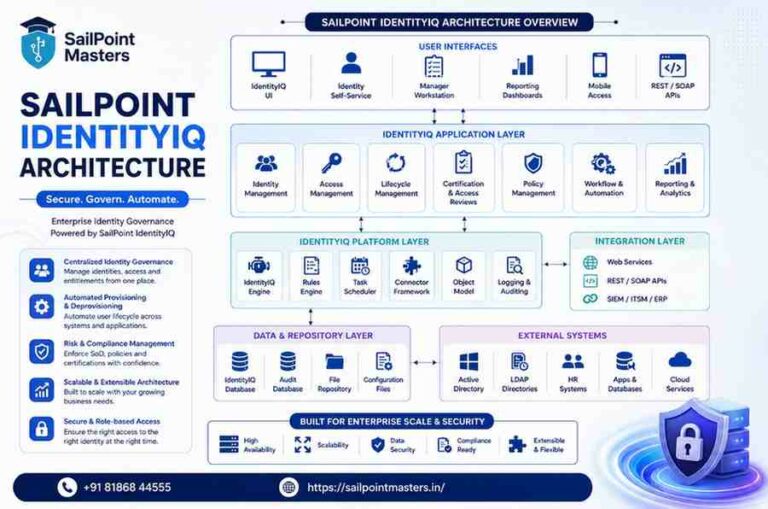
Identity Governance and Administration (IGA) has become one of the most critical pillars of enterprise security, and few platforms define that space as clearly as SailPoint IdentityIQ. Understanding SailPoint IdentityIQ Architecture is the difference between an administrator who clicks buttons and an engineer who can design, troubleshoot, and scale an identity program with confidence. If you are preparing for a role in this field, structured SailPoint Certification Training in Hyderabad will help you connect this architecture to real implementation work.
In this guide, we break down every layer, component, and workflow inside IdentityIQ (IIQ) so that developers, administrators, and IAM professionals can see how the whole system fits together. Whether you are studying the SailPoint IdentityIQ Architecture Diagram for the first time or refining a production deployment, this article gives you a clear, technically accurate mental model.
SailPoint IdentityIQ Architecture
What is SailPoint IdentityIQ Architecture?
SailPoint IdentityIQ Architecture is the layered design that governs how IdentityIQ collects identity data, processes it, and enforces governance policies across an organization. At its core, IIQ is an enterprise Java web application that follows a classic three-tier model: a presentation layer for the user interface, a business logic layer that runs the governance engine, and a persistence layer backed by a relational database.
What makes the architecture distinctive is the way IdentityIQ unifies fragmented account data into a single, correlated view of each person. Instead of managing dozens of disconnected accounts, IIQ builds an Identity Cube for every user and stores it in a central repository called the Identity Warehouse. From there, the platform can answer the fundamental governance questions: who has access to what, why they have it, and whether that access is still appropriate.
This design supports the full range of IGA capabilities, including lifecycle management, access certification, provisioning, and Separation of Duties (SoD) enforcement. To understand where IIQ fits in the broader product family, it helps to first review what SailPoint is as a company and platform.
Why Identity Governance Matters for Modern Enterprises
Enterprises today run hundreds of applications spanning on-premises data centers and multiple clouds. Every one of those systems creates accounts, entitlements, and audit obligations. Without a governance layer, access sprawl becomes unmanageable and audit failures become inevitable.
IdentityIQ solves this by acting as the authoritative control plane for identity. It answers to compliance frameworks, reduces the attack surface created by orphaned or over-privileged accounts, and automates the joiner-mover-leaver lifecycle that would otherwise consume enormous manual effort. The market reflects this demand: according to Grand View Research, the global IGA market continues to expand as organizations prioritize least-privilege access and Zero Trust security models.
Core Components of SailPoint IdentityIQ Architecture
IdentityIQ is not a single monolithic engine. It is a collection of cooperating modules that share a common governance platform and data model. Understanding each component individually makes the overall SailPoint IdentityIQ Architecture far easier to reason about. Because several of these components rely on BeanShell rules, many newcomers ask whether they can learn SailPoint without Java knowledge before diving in.
- Governance Platform: The foundational layer that holds the identity model, role model, policy model, and risk model shared by every other module.
- Identity Cube: A correlated, 360-degree representation of a single identity, combining all of that person’s accounts and entitlements from connected systems.
- Identity Warehouse: The central repository (the IIQ database) where all Identity Cubes, accounts, and entitlement data are persisted.
- Lifecycle Manager: Handles self-service access requests, password management, and joiner-mover-leaver lifecycle events.
- Compliance Manager: Drives access certifications, policy management, and audit reporting.
- Provisioning Engine: Calculates and executes the account changes required to fulfil requests and policy decisions.
- Workflow Engine: Orchestrates multi-step business processes such as approvals, provisioning, and lifecycle events.
- Rule Engine: Executes BeanShell rules that customize behavior at defined extension points.
- Task Scheduler: A Quartz-based scheduler that runs aggregation, identity refresh, and reporting tasks.
- Connectors: Integration adapters that read from and write to managed target systems.
SailPoint IdentityIQ Architecture Components Table
|
Component |
Purpose |
Function |
Key Benefit |
|
Identity Cube |
Unify identity data |
Correlates accounts and entitlements into one profile |
Single source of truth per user |
|
Identity Warehouse |
Store governance data |
Persists cubes, accounts, roles, and policies |
Central, queryable repository |
|
Lifecycle Manager |
Manage JML events |
Handles requests and lifecycle triggers |
Automated onboarding and offboarding |
|
Compliance Manager |
Enforce governance |
Runs certifications and policy checks |
Audit readiness and SoD control |
|
Provisioning Engine |
Execute changes |
Builds and pushes provisioning plans |
Consistent, automated access changes |
|
Workflow Engine |
Orchestrate processes |
Runs approvals and multi-step logic |
Flexible, customizable automation |
|
Connectors |
Integrate systems |
Aggregate and provision to targets |
Broad application coverage |
SailPoint IdentityIQ System Architecture Explained
The IdentityIQ system architecture is built on three logical tiers that map to how requests flow through the platform.
Presentation Layer (Web Application Layer): This is the browser-based user interface built on Java web technologies. Business users interact with it through QuickLinks, forms, and dashboards, while administrators configure the system through the setup screens. Every access request, certification decision, and report is initiated here.
Business Logic Layer (Application Server): The heart of the platform. This layer runs inside a Java application server such as Apache Tomcat, WebLogic, WebSphere, or JBoss. It hosts the governance platform, the workflow engine, the provisioning engine, the rule engine, and the task scheduler. All correlation, policy evaluation, and provisioning logic executes here.
Data Layer (Database): A relational database that stores the entire Identity Warehouse. IdentityIQ supports Oracle, Microsoft SQL Server, MySQL, and IBM DB2. This layer holds identities, accounts, entitlements, roles, policies, certifications, and audit records.
Because these tiers are logically separated, IdentityIQ can scale each independently. For a deeper look at how IIQ compares with the cloud-native alternative, see the differences between IdentityIQ and IdentityNow.
The Identity Cube and Identity Warehouse
The Identity Cube is arguably the most important concept in the entire architecture. When IdentityIQ aggregates accounts from various systems, it uses correlation logic to link those accounts to a single identity. The result is a cube: a rich object that knows every account, entitlement, role, and attribute belonging to one person.
These cubes live inside the Identity Warehouse, which is simply the logical name for the governance data stored in the IIQ database. The warehouse is what allows IdentityIQ to run instant queries such as “show every user with access to the finance application” or “list all orphaned accounts.” Official platform details are documented at the SailPoint IdentityIQ product page.
How SailPoint IdentityIQ Processes Identity Lifecycle Management
Identity lifecycle management follows the joiner-mover-leaver (JML) model, and IdentityIQ automates each stage through lifecycle events and workflows.
User Onboarding (Joiner): When an authoritative source such as an HR system reports a new hire, IdentityIQ creates the identity, evaluates birthright roles, and triggers provisioning to grant baseline access automatically.
User Modification (Mover): When a person changes department or manager, the identity refresh detects the attribute change, recalculates role assignments, and provisions or de-provisions access to match the new position.
User Termination (Leaver): When an identity is marked inactive, IdentityIQ triggers deprovisioning workflows that disable or delete accounts across all connected systems, closing the security gap left by orphaned access.
This automation is powered by the lifecycle event framework and the workflow engine working together. Role-driven access is central here, which is why understanding role-based access control in IdentityIQ is essential to lifecycle design.
Identity Lifecycle Table
|
Stage |
Trigger |
IIQ Action |
Outcome |
|
Joiner |
New hire in HR feed |
Create identity, assign birthright roles |
Day-one access provisioned |
|
Mover |
Department or role change |
Refresh identity, recalculate roles |
Access aligned to new position |
|
Leaver |
Termination event |
Trigger deprovisioning workflow |
All accounts disabled or removed |
|
Scheduled review cycle |
Generate access reviews |
Access validated by approvers |
|
|
Provisioning |
Any approved change |
Build and execute provisioning plan |
Target systems updated |
Authentication and Authorization Flow in SailPoint IdentityIQ
Authentication controls who can log in to the IdentityIQ console and UI, while authorization controls what they can do once inside. IdentityIQ supports several authentication methods, including its internal password store, pass-through authentication against LDAP or Active Directory, and single sign-on via SAML.
Authorization is governed by IIQ’s capability and scope model. Capabilities define the actions a user can perform, such as running certifications or managing roles, while scopes restrict which identities and objects a user can see. This combination lets organizations enforce least privilege even within the administrative interface itself. Standards guidance on access control models is maintained by NIST’s role-based access control project.
SailPoint IdentityIQ Architecture Diagram Explained
A typical SailPoint IdentityIQ Architecture Diagram shows data flowing from left to right. On the left sit the authoritative and target systems: HR platforms, Active Directory, LDAP directories, databases, and cloud applications. Connectors bridge these systems to IdentityIQ.
In the center sits IdentityIQ itself, running on one or more application servers. Inside this box the diagram usually highlights the governance platform, workflow engine, provisioning engine, and task scheduler. Below the application servers is the shared relational database that holds the Identity Warehouse.
On the right sit the consumers of governance: business users submitting access requests, managers performing certifications, and auditors pulling compliance reports. Reading the diagram this way, from source systems through the engine to the governance outcomes, makes the architecture intuitive rather than intimidating. For the cloud-native counterpart to this on-premises design, compare it with SailPoint Identity Security Cloud.
SailPoint IdentityIQ Deployment Architecture
Deployment architecture describes how IdentityIQ is physically installed to meet performance and availability requirements. The same software can run as a single instance for a proof of concept or as a large clustered environment for a global enterprise.
In production, organizations designate specific IIQ nodes as task servers or request servers so that heavy background jobs such as aggregation do not slow down the interactive UI nodes. A load balancer distributes user traffic across the UI nodes, and all nodes share the same database. To plan a real learning path toward these skills, the SailPoint IIQ curriculum maps the concepts to hands-on modules.
Deployment Architecture Comparison
|
Deployment Model |
Nodes |
Availability |
Best For |
|
Single Server |
One node, one database |
None |
Development and proof of concept |
|
Multi-Server |
Separate UI and task nodes |
Basic redundancy |
Mid-size production workloads |
|
High Availability |
Redundant nodes behind a load balancer |
Failover support |
Business-critical environments |
|
Cluster Deployment |
Many nodes, shared database, dedicated request servers |
Highest |
Large global enterprises |
SailPoint IdentityIQ Database Architecture
The database is the backbone of the entire platform. Every identity, account, entitlement, role, policy, certification, and audit event is persisted here. IdentityIQ ships with a defined schema and a set of database scripts that must be applied during installation and upgrades.
Because the Identity Warehouse can grow very large in enterprises with millions of accounts, database sizing, indexing, and maintenance are critical to performance. Regular archiving of old certifications and audit records keeps the schema lean. The database must also be highly available, since IdentityIQ cannot function if it loses its persistence layer.
SailPoint IdentityIQ Application Servers and Services
IdentityIQ runs as a Java web application deployed to a servlet container. Supported application servers include Apache Tomcat, Oracle WebLogic, IBM WebSphere, and JBoss/WildFly. Within the application server, several services run continuously.
The task scheduler, powered by Quartz, executes scheduled jobs such as aggregation and identity refresh. The workflow engine processes running business processes. The provisioning engine dispatches provisioning plans to connectors. For Windows-based provisioning, a separate lightweight service called IQService acts as a bridge between IdentityIQ and Active Directory. Developers extending these services should reference the SailPoint developer resources for APIs and rule guidance.
SailPoint IdentityIQ Connectors and Integration Architecture
Connectors are the integration muscle of IdentityIQ. Each connector knows how to read account and group data from a specific type of system and how to write changes back to it. IdentityIQ ships with a large library of connectors covering directories, databases, cloud apps, and ERP systems.
Some connectors run directly from the IIQ application server, while others use IQService or gateway components for systems that require agent-based access. Custom integrations can be built using JDBC, LDAP, REST, SCIM, and web services connectors. For a practical catalog of what IIQ can connect to, review this SailPoint connectors list and setup guide, and for ERP specifics see the SailPoint integration with SAP.
Integration Comparison
|
Target System |
Connector Type |
Primary Use |
Provisioning |
|
Active Directory |
Direct / IQService |
Accounts and groups |
Read and write |
|
LDAP |
Direct LDAP |
Directory identities |
Read and write |
|
SAP |
SAP connector |
ERP roles and users |
Read and write |
|
Oracle |
JDBC |
Database accounts |
Read and write |
|
ServiceNow |
Web services / REST |
Tickets and accounts |
Read and write |
|
Azure AD |
REST / Graph |
Cloud identities |
Read and write |
|
Workday |
Web services |
Authoritative HR source |
Read (aggregation) |
Identity Aggregation and Provisioning Workflow
Aggregation and provisioning are two directions of the same integration pipeline. Aggregation pulls data into IdentityIQ; provisioning pushes changes out.
Aggregation Workflow: A scheduled aggregation task connects to a source system through its connector, reads all accounts and groups, and loads them into the Identity Warehouse. The identity refresh task then correlates these accounts to identities, rebuilds Identity Cubes, evaluates roles, and detects policy violations.
Provisioning Workflow: When an access request is approved or a policy decision requires a change, the provisioning engine builds a provisioning plan. This plan describes exactly what must change on which system. The plan is passed to the relevant connector, which executes the change on the target system and reports the result back to IIQ.
This closed loop, from aggregation to correlation to provisioning, is what keeps the identity model synchronized with reality across the enterprise. Mid-level practitioners often reinforce these skills through focused SailPoint IdentityIQ certification training in Hyderabad before tackling production rollouts. Because this loop behaves differently in the cloud platform, it is worth reviewing the difference between IdentityIQ and IdentityNow workflows.
Certification and Access Review Architecture
Certifications are the mechanism by which IdentityIQ proves that access is appropriate. The Compliance Manager generates certification campaigns that ask reviewers, usually managers or application owners, to confirm or revoke each access item.
When a reviewer revokes an entitlement, IdentityIQ can automatically trigger a provisioning plan to remove that access from the target system, closing the loop between review and remediation. Certification data is stored in the warehouse, giving auditors a complete, timestamped record of who reviewed what and when. This architecture is what makes IIQ so effective for compliance frameworks like SOX and GDPR.
Role Management and Policy Enforcement
Roles turn thousands of individual entitlements into a manageable set of business-meaningful bundles. IdentityIQ supports business roles that map to job functions and IT roles that group technical entitlements. Assigning a business role can automatically grant the underlying IT roles and entitlements.
Policy enforcement works alongside roles. Separation of Duties policies define combinations of access that must never coexist, such as the ability to both create and approve a payment. During identity refresh, IIQ evaluates every identity against these policies and flags violations for remediation. Together, role modeling and policy enforcement deliver the least-privilege outcomes that modern security demands.
SailPoint IdentityIQ Architecture Best Practices
- Designate dedicated task and request servers so background jobs never degrade interactive performance.
- Keep customization at documented extension points using rules and workflows rather than modifying core code.
- Right-size the database and archive stale certification and audit data to maintain query speed.
- Use a single authoritative source for identity attributes to avoid correlation conflicts.
- Test connectors thoroughly in a non-production environment before enabling write operations.
- Version-control configuration exports so environments stay consistent through upgrades.
These practices come straight from field experience and are reinforced in official guidance at the SailPoint documentation portal.
Common Challenges and How to Solve Them
Correlation errors: Accounts that fail to link to the correct identity usually stem from inconsistent source attributes. Fix the authoritative feed and refine correlation logic.
Slow aggregation: Large source systems can make aggregation crawl. Use delta aggregation, partition the load across task servers, and tune connector settings.
Provisioning failures: These often trace back to connector permissions or target system changes. Robust error handling in workflows and clear retry logic keep the pipeline resilient.
Performance bottlenecks: As the warehouse grows, database tuning and JVM sizing become essential. Community discussion and shared solutions are available at the SailPoint developer community.
Why Understanding SailPoint IdentityIQ Architecture Is Essential for IAM Professionals
Architectural knowledge is what separates a routine operator from a trusted engineer. Here is how it benefits each role
- SailPoint Developers write rules and workflows that hook into the engine safely because they understand where their code executes and what it can affect.
- SailPoint Administrators troubleshoot aggregation and provisioning faster because they can trace a problem to the correct tier.
- IAM Engineers design scalable deployments that meet availability targets without guesswork.
- Security Consultants assess risk accurately because they know how policy enforcement and certifications actually work.
- Solution Architects integrate IIQ into complex enterprise ecosystems with confidence.
For anyone building a career in this space, mastering the architecture is a foundational step. A structured SailPoint identity access management program pairs this theory with the hands-on labs that make it stick, and reviewing common SailPoint interview questions helps translate knowledge into job offers. If you are mapping out where to begin, this SailPoint learning roadmap sequences architecture alongside the rest of the skill path.
Industry Trends Shaping Identity Governance
Several forces are accelerating demand for professionals who understand IdentityIQ Architecture. Zero Trust security has moved identity to the center of the security perimeter, making governance non-negotiable. Cloud adoption has multiplied the number of systems that need governing, and hybrid environments blend on-premises IIQ with cloud identity services.
Regulatory pressure continues to rise, with frameworks demanding provable, least-privilege access controls. Meanwhile, digital transformation initiatives depend on fast, secure onboarding at scale. Together, these trends ensure that IGA skills, and the architectural fluency behind them, remain in high demand. Those planning a career move can explore current SailPoint career paths to see where the market is heading.
SailPoint IdentityIQ Architecture Interview Questions
- Explain the three-tier architecture of SailPoint IdentityIQ.
- What is an Identity Cube and how is it built during aggregation?
- Describe the difference between aggregation and provisioning.
- How do task servers and request servers differ in a clustered deployment?
- What role does the Identity Warehouse play in the architecture?
- How does IdentityIQ enforce Separation of Duties policies?
- What is IQService and when is it required?
- Walk through the joiner-mover-leaver lifecycle in IIQ.
- How does the workflow engine interact with the provisioning engine?
- Which databases and application servers does IdentityIQ support?
Candidates preparing seriously should combine these with the broader SailPoint IIQ exam preparation resources for full coverage.
Key Takeaways
- SailPoint IdentityIQ Architecture follows a three-tier model: web presentation, Java business logic, and a relational database.
- The Identity Cube and Identity Warehouse turn fragmented account data into a single, governed source of truth.
- Connectors, workflows, and the provisioning engine form a closed loop of aggregation, correlation, and provisioning.
- Deployment scales from a single development server to clustered, high-availability enterprise environments.
- Mastering the architecture is essential for developers, administrators, engineers, consultants, and solution architects alike.
Conclusion
SailPoint IdentityIQ Architecture is elegant once you see how its layers cooperate. A clean three-tier foundation supports a rich governance engine that aggregates identity data, correlates it into cubes, and provisions access with precision. Every component, from connectors to the workflow engine to the certification framework, exists to answer one question reliably: does the right person have the right access for the right reason?
The best way to internalize this architecture is to build with it. Deploy a sandbox, run an aggregation, model a role, and watch a certification flow end to end. If you want a guided, hands-on path to true expertise, the expert-led programs at Brolly Academy turn this architectural knowledge into job-ready skill. Keep practicing, keep implementing, and keep learning, and IdentityIQ Architecture will become second nature.
FAQ
1. What is SailPoint IdentityIQ Architecture?
It is the three-tier design of IdentityIQ, consisting of a web presentation layer, a Java business logic layer running the governance engine, and a relational database that stores the Identity Warehouse. Together they aggregate, correlate, and provision identity data across the enterprise.
2. What are the core components of SailPoint IdentityIQ?
The core components include the governance platform, Identity Cube, Identity Warehouse, Lifecycle Manager, Compliance Manager, provisioning engine, workflow engine, rule engine, task scheduler, and connectors.
3. What is an Identity Cube in SailPoint IdentityIQ?
An Identity Cube is a correlated, 360-degree view of a single person that combines all of their accounts, entitlements, roles, and attributes from every connected system into one governed object.
4. Which databases does SailPoint IdentityIQ support?
IdentityIQ supports Oracle, Microsoft SQL Server, MySQL, and IBM DB2 as its persistence layer for the Identity Warehouse.
5. What application servers can run IdentityIQ?
IdentityIQ can be deployed on Java application servers including Apache Tomcat, Oracle WebLogic, IBM WebSphere, and JBoss or WildFly.
6. What is the difference between aggregation and provisioning?
Aggregation reads account and group data from source systems into IdentityIQ, while provisioning pushes approved changes out to target systems through connectors.
7. What is IQService in SailPoint IdentityIQ?
IQService is a lightweight .NET-based service that acts as a bridge between IdentityIQ and Windows or Active Directory systems, enabling secure provisioning to those targets.
8. How does IdentityIQ handle the identity lifecycle?
IdentityIQ automates the joiner-mover-leaver lifecycle using lifecycle events and workflows that create, modify, and disable access automatically as authoritative source data changes.
9. What is the Identity Warehouse?
The Identity Warehouse is the central repository, stored in the IIQ database, that holds all Identity Cubes, accounts, entitlements, roles, policies, and audit data.
10. Why is understanding IdentityIQ Architecture important?
Architectural understanding lets developers, administrators, and architects design scalable deployments, troubleshoot issues quickly, and enforce governance policies correctly, making it a core skill for any IAM professional.
SailPoint Trainer
SailPoint Masters Editorial Team | 15+ Articles Published
We specialize in SailPoint Certification Training in Hyderabad, helping aspiring professionals and IT experts develop in-demand Identity and Access Management (IAM) skills. Our training covers SailPoint IdentityIQ, Identity Security Cloud, certification preparation, real-world projects, and career guidance to support success in cybersecurity and identity governance careers.
Share