
Can You Learn SailPoint Without Java Knowledge?
Yes, you can learn SailPoint without Java knowledge. Most SailPoint work—administration, configuration, connector onboarding and Identity Security Cloud tasks—is configuration-driven, not code-heavy. Java only helps for deep custom rules in IdentityIQ, and beginners can pick up that scripting gradually. Strong IAM concepts, SQL, LDAP and REST API basics matter far more for a successful start.
★★★★★
4.9/5 rated by 1329+ students · Google Verified
Table of Contents
Introduction
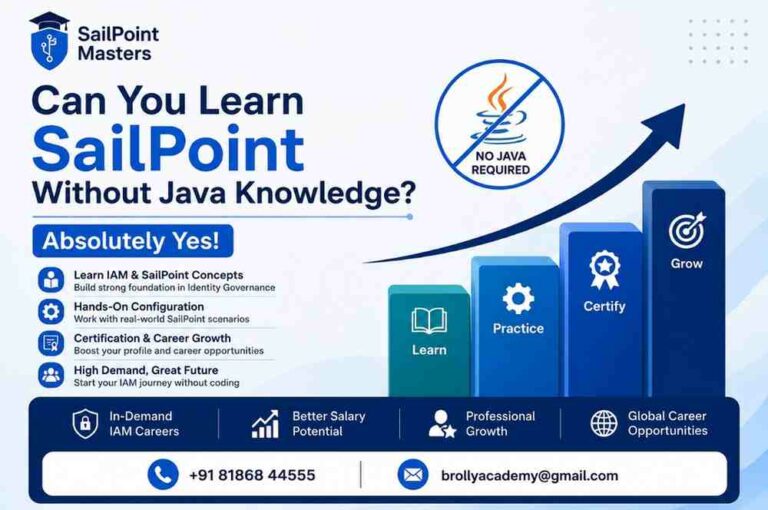
If you are exploring identity security as a career, one question keeps coming up: can you learn SailPoint without Java knowledge? The short, honest answer is yes. SailPoint is primarily an Identity Governance and Administration (IGA) platform, and the everyday work of administrators, analysts and most implementers is built around configuration, governance policy and automation rather than hardcore programming.
Java is helpful in specific places, but it is not a wall that blocks beginners. Many successful SailPoint professionals started from system administration, networking, support or cybersecurity backgrounds and never wrote a Java application in their lives. What they did learn were the right fundamentals. If you want a structured path into this field, a focused program such as SailPoint Certification Training in Hyderabad can take you from zero to job-ready without expecting you to be a Java engineer first.
In this guide, we will clear up exactly where Java is required and where it is not, which SailPoint modules involve scripting, the skills that genuinely matter, the career opportunities open to beginners, and a step-by-step roadmap to learn SailPoint without Java. We will also look at salary ranges in India and why SailPoint remains one of the fastest-growing identity and access management platforms in the world.
Can You Learn SailPoint Without Java Knowledge?
What Is SailPoint?
SailPoint is a market-leading platform for Identity Governance and Administration. In simple terms, it answers a question every large organisation must control: who has access to what, why do they have it, and is that access still appropriate? SailPoint automates the joiner-mover-leaver lifecycle, runs access certifications, enforces policies such as segregation of duties, and provisions or de-provisions accounts across hundreds of connected systems.
SailPoint offers two flagship products. IdentityIQ (IIQ) is the on-premises, highly customisable solution favoured by complex enterprises. Identity Security Cloud (ISC)—previously marketed as IdentityNow and built on the Atlas platform—is the cloud-native, software-as-a-service option. You can read more about the cloud product on the official SailPoint Identity Security Cloud page.
Because SailPoint sits at the heart of enterprise security and compliance, demand for skilled professionals is consistently high. The good news for newcomers is that the platform rewards people who understand identity governance principles, not just those who can code.
Can You Learn SailPoint Without Java Knowledge?
Yes—you can absolutely learn SailPoint without Java knowledge, especially when you start. Here is the practical reality of how SailPoint work is split
- Configuration and administration (no Java needed): setting up sources and connectors, onboarding applications, building roles and policies, scheduling access reviews, and managing the identity lifecycle.
- Light scripting (Java-like, learned gradually): small rules and workflow logic in IdentityIQ written in BeanShell, which looks similar to Java but is far simpler to pick up.
- Advanced custom development (Java helps): complex IIQ rules, custom connectors and deep integrations where solid Java familiarity becomes a genuine advantage.
So the platform is layered. A beginner can become productive in the first two layers without strong Java skills, then grow into the third layer over time. This is exactly why a beginner-friendly path like a SailPoint course for beginners focuses first on concepts and configuration, and only later introduces scripting in a gentle, example-driven way.
The mindset shift that helps most: SailPoint is a governance product before it is a coding product. If you understand identities, accounts, entitlements, roles and access requests, you already understand 70% of the job.
Is Java Required for SailPoint IdentityIQ?
Java is not required to begin with IdentityIQ, but it becomes useful as you go deeper. IIQ is a Java-based application under the hood, and its customisation layer uses BeanShell—a lightweight scripting language with Java-style syntax. When you write a rule to transform an attribute, build an account naming convention, or add logic to a workflow, you are usually writing short BeanShell snippets.
The key point is that you do not need to be a Java developer to do this. Most rules follow predictable patterns you can learn by example: read an attribute, apply a condition, return a value. Basic programming logic—variables, if-statements and string handling—is enough to get started. You can deepen your Java understanding later if you want to specialise in custom development.
To understand how rules, roles and policies fit together, it helps to study a real governance concept such as role-based access control in SailPoint IdentityIQ. That single topic teaches you far more about being effective in IIQ than memorising Java syntax ever would. Official references and rule documentation are available on the SailPoint documentation portal.
Is Java Needed for SailPoint Identity Security Cloud (ISC)?
For SailPoint Identity Security Cloud, the answer is even clearer: Java is not needed. ISC is a cloud, low-code platform. Instead of writing Java, you configure identity profiles, build transforms using JSON, set up provisioning, and connect applications through pre-built integrations. Where automation is required beyond the user interface, you typically use REST APIs, not Java code.
This makes ISC particularly welcoming for beginners and for professionals moving from administration or support roles. As enterprises continue migrating identity governance to the cloud, ISC skills are becoming increasingly valuable. If you are weighing your options between the two products, the comparison guide on SailPoint IIQ and IdentityNow explains how the platforms differ and which to learn first.
Which Programming Skills Are Helpful for SailPoint?
You do not need Java, but a few light technical skills make your SailPoint journey much smoother. Think of these as enablers rather than prerequisites
- SQL: identity data lives in databases. Being able to read and write basic queries helps you understand source data, troubleshoot and report.
- LDAP: the protocol behind directories. Understanding how directory entries and attributes work is core to identity management.
- Active Directory: one of the most common connected systems. Knowing how AD users, groups and OUs work is hugely practical.
- REST APIs: the modern way to automate and integrate, especially in Identity Security Cloud.
- Basic scripting: a little BeanShell (for IIQ) and a basic awareness of PowerShell (for Windows and AD automation).
- JSON: the format used for transforms and API payloads in ISC.
Notice that Java is absent from this beginner list. These foundational skills, combined with strong identity governance understanding, are what hiring managers actually look for first.
SailPoint Technologies You Should Learn
Beyond the headline products, several concepts and technologies form the working vocabulary of a SailPoint professional. Here is a plain-English explanation of the most important ones
- IdentityIQ (IIQ): SailPoint’s on-premises, highly customisable identity governance platform for complex enterprises.
- Identity Security Cloud (ISC): the cloud-native SaaS platform (built on Atlas) that delivers governance with a low-code, configuration-first approach.
- Identity Governance and Administration (IGA): the broader discipline SailPoint belongs to—managing identities, access and compliance across the enterprise.
- IdentityNow (legacy name): the former brand name for what is now Identity Security Cloud. You will still see “IdentityNow” in older documentation and job posts.
- BeanShell: a lightweight, Java-like scripting language used in IIQ rules and workflows for custom logic.
- Workflows: automated, multi-step processes (for example, an access request approval flow) that orchestrate what happens and when.
- Lifecycle Manager: the IIQ capability that handles joiner-mover-leaver events and self-service access requests.
- Active Directory integration: connecting SailPoint to AD to read and manage users, groups and access.
- REST APIs: standardised web interfaces used to automate and integrate SailPoint with other systems—central to ISC.
- SQL: the query language used to work with identity and account data stored in databases.
- LDAP: the directory protocol that underpins how identity attributes are stored and searched.
- PowerShell (basic overview): a scripting language used to automate Windows and Active Directory tasks that often sit alongside SailPoint deployments.
- Java (where required and where it isn’t): required only for advanced, custom IIQ development; not required for administration, configuration or ISC work.
For developer-focused integration and API details, the official SailPoint developer portal is an excellent reference once you progress beyond the basics.
SailPoint Career Opportunities for Beginners
One of the most encouraging facts for newcomers is how many entry points exist. You do not have to start as a developer. Common beginner-friendly roles include
- SailPoint Administrator: manages day-to-day operations, configuration, access reviews and connectors.
- IAM Analyst / Identity Analyst: handles access requests, certifications, audits and governance reporting.
- SailPoint Support Engineer: troubleshoots issues, monitors jobs and supports users.
- Junior SailPoint Consultant: assists with implementations and configuration under guidance.
From any of these, you can grow into senior engineering, development, or architecture roles as your skills deepen. To understand the full progression and the variety of paths available, explore our overview of SailPoint careers. Because SailPoint underpins enterprise security, the skill also opens doors in the wider cybersecurity field—as we discuss in whether SailPoint is good for cyber security careers.
Skills Required to Become a SailPoint Developer
If you do want to move toward development, here is what the role typically asks for—built up over time, not on day one
- Strong understanding of IGA concepts, identity lifecycle and provisioning.
- Comfort with BeanShell scripting and IIQ rules.
- Working knowledge of Java for advanced custom rules and connectors.
- REST API integration and JSON handling, especially for ISC.
- SQL and database familiarity for data sources and reporting.
- Experience with workflows, Lifecycle Manager and certifications.
Note that Java appears here, but as one skill among many and mainly for advanced work. A developer who is excellent at governance design and integration but only moderate at Java can still be highly effective.
Skills Required to Become a SailPoint Administrator
The administrator path is where most no-Java beginners thrive. Core skills include
- Identity governance fundamentals and access management policy.
- Connector and application onboarding (especially Active Directory).
- Configuring roles, access profiles and certifications.
- Basic SQL, LDAP and an awareness of REST APIs.
- Monitoring tasks, troubleshooting and user support.
- Documentation, compliance awareness and attention to detail.
None of these require Java. This is the clearest proof that you can build a real, well-paid SailPoint career without being a programmer. The table below summarises how the two roles compare.
SailPoint Developer vs SailPoint Administrator
|
Aspect |
SailPoint Developer |
SailPoint Administrator |
|
Primary focus |
Custom rules, workflows, integrations |
Configuration, operations, governance |
|
Coding involved |
Moderate (BeanShell, some Java, REST/JSON) |
Minimal (mostly configuration) |
|
Java needed? |
Helpful for advanced work |
Not required |
|
Best for |
Those who enjoy scripting and building |
Those who enjoy systems and governance |
|
Entry difficulty |
Moderate |
Beginner-friendly |
IdentityIQ vs Identity Security Cloud: Java Requirements
Since Java requirements differ between the two products, this comparison helps you choose where to begin. In practice, ISC is the lower-code, more beginner-accessible option, while IIQ offers deeper customisation that occasionally calls for Java-style scripting.
SailPoint IIQ vs SailPoint ISC
|
Aspect |
IdentityIQ (IIQ) |
Identity Security Cloud (ISC) |
|
Deployment |
On-premises |
Cloud (SaaS, Atlas platform) |
|
Customisation |
Highly customisable |
Configuration and low-code |
|
Scripting |
BeanShell (Java-like) |
JSON transforms, REST APIs |
|
Java involvement |
Helpful for advanced rules |
Not required |
|
Beginner accessibility |
Moderate |
High |
For a deeper technical contrast of how each platform automates processes, see our breakdown of the difference between IdentityIQ and IdentityNow workflows.
Step-by-Step Roadmap to Learn SailPoint Without Java
Here is a realistic, beginner-friendly roadmap you can follow even with zero Java experience. The goal is to build governance understanding first, then layer on light technical skills.
- Learn IAM and IGA fundamentals: identities, accounts, entitlements, roles, access requests and certifications.
- Understand the SailPoint product family: IIQ, ISC and the legacy IdentityNow name.
- Build supporting basics: a little SQL, LDAP concepts and Active Directory familiarity.
- Practise configuration: sources, connectors, identity profiles, roles and access reviews.
- Get hands-on with administration: run certifications, manage the lifecycle, troubleshoot tasks.
- Introduce light scripting: read and modify simple BeanShell rules and workflows in IIQ by example.
- Learn REST APIs and JSON: essential for ISC automation and integrations.
- Pursue certification and projects: validate your skills and build a portfolio.
The structured stages below map directly to this roadmap so you always know what to learn next. A guided SailPoint Masters syllabus walks through these stages in a logical order with practical labs.
SailPoint Learning Roadmap
|
Stage |
What You Learn |
|
Beginner |
IAM and IGA fundamentals, identity lifecycle, SailPoint overview, basic SQL, LDAP and Active Directory concepts. |
|
Intermediate |
IIQ and ISC architecture, connectors and application onboarding, roles, policies and access certifications. |
|
Advanced |
Workflows, Lifecycle Manager, BeanShell rules, REST APIs, JSON transforms and provisioning. |
|
Expert |
End-to-end implementation, custom rules and integrations, performance tuning, and solution architecture. |
Common Challenges Beginners Face
Knowing the typical hurdles in advance makes them far easier to overcome
- Concept overload: identity, account, entitlement, role and policy can blur together at first. Slow down and learn each clearly.
- Fear of scripting: beginners often overestimate how much code is involved. Most rules are short and pattern-based.
- Lack of practice environment: theory without hands-on labs does not stick. Practical exposure is essential.
- Terminology between products: IIQ and ISC use slightly different terms for similar ideas.
- Interview readiness: turning knowledge into confident answers. Reviewing SailPoint interview questions and answers early helps you study with the end goal in mind.
Best Learning Resources for SailPoint
To learn efficiently, combine official references with structured, hands-on training
- Official documentation for accurate product behaviour and rule references.
- The SailPoint community (Compass) for real-world questions and shared knowledge—available at the SailPoint community portal.
- Structured instructor-led training that sequences concepts logically and includes labs.
- Hands-on practice environments so you can configure, break and fix safely.
- Mock projects that mirror real enterprise scenarios.
If you are deciding how to study, our comparison of a SailPoint course online vs classroom training can help you pick the format that fits your schedule, and working learners may prefer the flexible approach in our guide for a SailPoint course for working professionals.
Certifications That Can Boost Your SailPoint Career
Certifications validate your skills and reassure employers. SailPoint offers official credentials across IdentityIQ and Identity Security Cloud, and these are increasingly requested in job descriptions. You can review the official options through SailPoint University.
To plan your certification journey and what to do once you pass, see our guidance on what to do after SailPoint certification, and prepare effectively using our SailPoint IIQ exam preparation tips. Crucially, none of these certifications demand that you be a Java expert—they reward governance understanding and practical platform skills.
SailPoint Salary in India
SailPoint skills are well rewarded in India because they sit at the intersection of security, compliance and automation. Actual pay varies by city, employer, certifications and whether you specialise in IIQ, ISC or both. The figures below are indicative market ranges for SailPoint and IAM professionals.
|
Experience |
Average Salary (Indicative) |
|
Fresher (0–2 Years) |
₹4 – ₹7 LPA |
|
Mid-Level (3–5 Years) |
₹8 – ₹15 LPA |
|
Senior (6–10 Years) |
₹16 – ₹28 LPA |
|
Architect/Lead (10+ Years) |
₹30 – ₹55 LPA+ |
For a city-specific view of fees and earning potential, our detailed breakdown of SailPoint course salary in Hyderabad goes deeper. The headline takeaway: certified professionals and those who master both products tend to command the upper end of these ranges.
Current Industry Insights and Demand
SailPoint’s relevance is backed by strong market momentum. According to Grand View Research, the global Identity Governance and Administration market was valued at around USD 7.95 billion in 2024 and is projected to reach roughly USD 27.11 billion by 2033, growing at a CAGR of about 14.9%. You can review the full analysis in the Grand View Research IGA market report.
Several trends are driving this growth and, with it, hiring demand
- Enterprise cloud migration: as organisations move to the cloud, identity becomes the new security perimeter, boosting demand for ISC skills.
- Identity security adoption: zero-trust strategies put governance and least-privilege access at the centre of security programmes.
- Regulatory compliance: audits and data-protection rules make access certification and governance mandatory, not optional.
- Cross-sector hiring: demand is strong across banking and financial services, healthcare, telecom, retail, manufacturing and IT services.
In India specifically, the combination of a large IT services industry and rapid digital transformation means SailPoint professionals are in steady demand, often with attractive remote and hybrid options.
SailPoint vs CyberArk
|
Aspect |
SailPoint |
CyberArk |
|
Core focus |
Identity governance (who should have access) |
Privileged access management (protecting admin access) |
|
Primary use |
Access reviews, lifecycle, compliance |
Securing and vaulting privileged credentials |
|
Coding intensity |
Low to moderate (config-first) |
Low to moderate (config-first) |
|
Best paired with |
CyberArk for full identity security |
SailPoint for governance coverage |
SailPoint vs Okta
|
Aspect |
SailPoint |
Okta |
|
Core focus |
Identity governance and administration (IGA) |
Access management, single sign-on, MFA |
|
Main question answered |
Should this person have this access? |
Is this person who they claim to be? |
|
Typical strength |
Certifications, provisioning, compliance |
Authentication and seamless login |
|
Relationship |
Often deployed together—governance plus access management—rather than as direct rivals. |
|
Why SailPoint Is One of the Best IT Careers in India
SailPoint stands out as a smart long-term bet for several reasons
- Strong job demand: identity governance is mission-critical, so roles are resilient even when broader IT hiring slows.
- Healthy salary growth: specialised, in-demand skills translate into above-average compensation and steady increments.
- Remote and hybrid opportunities: much of the work can be performed remotely, widening your options.
- Cloud identity trends: the shift to Identity Security Cloud keeps the skill modern and future-facing.
- Long-term prospects: as long as organisations need to control access, IGA expertise stays relevant.
- Future relevance of IAM: with zero-trust and compliance only growing, identity professionals are positioned for lasting careers.
For learners in the region, combining strong fundamentals with quality SailPoint training in Hyderabad is one of the most direct routes into this resilient field—no Java mastery required to begin.
Key Takeaways
- Java is not a barrier: you can learn SailPoint without Java knowledge and build a successful career starting from administration and configuration.
- Modules differ: IdentityIQ uses light BeanShell scripting, while Identity Security Cloud is low-code and needs no Java.
- Fundamentals win: IAM/IGA concepts, SQL, LDAP, Active Directory and REST APIs matter most for beginners.
- Strong demand and salaries: SailPoint skills are well paid in India and backed by a fast-growing IGA market projected to reach ~USD 27 billion by 2033.
- A clear roadmap exists: learn governance first, then layer on configuration, scripting, APIs and certification to become job-ready.
Conclusion
So, can you learn SailPoint without Java knowledge? Without a doubt. SailPoint rewards people who understand identity governance, not just those who can write code. Java has its place in advanced IdentityIQ development, but it is never the gate that keeps beginners out. Administration, configuration, Identity Security Cloud work and certification are all well within reach if you focus on the right fundamentals and get enough hands-on practice.
If you are ready to start, do not let the Java myth hold you back. Begin with IAM concepts, get comfortable with configuration, and grow into scripting and integrations at your own pace. With structured guidance and real labs from SailPoint Masters, you can move from complete beginner to a confident, employable SailPoint professional—and step into one of the most resilient careers in identity security. Start learning, practise consistently, and build your future in SailPoint today.
FAQ
1. Can you learn SailPoint without Java knowledge?
Yes. Administration, configuration and most Identity Security Cloud work are configuration-driven. Java only helps for advanced custom rules in IdentityIQ, which you can learn gradually.
2. Is Java mandatory for SailPoint IdentityIQ?
No. IIQ uses BeanShell, a Java-like scripting language, for custom logic. Basic programming understanding is enough to start; deep Java is only useful for advanced development.
3. Is Java needed for SailPoint Identity Security Cloud?
No. ISC is a low-code cloud platform that relies on configuration, JSON transforms and REST APIs rather than Java, making it very beginner-friendly.
4. Which skills are most important to learn SailPoint?
Identity and access management concepts, SQL, LDAP, Active Directory and REST API basics matter far more than Java for newcomers.
5. Can a non-programmer build a SailPoint career?
Yes. Many administrators and IAM analysts come from system administration, support or security backgrounds and focus on governance and configuration, not coding.
6. What is BeanShell in SailPoint?
BeanShell is a lightweight scripting language used in IdentityIQ rules and workflows. Its Java-like syntax is easy to learn by example without mastering full Java.
7. How long does it take to learn SailPoint without Java?
With consistent study and hands-on practice, beginners can reach a job-ready level in roughly four to six months through structured training.
8. Should I learn IdentityIQ or Identity Security Cloud first?
Many start with IIQ to learn core governance concepts, then move to ISC as enterprises adopt the cloud. Learning both maximises your opportunities.
9. Do SailPoint developers earn more than administrators?
Developers can earn slightly more due to the technical nature of the role, but experienced administrators and architects also command high salaries. Certifications and skills drive growth more than coding alone.
10. Is SailPoint a good career choice in India?
Yes. With strong demand across banking, healthcare, telecom, retail, manufacturing and IT services, plus competitive salaries and cloud-driven growth, SailPoint is a future-proof career path.
SailPoint Trainer
SailPoint Masters Editorial Team | 15+ Articles Published
We specialize in SailPoint Certification Training in Hyderabad, helping aspiring professionals and IT experts develop in-demand Identity and Access Management (IAM) skills. Our training covers SailPoint IdentityIQ, Identity Security Cloud, certification preparation, real-world projects, and career guidance to support success in cybersecurity and identity governance careers.
Share