
What is SailPoint? A Complete Guide to Identity Governance, Features & Careers
What is SailPoint?
SailPoint is a market-leading Identity Governance and Administration (IGA) platform that centralizes visibility and control over digital identities and their access across an enterprise. It automates provisioning, access requests, certifications, role management, and compliance reporting through two flagship products — the on-premises IdentityIQ and the SaaS-based Identity Security Cloud — helping organizations enforce least-privilege access and prove compliance to auditors.
★★★★★
4.9/5 rated by 1329+ students · Google Verified
Table of Contents
What is SailPoint?
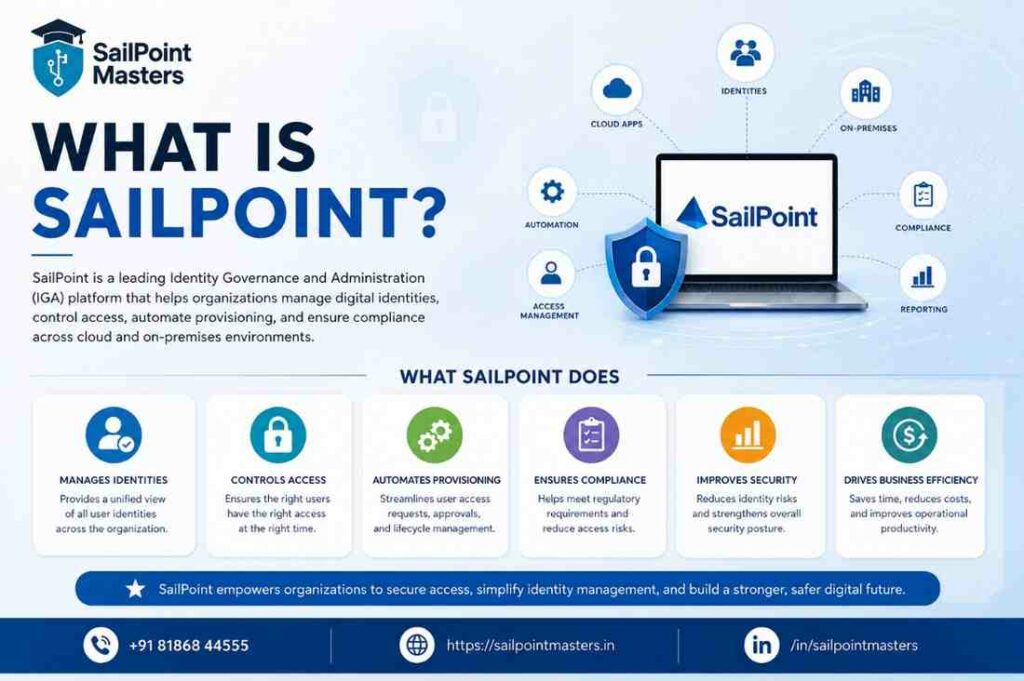
SailPoint is an identity security company whose software specializes in Identity Governance and Administration. In plain terms, it answers a question that grows harder as companies scale: who has access to what, and should they? The platform builds a single, correlated view of every identity — employees, contractors, partners, and increasingly service accounts, machine identities, and AI agents — and the entitlements each one holds across the entire technology estate.
The company was founded in 2005 in Austin, Texas, and has spent nearly two decades establishing itself at the front of the identity governance category. After a stretch under private ownership, SailPoint returned to public markets, listing on the Nasdaq under the ticker SAIL in February 2025 — a move that reflected how central identity security has become to enterprise risk management.
Everything SailPoint does maps back to three persistent headaches for security and compliance teams:
- Visibility: Seeing, in one place, exactly which identities can reach which systems, and understanding why.
- Control: Granting access precisely when it is needed and pulling it back the instant it is not.
- Compliance: Producing the evidence auditors demand to confirm access is appropriate and properly governed.
It delivers this through two products: SailPoint IdentityIQ, a deeply configurable on-premises platform, and SailPoint Identity Security Cloud, a SaaS offering built on the Atlas foundation. New learners often wonder which to study first — our comparison of SailPoint IIQ and IdentityNow modules breaks down the practical differences.
What is SailPoint
Why SailPoint is Important for Identity Governance
To appreciate what SailPoint brings, it helps to distinguish two overlapping disciplines. Identity and Access Management (IAM) is the wider practice of confirming who a user is and what they are permitted to do — the domain of Single Sign-On, Multi-Factor Authentication, and the login moment itself.
Identity Governance and Administration (IGA) operates one level up. Instead of focusing on the point of authentication, it governs the whole life of access: how it is requested, approved, periodically reviewed, certified, and eventually revoked, with every decision documented and driven by policy. SailPoint delivers industry-leading capabilities for managing identity governance across enterprise environments.
SailPoint’s own explanation of identity governance is a useful companion reference.
Why does this matter at scale? Picture a multinational bank with 50,000 staff spread across 800 applications. Without governance, departed employees keep live accounts for months, long-tenured users quietly pile up privileges they no longer need, and auditors have no reliable way to confirm anything. A single forgotten account can be the doorway to a very expensive breach. SailPoint automates governance across that entire population, converting an impossible manual chore into a controlled, traceable workflow.
Core Features of SailPoint
SailPoint packs a broad governance toolkit into a single platform. The capabilities that matter most include
- Lifecycle Management: Grants and removes access automatically as people are hired, change roles, or exit.
- Access Request: A self-service catalog where users ask for access, routed through structured approval workflows.
- Access Certification: Scheduled reviews in which managers reconfirm or withdraw their team’s access.
- Role Management: Bundles entitlements into business roles so access can be granted by policy rather than one permission at a time.
- Policy & SoD Enforcement: Catches and blocks risky combinations, such as Separation of Duties conflicts.
- Password Management: Self-service resets kept in sync across every connected system.
- Compliance Reporting: Ready-made dashboards and evidence tailored to frameworks like SOX, HIPAA, and GDPR.
- AI-Powered Intelligence: Uses advanced analytics to detect unusual access patterns and recommend appropriate approval actions.
How SailPoint Works
At a high level, SailPoint reaches into every place identities and access live, pulls that information into one governance model, and then applies policy to it. The cycle usually runs like this
- Connect: Connectors plug into source systems — Active Directory, LDAP, Microsoft Entra ID (formerly Azure AD), HR platforms, databases, and SaaS apps.
- Aggregate: Accounts and entitlements are drawn in and stitched together into a correlated view of each identity.
- Govern: Policies, roles, and risk models test whether the access on record is actually appropriate.
- Act: Triggered by requests, approvals, certifications, or HR events, SailPoint provisions or removes access automatically.
- Audit: Every action is logged, leaving an unbroken trail for compliance reviews.
This connect-aggregate-govern-act-audit loop powers both IdentityIQ and Identity Security Cloud, and grasping it is essential for anyone pursuing SailPoint training in Hyderabad or elsewhere. The official SailPoint documentation shows these mechanics in real configurations.
SailPoint IdentityIQ (IIQ)
SailPoint IdentityIQ — usually shortened to IIQ — is the company’s on-premises (and privately hosted) governance platform. For years it has been the go-to choice for enterprises that want deep customization and full ownership of their deployment.
IIQ runs on a flexible Java-based architecture and is highly configurable. Teams tailor its behaviour with rules written in BeanShell (a lightweight Java scripting layer), build custom workflows, and adapt connectors to fit complicated environments. That adaptability is why IIQ remains popular in tightly regulated sectors like banking, healthcare, and government. To understand how access is modelled inside IIQ, our guide to Role-Based Access Control in SailPoint IdentityIQ is a solid next read, and the IdentityIQ architecture breakdown maps out its internal objects.
SailPoint Identity Security Cloud
SailPoint Identity Security Cloud (ISC) is the modern SaaS platform built on the Atlas foundation. It is the direct successor to IdentityNow, which was renamed Identity Security Cloud as SailPoint consolidated its cloud portfolio.
Because it is delivered as a service, ISC lifts the weight of infrastructure management off customers, scales on demand, and continuously ships new capabilities and AI-driven features. For cloud-first organizations it is the natural fit, and it is where most of SailPoint’s current innovation lands. The vendor’s Identity Security Cloud overview is a good primer, and our dedicated article on SailPoint Identity Security Cloud digs into its modules. If you are torn between platforms, the differences in IdentityIQ and IdentityNow workflows are worth studying.
Benefits of Using SailPoint
Enterprises adopt SailPoint because the payoff shows up across security, efficiency, and compliance at the same time:
- Stronger security posture: Enforces least-privilege access and clears out orphaned accounts.
- Faster onboarding: New hires get the correct access on day one through automation.
- Lighter IT load: Self-service and automation slash help-desk tickets.
- Audit readiness: Ongoing certification and reporting make audits far less painful.
- Scalability: Governs millions of identities across hybrid estates.
- Risk reduction: AI flags unusual or excessive access before it turns into a breach.
SailPoint Architecture and Components Overview
SailPoint’s architecture is built to represent identities and access in a structured, governable form. IIQ and ISC differ in how they are deployed, but they lean on the same core building blocks
- Identity Cube (IIQ): A single profile that correlates all of a person’s accounts and entitlements.
- Connectors: Integration modules that read from and write back to source and target systems.
- Applications: How connected systems are represented inside SailPoint.
- Entitlements: The fine-grained permissions — group memberships, roles, privileges — a user can hold.
- Roles: Collections of entitlements mapped to a job function.
- Policies: Rules that flag violations such as Separation of Duties conflicts.
- Workflows: Automated, multi-step processes for requests and approvals.
- Rules: Custom logic (BeanShell in IIQ) that extends what the platform can do.
Knowing how these pieces fit together is the bedrock of every SailPoint implementation and a headline topic in any serious program, such as the SailPoint IIQ curriculum.
Key SailPoint Capabilities Explained
SailPoint Lifecycle Management
Lifecycle Management automates the joiner-mover-leaver flow. When HR records a new hire, SailPoint provisions the right access on its own. When someone transfers departments, access is recalculated. When they leave, everything is revoked immediately — sealing one of the widest security gaps any organization faces.
SailPoint Access Request
Access Request hands users a self-service catalog for requesting extra access. Each request travels through configurable approval workflows, so the appropriate managers and resource owners sign off before anything is granted.
SailPoint Access Certification
Access Certification — also called access review — is a recurring campaign in which managers and owners look at who holds what access and either confirm or remove it. These campaigns anchor compliance by producing documented proof that access is justified.
SailPoint Provisioning and De-provisioning
Provisioning creates or updates access in target systems; de-provisioning strips it away. SailPoint can do either automatically on an event, or in response to an approved request, pushing changes straight into systems like Active Directory or SaaS apps through connectors. To see how source data flows first, review how aggregation in SailPoint works.
SailPoint Role Management
Role-Based Access Control (RBAC) groups entitlements into roles tied to job functions, so granting a “Finance Analyst” role delivers a curated bundle of access rather than dozens of separate permissions. RBAC simplifies administration and tightens governance. The model traces back to the NIST Role-Based Access Control standard, which formalized the approach now used industry-wide.
SailPoint Compliance and Audit
Compliance is one of SailPoint’s most compelling strengths. Regulations such as SOX, HIPAA, GDPR, and PCI-DSS demand that organizations control and evidence access to sensitive data. SailPoint supports this by
- Running scheduled access certification campaigns.
- Enforcing Separation of Duties policies to head off conflicts of interest.
- Maintaining a complete, tamper-evident record of every access change.
- Producing audit-ready reports that satisfy regulators and external auditors.
SailPoint Integrations
Much of SailPoint’s value comes from how widely it connects. Frequent integration targets and technologies include
- Active Directory & LDAP: The backbone of on-premises identity in most enterprises.
- Microsoft Entra ID (Azure AD): Cloud identity for Microsoft-centric estates.
- SaaS applications: Salesforce, Workday, ServiceNow, and hundreds more.
- Databases: SQL-based systems reached through database connectors.
- REST APIs & web services: Custom links for systems with no packaged connector.
Developers extending these integrations lean on REST APIs, XML for configuration, and SQL for data access. The SailPoint Developer portal is the definitive resource for API-driven work, and our connectors list and setup guide walks through the most common ones.
SailPoint Implementation Process
A typical SailPoint rollout follows a structured project lifecycle
- Requirements & design: Set governance goals, scope the applications, and design the identity model.
- Environment setup: Install IIQ or stand up ISC tenants.
- Source integration: Connect authoritative sources such as HR and aggregate identity data.
- Application onboarding: Connect target apps and pull in their accounts and entitlements.
- Configuration: Build roles, policies, workflows, and certification campaigns.
- Testing: Validate provisioning, approvals, and reporting end to end.
- Go-live & support: Move to production and provide ongoing maintenance.
SailPoint Roles and Responsibilities
SailPoint careers cover several specialized roles. Common job titles and their focus areas include
- SailPoint Developer: Builds connectors, rules, workflows, and customizations.
- SailPoint Engineer: Deploys, configures, and maintains the platform.
- SailPoint Administrator: Runs day-to-day operations, certifications, and support.
- SailPoint Architect: Designs the overall governance solution and integration strategy.
- IAM Consultant: Advises clients on governance strategy and leads implementations.
Skills Required to Become a SailPoint Developer
Becoming an effective SailPoint developer means blending identity concepts with technical skills
- Identity fundamentals: A firm grasp of IAM, IGA, RBAC, and the access lifecycle.
- Java & BeanShell: Central to customizing IdentityIQ rules and logic.
- SQL: For querying and integrating database-backed systems.
- XML: Used heavily in IIQ object configuration.
- REST APIs & web services: Essential for ISC and modern integrations.
- Directory services: Comfort with Active Directory, LDAP, and Entra ID.
Encouraging news for career changers: you do not have to be a Java expert to begin. Our guide on whether you can learn SailPoint without Java knowledge explains how beginners can ramp up without a coding background.
SailPoint Career Opportunities in India
India has become a global engine for identity security delivery, with multinational banks, consultancies, and technology service providers running large SailPoint practices out of Hyderabad, Bengaluru, Pune, and Chennai. That concentration of project work has generated steady, long-running demand for SailPoint professionals at every experience level.
Because identity governance is both mission-critical and specialized, the available talent stays thinner than demand — a gap that keeps opportunities plentiful and pay healthy. For the full range of paths, explore our overview of SailPoint careers and whether SailPoint is good for cybersecurity careers.
Industries and Top Companies Hiring SailPoint Professionals
SailPoint professionals earn attractive salaries because the skill set is niche and in short supply. The table below shows typical annual compensation in India by experience level; actual figures shift with city, employer, and certification status.
|
Experience Level |
Average Salary (INR per annum) |
|
Fresher (0–2 Years) |
₹4,00,000 – ₹7,00,000 |
|
Mid-Level (3–5 Years) |
₹8,00,000 – ₹15,00,000 |
|
Senior (6–10 Years) |
₹16,00,000 – ₹28,00,000 |
|
Architect / Lead (10+ Years) |
₹30,00,000 – ₹50,00,000+ |
For a city-specific view, see our detailed analysis of SailPoint course salary in Hyderabad.
SailPoint Salary in India
SailPoint professionals command attractive salaries because the skill set is specialized and in high demand. The table below shows typical annual compensation ranges in India by experience level. Actual figures vary by city, employer, and certification status.
|
Experience Level |
Average Salary (INR per annum) |
|
Fresher (0–2 Years) |
₹4,00,000 – ₹7,00,000 |
|
Mid-Level (3–5 Years) |
₹8,00,000 – ₹15,00,000 |
|
Senior (6–10 Years) |
₹16,00,000 – ₹28,00,000 |
|
Architect / Lead (10+ Years) |
₹30,00,000 – ₹50,00,000+ |
For a city-specific breakdown, see our detailed analysis of SailPoint course salary in Hyderabad.
SailPoint Certification Guide
SailPoint certifications validate your expertise and lift your employability sharply. The main credential paths follow the two flagship products
- IdentityIQ certifications: Engineer and Architect-level credentials for the on-premises platform.
- Identity Security Cloud certifications: Associate, Engineer, and Architect tracks for the SaaS platform.
Certification signals hands-on capability to employers and is frequently a hiring filter for consulting roles. Our guide to SailPoint certification and free resources is a good place to plan your path, and if you are prepping for the exam itself, the SailPoint IIQ exam preparation guide covers what to expect.
SailPoint Career Roadmap
A structured progression helps you move from beginner to expert without wasted effort. The roadmap below outlines what to focus on at each stage.
|
Stage |
Focus Areas |
|
Beginner |
IAM & IGA fundamentals, identity lifecycle, basic RBAC, SailPoint product overview. |
|
Intermediate |
IdentityIQ configuration, connectors, certifications, workflows, basic BeanShell/Java. |
|
Advanced |
Custom rules, complex provisioning, REST API integration, Identity Security Cloud modules. |
|
Expert |
Solution architecture, enterprise rollout strategy, performance tuning, team leadership. |
For a guided sequence, follow our complete SailPoint roadmap.
SailPoint vs Other IAM Tools
SailPoint is regularly weighed against other identity and access management vendors. Many tools overlap, but each emphasizes a different problem. The tables below summarize how SailPoint lines up against popular alternatives.
SailPoint vs Okta
|
Aspect |
SailPoint |
Okta |
|
Primary focus |
Identity Governance (IGA) |
Access Management (SSO/MFA) |
|
Core strength |
Certification, provisioning, compliance |
Authentication and login experience |
|
Best for |
Governing who should have access |
Securing the moment of login |
SailPoint vs CyberArk
|
Aspect |
SailPoint |
CyberArk |
|
Primary focus |
Identity Governance for all users |
Privileged Access Management (PAM) |
|
Core strength |
Lifecycle, access reviews, RBAC |
Securing privileged/admin accounts |
|
Best for |
Broad workforce governance |
Protecting high-risk credentials |
SailPoint vs Saviynt
|
Aspect |
SailPoint |
Saviynt |
|
Deployment |
IIQ (on-prem) and ISC (SaaS) |
Cloud-native (SaaS) |
|
Maturity |
Long-established market leader |
Newer cloud-first challenger |
|
Best for |
Customization and enterprise scale |
Cloud-first, converged IGA |
SailPoint vs Microsoft Entra ID
|
Aspect |
SailPoint |
Microsoft Entra ID |
|
Primary focus |
Deep, multi-platform governance |
Identity for the Microsoft ecosystem |
|
Governance depth |
Advanced certification and SoD |
Built-in governance features |
|
Best for |
Complex, heterogeneous enterprises |
Microsoft-centric environments |
In practice, many enterprises run SailPoint alongside these tools — pairing SailPoint governance with Entra ID for authentication, for example — rather than picking a single winner.
Market Trends and Statistics
The numbers behind identity security make a strong case for building a career here
- Rapid market growth: The Identity Governance and Administration market was valued at USD 7.95 billion in 2024 and is projected to reach USD 27.11 billion by 2033, growing at a 14.9% CAGR, according to Grand View Research.
- Cloud-driven demand: Fast SaaS and cloud adoption multiplies the identities and access points organizations must govern.
- Rising cyber threats: Identity-based attacks remain a leading breach vector, pushing identity security up the boardroom agenda.
- Regulatory pressure: Widening compliance requirements make governance non-negotiable.
- Digital transformation in India: Large-scale digitization across BFSI, government, and enterprise IT keeps local hiring for identity skills strong.
Why SailPoint is One of the Best Identity Security Careers in India
If you are deciding where to spend your learning time, SailPoint stands out for several reasons
- High demand: Specialized skills and a limited talent pool keep openings plentiful.
- Attractive pay: Compensation outpaces many general IT roles at every level.
- Long-term growth: A clear path from developer to architect and consulting leadership.
- Global mobility: Skills transfer worldwide, opening onshore and remote roles abroad.
- Future-proof: Identity security only grows more central as organizations move to the cloud and adopt AI.
Future Scope of SailPoint
The outlook for SailPoint and identity governance is bright. As cloud footprints expand and AI agents proliferate, the count of human and non-human identities to govern is climbing steeply. SailPoint is investing heavily in AI-driven governance, machine identity security, and continuous, intelligent access decisions. For professionals, that means the skills you build today will stay relevant and in demand for years. To see how the field maps to security roles, revisit whether SailPoint suits a cybersecurity career.
How to Start Learning SailPoint
Getting started with SailPoint is more approachable than most beginners expect. A practical learning path looks like this
- Build identity fundamentals: Understand IAM, IGA, RBAC, and the access lifecycle.
- Pick a product to focus on: Start with IdentityIQ or Identity Security Cloud based on your goals.
- Get hands-on: Practice in a lab, configuring connectors, roles, and certifications.
- Learn the supporting tech: Pick up the basics of Java/BeanShell, SQL, XML, and REST APIs.
- Pursue certification: Validate your skills with an official SailPoint credential.
- Join a structured program: Guided, instructor-led training accelerates real-world readiness.
Key Takeaways
- SailPoint is a market-leading Identity Governance and Administration platform that controls who has access to what across an organization.
- Its two flagship products are IdentityIQ (on-premises) and Identity Security Cloud (SaaS, formerly IdentityNow).
- Core capabilities span lifecycle management, access requests, certification, provisioning, role management, and compliance reporting.
- SailPoint careers pay well and are in high demand, with strong opportunities across India and worldwide.
- Certification plus hands-on practice is the quickest route to a rewarding identity security career.
Conclusion: Start Your SailPoint Journey Today
SailPoint has firmly earned its place as the gold standard in identity governance, helping organizations answer the critical question of who should have access to what — securely, efficiently, and in a way auditors trust. As cloud adoption accelerates and cyber threats intensify, demand for skilled SailPoint professionals shows no sign of cooling.
Whether you are a fresher stepping into cybersecurity or an experienced IT professional ready to specialize, SailPoint opens the door to a high-paying, future-proof, globally portable career. Strong salaries, abundant openings, and long-term relevance make it one of the smartest skills you can invest in — and the best way to start is with hands-on, certification-focused training from SailPoint Masters.
Ready to Launch Your Identity Security Career?
Get hands-on, instructor-led, certification-focused training designed to make you job-ready. Begin your journey with SailPoint Masters and turn identity governance into your career advantage.
FAQ
1. What is SailPoint used for?
SailPoint is used for Identity Governance and Administration — managing digital identities and controlling who can reach which applications and data. It automates provisioning, access requests, certifications, and compliance reporting across cloud and on-premises systems.
2. Is SailPoint an IAM or IGA tool?
SailPoint is primarily an Identity Governance and Administration (IGA) tool, a specialized layer within the broader Identity and Access Management (IAM) field. It governs the access lifecycle rather than the authentication moment.
3. What is the difference between SailPoint IdentityIQ and Identity Security Cloud?
IdentityIQ (IIQ) is SailPoint’s on-premises, highly customizable governance platform, while Identity Security Cloud (ISC) is its modern SaaS solution built on the Atlas platform. ISC was formerly known as IdentityNow.
4. Do I need to know Java to learn SailPoint?
You can start learning SailPoint without being a Java expert. Java and BeanShell help with advanced IdentityIQ customization, but beginners can build strong foundations in identity concepts and configuration first and add coding skills over time.
5. What is the salary of a SailPoint professional in India?
SailPoint salaries in India typically run from ₹4–7 lakh for freshers to ₹30 lakh and above for architects and leads. Pay rises quickly with experience and certification because the skill set is specialized.
6. Is SailPoint a good career choice?
Yes. SailPoint is an excellent career choice thanks to high demand, attractive salaries, strong growth, and global opportunities. Identity security is a future-proof field as organizations move to the cloud and adopt AI.
7. What skills are required to become a SailPoint developer?
Key skills include identity fundamentals (IAM, IGA, RBAC), Java and BeanShell, SQL, XML, REST APIs and web services, and familiarity with directory services such as Active Directory, LDAP, and Microsoft Entra ID.
8. Which companies use SailPoint?
SailPoint is used by thousands of enterprises worldwide, especially in banking, healthcare, technology, retail, and government. Major consulting firms and system integrators also hire certified SailPoint experts for client implementations.
9. How long does it take to learn SailPoint?
With focused, structured training, most learners reach job-ready SailPoint skills in roughly three to four months. The timeline depends on your background, the product you choose, and how much hands-on practice you complete.
10. Is SailPoint certification worth it?
Yes. SailPoint certification validates your expertise, is often a hiring filter for consulting and enterprise roles, and typically increases earning potential. It shows employers you can deliver real-world identity governance solutions.
SailPoint Trainer
SailPoint Masters Editorial Team | 15+ Articles Published
We specialize in SailPoint Certification Training in Hyderabad, helping aspiring professionals and IT experts develop in-demand Identity and Access Management (IAM) skills. Our training covers SailPoint IdentityIQ, Identity Security Cloud, certification preparation, real-world projects, and career guidance to support success in cybersecurity and identity governance careers.
Share