
SailPoint Roadmap 2026: Your Complete Career and Learning Path
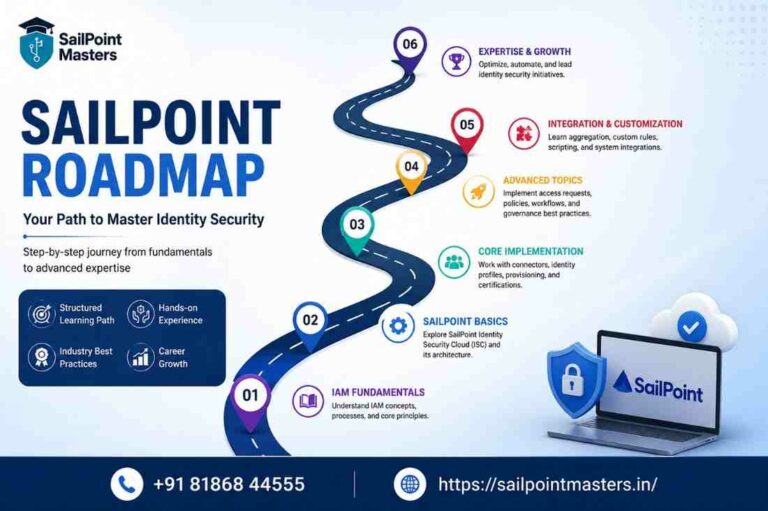
The SailPoint Roadmap provides a structured path from IAM fundamentals to advanced identity governance and cloud security expertise. It helps learners build the technical and practical skills required for real-world SailPoint implementations. The SailPoint Certification Training in Hyderabad program is designed around this roadmap, offering hands-on learning aligned with industry requirements.
★★★★★
4.9/5 rated by 1329+ students · Google Verified
Table of Contents
What is SailPoint?
SailPoint is a market-leading identity security platform that helps organizations manage who has access to what, why they have it, and whether that access is still appropriate. It automates the entire identity lifecycle, from the day an employee joins to the day they leave, and proves compliance to auditors along the way.
The company offers two flagship products. SailPoint IdentityIQ (IIQ) is the on-premises governance engine favoured by large, complex enterprises. SailPoint Identity Security Cloud (ISC) — formerly IdentityNow, now delivered on the Atlas platform — is the SaaS, cloud-native option built for speed and scale. SailPoint returned to public markets and trades on the Nasdaq under the ticker SAIL, a strong signal of how central identity governance has become to enterprise security spending.
In simple terms, SailPoint answers a deceptively hard question every regulated business faces: can you prove that every person and machine has exactly the access they need, and nothing more?
SailPoint Roadmap
Why SailPoint Skills Are in High Demand
Identity Governance and Administration is one of the fastest-growing segments in cybersecurity. According to Grand View Research, the global IGA market was valued at roughly USD 7.95 billion in 2024 and is projected to reach about USD 27.11 billion by 2033, growing at a compound annual rate near 14.9%. The broader IAM market is even larger, sitting around USD 26.77 billion in 2025.
That growth translates directly into hiring. Every bank, hospital, and government department adopting zero-trust security needs people who can implement identity governance — and SailPoint is the platform many of them choose. The talent pool, however, is thin. Few engineers combine governance knowledge with the scripting and integration skills SailPoint demands, which keeps salaries high and competition for skilled professionals fierce. If you want a closer look at the career upside, our deep dive on SailPoint careers breaks down the role landscape.
Understanding the Complete SailPoint Roadmap
A good SailPoint roadmap is layered. You do not start by clicking around the admin console — you start by understanding the problem identity governance solves, then build technical depth in deliberate stages. Identity is the foundation of modern cybersecurity.
|
Stage |
Skills to Learn |
Outcome |
|
Beginner |
IAM and IGA fundamentals, identity lifecycle, RBAC concepts, access certification basics, core SailPoint terminology |
You can explain what SailPoint does and how identity governance works in an enterprise. |
|
Intermediate |
IdentityIQ architecture, application onboarding, provisioning and deprovisioning, Java basics, BeanShell, SQL queries |
You can configure connectors, run access reviews, and support a live IIQ environment. |
|
Advanced |
Custom workflows, rules and policies, REST APIs, Active Directory and Azure AD/Entra ID integration, ISC on Atlas |
You can design end-to-end identity solutions across cloud and on-prem systems. |
|
Expert |
Solution architecture, governance strategy, performance tuning, migration (IIQ to ISC), team leadership |
You can own enterprise identity programs and lead delivery as an architect or lead. |
The sections below expand each layer so you know exactly what to study and in what order.
SailPoint Roadmap for Beginners
Beginners often make the mistake of jumping straight into the tool. Resist that. Spend your first weeks understanding the discipline. Learn what Identity and Access Management (IAM) is: the framework that ensures the right people get the right access to the right resources at the right time. Then learn Identity Governance and Administration (IGA), the layer that adds policy, review, and compliance on top of IAM.
From there, get comfortable with the vocabulary that recurs across every SailPoint project: identities, accounts, entitlements, roles, certifications, and policies. Grasp Role-Based Access Control (RBAC) and the idea of least privilege. Our guide to a structured SailPoint course for beginners walks through this foundation in plain language. Get these concepts right and everything technical afterwards becomes far easier.
SailPoint IdentityIQ Learning Path
IdentityIQ is where most learners build their hands-on muscle. Start with the architecture — how IIQ models identities, aggregates accounts from connected systems, and runs governance processes. Then practise the core operations that show up in every deployment.
- Application onboarding: connecting source systems such as Active Directory, databases, and SaaS apps.
- Provisioning and deprovisioning: automatically granting and revoking access as people join, move, and leave.
- Access certification: periodic reviews where managers confirm or revoke access to satisfy auditors.
- Workflows, rules, and BeanShell: the customization layer that tailors IIQ to a business.
If you are weighing which product to learn first, the comparison in SailPoint IIQ vs IdentityNow helps you decide based on your target roles. For the customization layer specifically, study how IdentityIQ and IdentityNow workflows differ, since this is a frequent interview topic. Full product behaviour is documented in the official SailPoint documentation.
SailPoint Identity Security Cloud (ISC) Roadmap
Identity Security Cloud is the future-facing side of the platform. Built on the Atlas foundation, ISC delivers governance as a SaaS service, which means faster onboarding, automatic updates, and cloud-native scale. The concepts you learned in IIQ carry over — sources, identities, access profiles, roles, and certifications — but the delivery model and tooling change.
On the ISC roadmap, focus on cloud connectors, the virtual appliance that bridges on-prem systems, access request and approval flows, and SailPoint’s API-first approach. Because many enterprises are migrating from IIQ to ISC, professionals who understand both are especially valuable. Our overview of SailPoint Identity Security Cloud explains how the SaaS model reshapes day-to-day identity work and where the migration opportunities lie.
SailPoint Roles and Responsibilities
SailPoint careers split into a few recognizable tracks. A SailPoint Developer writes the rules, workflows, and BeanShell that customize behaviour and builds integrations with REST APIs. A SailPoint Administrator keeps the platform healthy: managing aggregations, certifications, user issues, and routine configuration. A SailPoint Engineer often blends both, while a SailPoint Architect designs the overall solution and governance strategy.
Across all of these, the common responsibilities are onboarding applications, automating provisioning, running access reviews, troubleshooting connector issues, and ensuring the deployment passes audits. The more of the lifecycle you can own end to end, the more senior — and better paid — your role becomes.
Essential Skills Required for SailPoint Professionals
SailPoint is a platform skill sitting on top of a stack of general engineering skills. To be genuinely effective, you need a blend
- Java basics: SailPoint runs on Java, and BeanShell scripting is Java-like. You do not need to be a full software engineer, but you must read and write logic comfortably.
- SQL basics: identity data lives in databases; queries help you investigate and report.
- REST APIs: modern integrations and ISC automation are API-driven.
- Directory services: Active Directory and Azure AD / Entra ID are the most common connected systems.
- Cloud and security fundamentals: a working grasp of cloud identity and zero-trust principles.
Worried about the coding side? You are not alone — and it is more approachable than it looks. Our honest take on whether you can learn SailPoint without Java knowledge sets realistic expectations for non-developers.
SailPoint Technologies and Concepts You Must Learn
Beyond the platform itself, a complete SailPoint professional understands the surrounding concepts. Identity Lifecycle Management automates joiners, movers, and leavers. Access Certification proves to auditors that access is reviewed. RBAC groups entitlements into roles so access is granted by job function rather than one permission at a time — our detailed guide to role-based access control in SailPoint IdentityIQ shows how this works in practice. The model traces back to the formal NIST RBAC standard.
Provisioning and deprovisioning push and revoke access automatically. Application onboarding connects new systems into governance — see how this scales in enterprise SailPoint integration with SAP. Workflows and BeanShell handle custom logic, and REST APIs connect SailPoint to everything else. SailPoint’s developer portal is the canonical reference for API work.
SailPoint Career Opportunities in India
India has become a global delivery hub for identity governance. Hyderabad, Bengaluru, Pune, and Chennai host large captive centres and system integrators that staff SailPoint projects for clients worldwide. That means strong demand for SailPoint developers, administrators, consultants, and architects — often with the option of remote or hybrid work.
Because identity security spans every industry, your skills are portable. A SailPoint professional can move between banking, healthcare, and technology without starting over. To understand the typical hiring questions, review our curated SailPoint interview questions and answers before you apply.
Industries Hiring SailPoint Professionals
Regulated and data-heavy industries lead SailPoint adoption because they carry the heaviest compliance burden
- Banking, financial services, and insurance (BFSI): the largest vertical, driven by audit and regulatory pressure.
- Healthcare and life sciences: protecting patient data and meeting strict privacy rules.
- Government and public sector: securing citizen data and critical services.
- IT services and technology: both as adopters and as integrators delivering projects.
- Retail, manufacturing, and energy: managing sprawling workforces and supply-chain identities.
Top Companies Hiring SailPoint Experts
You will find SailPoint roles across three broad employer types. Global system integrators and consultancies — the large IT services firms — run the bulk of implementation projects and hire continuously. Captive centres of multinational banks and technology companies build in-house identity teams in India. And product and security specialists, including SailPoint partners, deliver niche governance work.
The practical takeaway: target employers that deliver SailPoint projects, not just those that use it. Integrators offer the steepest learning curve and the fastest path from junior to senior because you touch many environments in a short time.
SailPoint Salary in India
SailPoint pays well because the skill is scarce and the stakes are high. The figures below are indicative market ranges for India and vary by city, employer type, and how much of the lifecycle you can own independently. For a city-specific view, see our breakdown of SailPoint salary in Hyderabad.
|
Experience Level |
Average Salary in India (Indicative) |
|
Fresher (0–2 Years) |
₹4–7 LPA |
|
Junior (2–4 Years) |
₹7–12 LPA |
|
Mid-Level (4–7 Years) |
₹12–20 LPA |
|
Senior (7–10 Years) |
₹20–32 LPA |
|
Architect/Lead (10+ Years) |
₹32–50+ LPA |
The jump from administrator to developer to architect is where compensation accelerates, because each step adds design responsibility and independence.
SailPoint Certifications That Boost Your Career
Certifications validate your skills and help your CV clear screening. SailPoint offers role-based credentials across IdentityIQ and Identity Security Cloud, from associate to professional levels, available through SailPoint University. Certification proves you know the platform, but real projects prove you can deliver — pursue both.
For exam strategy, our guide to SailPoint IIQ exam preparation covers what to study and how to practise. If you are budget-conscious, start with the free and low-cost paths in SailPoint certification and free resources before investing in formal training.
SailPoint Roadmap for Freshers
If you are a fresher, the roadmap is simple in shape but demands discipline. Build the IAM and IGA foundation first, then learn enough Java, SQL, and REST to be dangerous. Get hands-on with IdentityIQ in a lab — onboard an application, run a certification, write a small workflow. Earn an entry-level certification to validate the basics.
Most importantly, build something you can talk about in an interview. Freshers who can describe a real (even practice) deployment stand out sharply from those who only memorized theory. A structured beginner SailPoint course compresses this timeline by giving you guided labs instead of guesswork.
SailPoint Roadmap for Experienced IT Professionals
Experienced professionals have a major advantage: transferable skills. If you come from Active Directory administration, Java development, IAM, security, or middleware, you already hold pieces of the puzzle. Your roadmap is about layering SailPoint-specific governance on top of what you know.
Focus on the gaps. A Java developer needs IGA concepts; an AD admin needs scripting and workflows; a security analyst needs hands-on configuration. Then aim straight for developer or consultant roles rather than entry-level positions. Our resources for working professionals are designed for weekend and evening upskilling, and what to do after certification maps the next moves once you are certified.
Future Scope of SailPoint in India
The trajectory is firmly upward. Three forces drive it: accelerating cloud adoption, tightening regulatory and audit requirements, and the explosion of machine and non-human identities that now vastly outnumber human users. Each one increases demand for governance, and SailPoint is positioned at the centre.
Artificial intelligence is reshaping the field too, with AI-driven role mining and anomaly detection becoming standard. Rather than replacing identity professionals, this raises the bar — companies need people who can configure, tune, and trust these systems. For India specifically, the combination of global delivery centres and rising domestic cloud adoption makes the long-term outlook excellent.
Why SailPoint Is One of the Best Cybersecurity Careers in India
Cybersecurity is crowded, but identity security is a specialism with unusually favourable economics. Demand outstrips supply, the work is intellectually varied, and the path from junior to architect is well defined. Unlike some security niches that ebb and flow, identity governance is structurally tied to compliance, which means steady, recession-resistant demand.
It is also a career with global mobility — the same SailPoint skills are needed in every major market — and strong remote potential. If you want a fuller argument, our analysis of whether SailPoint is good for cybersecurity careers weighs the pros and cons honestly.
Why SailPoint Is One of the Most In-Demand IAM Careers in India
It is worth stating plainly why this path rewards the effort
- High salary potential: scarce skills command premium pay, with architect roles reaching well above ₹30 LPA.
- Global demand: every regulated enterprise worldwide needs identity governance, making your skills internationally portable.
- Cloud security growth: the shift to ISC and SaaS governance is creating a wave of migration projects.
- Remote job opportunities: much identity work is configuration and design, well suited to hybrid and remote roles.
- Long-term career stability: compliance never goes away, so governance demand is durable across economic cycles.
This is the rare specialism that is both high-paying and structurally stable — a strong place to build a decade-long career.
SailPoint vs CyberArk, Saviynt, and Product Comparisons
Understanding where SailPoint sits relative to neighbouring tools sharpens your positioning in interviews. The tables below summarize the key distinctions.
SailPoint vs CyberArk
|
Aspect |
SailPoint |
CyberArk |
|
Primary focus |
Identity Governance and Administration (IGA) |
Privileged Access Management (PAM) |
|
Core question |
Does the right person have the right access? |
Are privileged credentials and sessions secured? |
|
Typical users |
All workforce identities |
Admins and high-privilege accounts |
|
Relationship |
Complementary — many enterprises run both together. |
|
SailPoint vs Saviynt
|
Aspect |
SailPoint |
Saviynt |
|
Category |
IGA leader, IIQ and ISC |
Cloud-first IGA challenger |
|
Maturity |
Long enterprise track record |
Newer, cloud-native focus |
|
Deployment |
On-prem (IIQ) and SaaS (ISC) |
Primarily SaaS |
|
Market position |
Widely adopted, large skills demand |
Growing adoption, smaller talent pool |
SailPoint IdentityIQ vs Identity Security Cloud
|
Aspect |
IdentityIQ (IIQ) |
Identity Security Cloud (ISC) |
|
Deployment |
On-premises |
SaaS on Atlas platform |
|
Customization |
Deep, via rules and BeanShell |
Configuration and API-driven |
|
Updates |
Manual upgrades |
Automatic, continuous |
|
Best for |
Complex, highly customized estates |
Speed, scale, and cloud-first orgs |
SailPoint Developer vs SailPoint Administrator
|
Aspect |
Developer |
Administrator |
|
Main work |
Rules, workflows, BeanShell, API integrations |
Aggregations, certifications, user support, config |
|
Key skills |
Java, REST, deep customization |
Operations, troubleshooting, governance processes |
|
Typical pay |
Higher, design-heavy |
Solid, operations-focused |
Market Demand and Industry Trends
The numbers tell a clear story. The IGA market is compounding at roughly 14.9% a year, North America holds the largest revenue share, and cloud-based deployments are the fastest-growing segment. Several trends reinforce this momentum
- Zero-trust adoption: continuous verification puts identity at the core of security architecture.
- Cloud security growth in India: domestic enterprises and global captives are scaling cloud identity programs.
- Machine identity explosion: non-human identities now far outnumber humans, expanding governance scope.
- Digital transformation: every new SaaS app and integration adds identities that must be governed.
- AI-driven governance: intelligent role mining and risk scoring are becoming default capabilities.
For learners, the implication is simple: invest in SailPoint now and you are riding a structural, multi-year wave rather than a fad.
How to Start Your SailPoint Career Journey
Here is the practical starting sequence. First, learn IAM and IGA fundamentals. Second, set up a lab and practise IdentityIQ hands-on. Third, fill technical gaps in Java, SQL, and REST. Fourth, earn a certification. Fifth, build a portfolio project you can discuss in interviews. Sixth, apply to integrators and captive centres that deliver SailPoint work.
Self-study works, but structured training shortens the timeline and removes guesswork. If you are deciding how to learn, compare formats in our guide to online vs classroom training, and review the full SailPoint Masters syllabus to see how a complete curriculum maps to this roadmap. For mentor-led, job-focused preparation, explore the SailPoint training in Hyderabad program that turns this plan into guided practice.
Key Takeaways
- Follow the layers, not shortcuts: master IAM and IGA fundamentals before touching the console, then build technical depth in order.
- Learn both products: IdentityIQ depth plus Identity Security Cloud fluency makes you valuable in a migration-heavy market.
- Add the supporting stack: Java basics, SQL, REST APIs, and directory integration turn platform knowledge into real capability.
- Certify and build a portfolio: credentials clear screening; a demonstrable project wins the interview.
- Target the right employers: integrators and captive centres offer the fastest route from junior to architect.
Conclusion
The SailPoint Roadmap is not complicated — it is sequential. Start with the why of identity governance, build hands-on depth in IdentityIQ and Identity Security Cloud, add the Java, SQL, REST, and directory skills that make you effective, validate it all with certification, and prove it with a project. Do that, and you step into one of the most in-demand, well-paid, and stable careers in cybersecurity today.
India’s identity security market is expanding fast, demand outstrips supply, and the path from fresher to architect is clearly mapped. There has rarely been a better moment to start. If you want to follow this roadmap with structured mentoring, hands-on labs, and certification support, SailPoint Masters is built to take you from beginner to job-ready — your identity security career can begin today.
FAQ
1. What is a SailPoint Roadmap?
A SailPoint roadmap is a structured learning path that guides you from IAM fundamentals to advanced SailPoint implementation skills.
2. Why is a SailPoint roadmap important?
It helps learners follow a clear progression and develop job-ready identity security expertise.
3. Who should follow a SailPoint roadmap?
IT professionals, cybersecurity enthusiasts, IAM administrators, and fresh graduates can benefit from it.
4. What is the first step in the SailPoint roadmap?
Start by understanding Identity and Access Management (IAM) concepts and business processes.
5. Is programming knowledge required to start learning SailPoint?
No, basic administration can be learned without coding, though scripting knowledge helps with advanced customization.
6. How long does it take to complete a SailPoint roadmap?
Most learners can build practical SailPoint skills within 3–6 months of consistent study.
7. Which SailPoint product should beginners learn first?
Beginners should start with SailPoint Identity Security Cloud (ISC) before exploring advanced IdentityIQ features.
8. Is Java mandatory in the SailPoint roadmap?
Java is useful for complex customizations but is not required for learning core SailPoint administration.
9. What skills are covered in a SailPoint roadmap?
The roadmap typically includes IAM, provisioning, certifications, access governance, workflows, and reporting.
10. Can freshers get a job after following a SailPoint roadmap?
Yes, practical experience and project-based learning can help freshers qualify for entry-level IAM roles.
11. Does the SailPoint roadmap include cloud identity concepts?
Yes, modern SailPoint learning paths cover cloud-based identity governance and security practices.
12. Which certifications align with the SailPoint roadmap?
SailPoint certification programs validate the skills gained throughout the learning journey.
13. What are the career opportunities after completing a SailPoint roadmap?
Roles include SailPoint Developer, IAM Engineer, Identity Administrator, and Identity Governance Consultant.
14. Is SailPoint a good career choice in 2026?
Yes, increasing demand for identity security professionals continues to create strong career opportunities worldwide.
15. How can I accelerate my progress on the SailPoint roadmap?
Hands-on labs, real-world projects, and consistent practice significantly improve learning outcomes.
SailPoint Trainer
SailPoint Masters Editorial Team | 15+ Articles Published
We specialize in SailPoint Certification Training in Hyderabad, helping aspiring professionals and IT experts develop in-demand Identity and Access Management (IAM) skills. Our training covers SailPoint IdentityIQ, Identity Security Cloud, certification preparation, real-world projects, and career guidance to support success in cybersecurity and identity governance careers.
Share