
IdentityIQ vs Identity Security Cloud: The Complete 2026 Comparison
IdentityIQ vs Identity Security Cloud comes down to control versus convenience. SailPoint IdentityIQ is a self-hosted, deeply customizable identity governance suite for complex environments, while Identity Security Cloud is a SaaS, AI-driven platform built for faster deployment and continuous compliance. IdentityIQ suits heavy customization; Identity Security Cloud suits cloud-first organizations that want lower overhead and automatic updates.
★★★★★
4.9/5 rated by 1329+ students · Google Verified
Table of Contents
Introduction
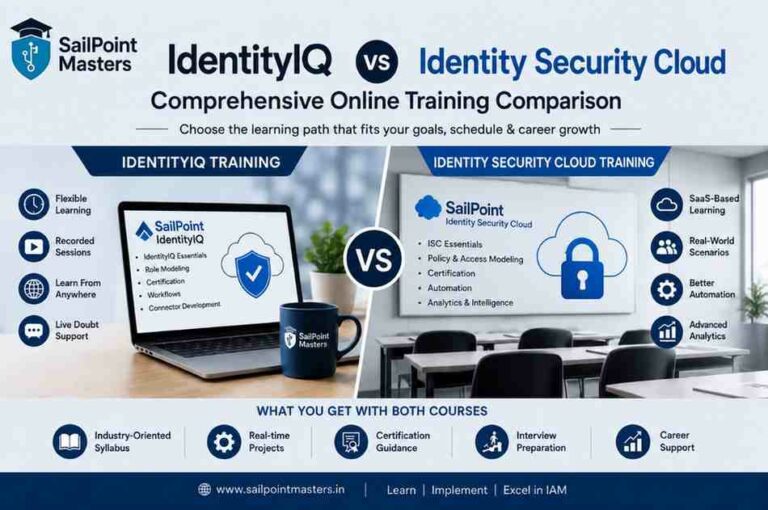
Choosing between SailPoint’s two flagship platforms is one of the most consequential decisions an identity team makes, which is exactly why IdentityIQ vs Identity Security Cloud has become a defining question for security architects, compliance leaders, and IAM engineers. Both platforms solve the same core problem — governing who has access to what, and proving it — but they take very different paths to get there. If you are building the skills to work with either platform, structured SailPoint Certification Training in Hyderabad gives you the hands-on grounding this comparison assumes.
SailPoint IdentityIQ (often shortened to IIQ) is a mature, on-premises identity governance and administration solution that organizations deploy and operate inside their own infrastructure. It is prized for depth: rule-based logic, a flexible object model, and the ability to model almost any governance process an enterprise can imagine. Identity Security Cloud (ISC) — formerly known as IdentityNow — is SailPoint’s cloud-native, multi-tenant SaaS platform. It delivers the same governance disciplines through a continuously updated service that SailPoint hosts, secures, and maintains on your behalf.
Organizations compare these two IAM platforms because the choice ripples across security posture, audit readiness, staffing, and total cost of ownership for years. Pick the platform that matches your architecture, compliance obligations, and growth trajectory, and identity governance becomes a business enabler. Pick the wrong one, and teams fight the tool instead of the threat. This guide breaks down every dimension that matters so you can decide with confidence.
IdentityIQ vs Identity Security Cloud
What is SailPoint IdentityIQ?
SailPoint IdentityIQ is an enterprise-grade Identity Governance and Administration (IGA) platform designed to run in your own data center or private cloud. Built on a Java foundation with a rich XML object model, IdentityIQ centralizes identity lifecycle management, access requests, certifications, and policy enforcement into a single governance layer that spans on-premises and cloud applications alike.
What sets IdentityIQ apart is customization. Governance logic is expressed through configurable rules, workflows, and connectors, letting engineers tailor provisioning, role modeling, and approval routing to even the most idiosyncratic business processes. This depth is why regulated enterprises with intricate legacy estates continue to standardize on IIQ. To understand how the pieces fit together, our guide to SailPoint IdentityIQ architecture walks through the core components in detail.
IdentityIQ also handles the unglamorous but critical work of pulling identity data from source systems. The aggregation process collects accounts and entitlements so the platform can build an accurate, correlated picture of who holds which access across the enterprise.
That Java underpinning leads many newcomers to ask whether you can learn SailPoint without Java knowledge — the short answer is yes, though basic scripting fluency makes rule work easier.
What is Identity Security Cloud?
Identity Security Cloud is SailPoint’s SaaS identity governance platform, delivered as a continuously updated cloud service on the vendor’s Atlas foundation. Because it is multi-tenant and cloud-native, ISC removes the burden of installing, patching, and scaling infrastructure — SailPoint operates the platform while your team focuses on governance outcomes rather than server maintenance.
ISC leans heavily on AI-powered identity security. Machine learning models surface access recommendations, flag outlier permissions, and streamline certification decisions so reviewers approve with evidence instead of guesswork. Provisioning, access requests, password management, and certifications all run through an intuitive interface designed for business users, not just administrators. Our overview of SailPoint Identity Security Cloud covers the module structure and capabilities more fully.
Because ISC evolved from IdentityNow, teams migrating or comparing terminology should note the rebrand. The underlying governance engine, connectors, and workflow model carry forward, though the cloud approach to automation differs from on-premises tooling — a nuance explored in our breakdown of the workflow differences between IdentityIQ and IdentityNow.
IdentityIQ vs Identity Security Cloud: Key Differences
The clearest way to frame IdentityIQ vs Identity Security Cloud is deployment philosophy. IdentityIQ is software you own and run; Identity Security Cloud is a service you subscribe to. That single distinction cascades into architecture, upgrade cadence, customization style, and cost structure.
IdentityIQ favors code-level extensibility — engineers write rules and workflows to shape behavior precisely. Identity Security Cloud favors configuration over code, using guided setup, transforms, and AI recommendations to accelerate delivery while reducing bespoke scripting. IIQ upgrades are planned projects you schedule; ISC updates arrive automatically and continuously, so you are always current without upgrade downtime.
Neither is universally “better.” IdentityIQ trades operational effort for near-limitless control, while Identity Security Cloud trades some deep customization for speed, simplicity, and hands-off maintenance.
IdentityIQ vs Identity Security Cloud Feature Comparison
The table below maps the two platforms across the dimensions that most influence platform selection. Use it as a scannable reference before diving into the deeper sections that follow.
|
Dimension |
SailPoint IdentityIQ |
Identity Security Cloud |
|
Deployment |
On-premises / self-hosted (IaaS) |
Cloud-native SaaS (vendor-hosted) |
|
Architecture |
Java-based, XML object model |
Multi-tenant Atlas cloud platform |
|
Scalability |
Scales with your infrastructure planning |
Elastic, managed by the vendor |
|
Customization |
Deep, code-level (rules and workflows) |
Configuration-first with guided setup |
|
Artificial Intelligence |
Available via add-on analytics |
Native AI-driven recommendations |
|
Automation |
Highly flexible, engineer-defined |
Streamlined, template-driven |
|
Compliance |
Point-in-time and scheduled campaigns |
Continuous, always-current governance |
|
Reporting |
Extensive custom reports |
Dashboards plus identity analytics |
|
Integration |
Broad direct and custom connectors |
SaaS connectivity plus virtual appliance |
|
User Experience |
Admin-centric, powerful |
Modern, business-user friendly |
|
Security |
You own hardening and patching |
Vendor-managed, continuously patched |
|
Maintenance |
Customer-managed upgrades |
Automatic, zero-downtime updates |
|
Licensing |
Perpetual or term, module-based |
Subscription, per-identity tiers |
|
Best Use Cases |
Complex, highly customized estates |
Cloud-first, fast time-to-value |
Deployment Models Explained
Deployment is where the two platforms diverge most visibly. IdentityIQ runs on infrastructure you control, which means you decide sizing, redundancy, and disaster recovery — powerful for organizations with strict data-residency or air-gap requirements, but demanding in operational effort. Identity Security Cloud shifts that responsibility to SailPoint, delivering governance as an always-on service.
Many enterprises operate in between, connecting cloud governance to on-premises systems through a virtual appliance. The deployment comparison table below clarifies which model fits which organization.
|
Model |
Advantages |
Limitations |
Ideal Organizations |
|
On-Premises |
Full control, data residency, deep customization |
Higher infrastructure and staffing cost |
Regulated enterprises, air-gapped environments |
|
Cloud (SaaS) |
Fast deployment, no infrastructure, continuous updates |
Less low-level customization |
Cloud-first and fast-growing organizations |
|
Hybrid |
Cloud governance reaching on-prem systems |
Requires connectivity components to manage |
Enterprises modernizing legacy estates |
Identity Governance and Administration (IGA) Capabilities
At their core, both platforms are IGA engines. Identity Governance and Administration unites two disciplines: administration (creating, updating, and removing access) and governance (making sure that access is appropriate, compliant, and continuously reviewed). Whether you deploy IIQ or ISC, you gain identity lifecycle management, access request management, certifications, and policy enforcement in one place.
The difference lies in delivery. IdentityIQ exposes granular controls that let engineers govern the most complex scenarios, while Identity Security Cloud abstracts much of that complexity behind AI-assisted defaults and a cleaner interface. For teams weighing SailPoint against other vendors, our SailPoint vs Saviynt comparison shows how these IGA capabilities stack up in the broader market.
AI-Driven Identity Security Features
Artificial intelligence is the clearest dividing line between the platforms today. Identity Security Cloud embeds AI-powered identity security natively:
it recommends access based on peer-group analysis, highlights risky or rarely used entitlements, and helps reviewers cut through the noise of large certification campaigns. This identity analytics layer turns raw access data into decisions.
IdentityIQ can deliver advanced analytics too, but historically through add-on capabilities rather than a built-in, continuously improving cloud model. For organizations pursuing identity-first security and Zero Trust, AI-driven recommendations reduce the manual toil that causes rubber-stamped approvals — a genuine security improvement, not just a convenience.
Provisioning and Lifecycle Management
Identity lifecycle management governs the full arc of an identity — joiner, mover, leaver — and both platforms automate it. When someone is hired, changes roles, or departs, the platform provisions or revokes access across connected systems automatically, closing the gaps that manual processes leave open.
IdentityIQ models these flows with configurable lifecycle events and provisioning policies, giving engineers precise control over birthright access and downstream fulfillment. Identity Security Cloud delivers the same outcomes through cloud rules and transforms with less bespoke code. Both approaches depend on strong role modeling; our guide to role-based access control in IdentityIQ explains how roles drive automated, consistent provisioning.
Access Certifications and Compliance
Access certifications — periodic reviews where managers confirm their people still need their access — are a compliance cornerstone, and both platforms run them well. The strategic difference is cadence. IdentityIQ typically executes scheduled certification campaigns, which produce strong point-in-time evidence for auditors.
Identity Security Cloud pushes toward continuous compliance, using event-driven micro-certifications and AI recommendations to keep access appropriate between formal campaigns. Both support segregation of duties (SoD) policy enforcement, ensuring no single identity holds a toxic combination of permissions that would enable fraud or error.
Role Management and Access Controls
Role-Based Access Control (RBAC) is the backbone of scalable governance. Instead of granting entitlements one by one, roles bundle access by job function so provisioning becomes predictable and reviewable. IdentityIQ offers sophisticated role modeling — business roles, IT roles, and role hierarchies — that mature organizations use to tame entitlement sprawl.
Identity Security Cloud provides an access model with AI assistance that helps discover and refine roles from real usage patterns, lowering the barrier to a clean RBAC foundation. Whichever platform you choose, disciplined role management is what keeps least-privilege achievable at enterprise scale.
Workflow Automation Comparison
Workflow automation orchestrates approvals, provisioning steps, and remediation. IdentityIQ uses a powerful, engineer-facing workflow engine backed by rules, giving teams end-to-end control over multi-step business logic. That flexibility is unmatched when processes are complex — and it is why IIQ workflows have such a strong following among developers.
Identity Security Cloud favors streamlined, configuration-driven automation that most teams can build without deep scripting. The trade-off is familiar: maximum flexibility in IIQ versus speed and simplicity in ISC. Teams deciding which platform to specialize in often review our guidance on which SailPoint module to learn before committing.
Reporting and Analytics
Governance is only as good as the visibility behind it. IdentityIQ ships extensive, customizable reporting that satisfies demanding audit and forensic needs. Identity Security Cloud complements standard reports with modern dashboards and identity analytics that surface risk trends and access anomalies in real time, aligning naturally with continuous governance.
Integration and Connector Support
Both platforms connect to a vast application ecosystem. IdentityIQ offers a large library of direct connectors plus the ability to build custom connectors for niche systems. Identity Security Cloud provides SaaS connectivity for cloud apps and reaches on-premises sources through a virtual appliance. To see connectivity in practice, review our connectors and integrations guide, and for enterprise resource planning environments, our walkthrough of integration with SAP and enterprise applications.
Scalability and Performance
Scalability behaves differently across the two models. With IdentityIQ, you scale by planning and provisioning infrastructure, which gives control but requires capacity forecasting. Identity Security Cloud scales elastically as a managed service, absorbing spikes in identities and certifications without you touching a server. For rapidly growing organizations, that elasticity is a decisive advantage.
Security and Compliance Standards
Security responsibility splits along deployment lines. In IdentityIQ, your team owns hardening, patching, and monitoring of the governance platform itself. In Identity Security Cloud, SailPoint maintains platform security, certifications, and continuous patching under a shared-responsibility model. Both platforms directly support Zero Trust identity strategies, where identity becomes the primary control plane — a principle formalized in the U.S. government’s NIST Zero Trust Architecture guidance.
Identity sitting at the centre of Zero Trust is a big reason SailPoint is a strong foundation for a cybersecurity career, whichever platform you specialize in.
Current Industry Insights and Demand
Cost models mirror the delivery models. IdentityIQ is typically licensed on a perpetual or term basis by module, with additional spend on infrastructure and the staff who run it. Identity Security Cloud uses subscription pricing, usually tiered by number of identities and modules, with infrastructure and maintenance folded into the fee.
|
Consideration |
SailPoint IdentityIQ |
Identity Security Cloud |
|
Pricing model |
Perpetual or term, module-based |
Subscription, per-identity tiers |
|
Infrastructure cost |
Customer-owned and budgeted separately |
Included in the subscription |
|
Upgrade cost |
Project-based upgrade effort |
Continuous updates at no extra charge |
|
Staffing overhead |
Higher (operations and administration) |
Lower (vendor-managed operations) |
|
Time to value |
Longer, project-driven rollout |
Faster, accelerated onboarding |
For official product details and current packaging, review the vendor’s SailPoint IdentityIQ product page and compare it against the cloud platform’s published pricing directly.
Advantages of IdentityIQ
IdentityIQ’s strengths cluster around control and depth. It offers unmatched customization for complex governance logic, full ownership of data and infrastructure for strict residency needs, a mature connector ecosystem, and battle-tested reliability in large regulated enterprises. For organizations whose processes cannot be squeezed into standardized templates, IIQ’s flexibility is the deciding factor.
Advantages of Identity Security Cloud
Identity Security Cloud’s advantages center on speed and simplicity: rapid deployment, native AI-driven insights, continuous compliance, automatic updates, lower infrastructure and staffing overhead, and a modern experience that business users actually adopt. For teams that want governance outcomes without operating a platform, ISC removes the friction. Technical builders can explore its extensibility through the SailPoint developer platform and reference the official SailPoint documentation for configuration guidance.
IdentityIQ vs Identity Security Cloud: Which One Should You Choose?
The honest answer depends on your architecture and priorities. Choose IdentityIQ when you need deep customization, on-premises control, or must satisfy strict data-residency mandates. Choose Identity Security Cloud when you want faster deployment, AI-driven governance, continuous compliance, and freedom from infrastructure management. The decision matrix below translates this into concrete recommendations by organization type.
|
Organization Type |
Recommended Platform |
Why |
|
Small Businesses |
Identity Security Cloud |
Low overhead, fast setup, no infrastructure |
|
Mid-Sized Companies |
Identity Security Cloud |
Scales easily with AI-assisted governance |
|
Large Enterprises |
Either (often IdentityIQ) |
Depends on customization and residency needs |
|
Government Organizations |
IdentityIQ |
Data residency and on-premises control |
|
Healthcare |
Either |
Compliance-heavy; ISC for speed, IIQ for control |
|
Banking & Financial Services |
IdentityIQ |
Complex, regulated, highly customized estates |
|
Manufacturing |
Identity Security Cloud |
Distributed workforce, cloud-first modernization |
|
Retail |
Identity Security Cloud |
Seasonal scaling and rapid onboarding |
Industries Using IdentityIQ and Identity Security Cloud
Both platforms serve every regulated and identity-intensive sector, though selection patterns emerge. Banking, insurance, and government frequently favor IdentityIQ for its control and customization. Technology firms, retailers, and modern healthcare providers increasingly adopt Identity Security Cloud for its cloud agility and continuous compliance. Manufacturing and energy organizations modernizing legacy systems often land on hybrid models that pair cloud governance with on-premises reach.
Market Insights: Where Identity Governance Is Heading
The macro trend favors cloud and AI. The identity governance and administration market was valued at roughly USD 7.95 billion in 2024 and is projected to reach about USD 27.11 billion by 2033, growing at a compound annual rate near 14.9% according to Grand View Research. That growth is fueled by cloud security adoption, digital transformation, and the mainstreaming of Zero Trust and identity-first security strategies. That demand feeds straight into compensation, as current SailPoint salary trends in Hyderabad make clear.
As enterprises consolidate identity as the new perimeter, demand for SaaS identity governance and AI-powered identity security continues to accelerate — momentum that pulls many organizations toward Identity Security Cloud while IdentityIQ retains its stronghold in deeply customized environments.
Why Identity Security Cloud Is Transforming Modern Identity Governance
Identity Security Cloud represents where the industry is heading, and its advantages are structural rather than cosmetic. Its cloud-native architecture eliminates the infrastructure that once slowed governance programs. AI-powered decision-making replaces guesswork in access reviews with evidence and recommendations. Continuous compliance keeps access appropriate every day, not just at audit time.
Add lower infrastructure costs, faster deployment measured in weeks rather than quarters, and simplified administration that frees skilled staff for higher-value work, and the appeal is clear. For a growing share of organizations, cloud-delivered governance is not merely an alternative to on-premises tooling — it is the new default. Foundational context on the vendor and its platforms is available in our primer, What is SailPoint, while practitioners compare real-world migration experiences in the SailPoint community.
Future of Identity Governance and Cloud Identity Security
The road ahead is defined by deeper automation, richer AI, and tighter alignment with Zero Trust. Expect identity analytics to move from reactive detection to predictive prevention, certifications to become increasingly continuous, and hybrid identity management to remain a practical reality as enterprises modernize at their own pace. SailPoint’s investment in its cloud platform signals that Identity Security Cloud will anchor its innovation, even as IdentityIQ continues to serve organizations that need on-premises depth. Whichever direction the market takes, skilled practitioners will remain in demand — and structured SailPoint training in Hyderabad is the fastest way to build that expertise.
If you are planning your own path, our SailPoint learning roadmap sequences the skills to build in order, and certified professionals can look ahead with our guide on what comes after SailPoint certification.
Key Takeaways
- Deployment defines the choice: IdentityIQ is self-hosted and customizable; Identity Security Cloud is SaaS, AI-driven, and vendor-managed.
- Customization vs. speed: Choose IIQ for deep, code-level control; choose ISC for rapid deployment and continuous updates.
- AI is the differentiator: Identity Security Cloud embeds AI-powered recommendations and identity analytics natively.
- Compliance cadence differs: IIQ excels at scheduled campaigns; ISC pushes toward continuous, always-current governance.
- Match the platform to your organization: Regulated, highly customized estates lean IIQ; cloud-first, fast-scaling teams lean ISC.
Conclusion
The IdentityIQ vs Identity Security Cloud decision is not about which platform is superior in the abstract — it is about which platform is superior for your security requirements, scalability goals, and long-term digital transformation strategy. IdentityIQ rewards organizations that need control and customization; Identity Security Cloud rewards those that value speed, AI, and freedom from infrastructure. Evaluate both against your real constraints, run a proof of concept where you can, and choose the platform your team can operate with confidence. If you want to master either platform with expert, hands-on guidance, SailPoint Masters can help you build career-ready identity governance skills.
FAQ
-
What is the main difference between IdentityIQ and Identity Security Cloud?
IdentityIQ is an on-premises, highly customizable identity governance platform you host and manage yourself, while Identity Security Cloud is a SaaS, AI-driven platform that SailPoint hosts and maintains. The core difference is control and customization versus speed and convenience.
-
Is Identity Security Cloud the same as IdentityNow?
Yes. Identity Security Cloud is the current name for the platform formerly known as IdentityNow. SailPoint rebranded it, but the cloud-native governance engine, connectors, and SaaS delivery model carry forward under the Atlas platform.
-
Which is better, IdentityIQ or Identity Security Cloud?
Neither is universally better. IdentityIQ is better for complex, highly customized, on-premises environments, while Identity Security Cloud is better for cloud-first organizations that want faster deployment, native AI, and continuous compliance without managing infrastructure.
-
Can IdentityIQ and Identity Security Cloud manage on-premises applications?
Both can. IdentityIQ connects to on-premises systems natively, and Identity Security Cloud reaches on-premises sources through a virtual appliance, enabling hybrid identity management that governs cloud and legacy applications together.
-
Does Identity Security Cloud use artificial intelligence?
Yes. Identity Security Cloud embeds AI-powered identity security natively, offering access recommendations, outlier detection, and identity analytics that streamline certifications and reduce rubber-stamped approvals across large access campaigns.
-
Is IdentityIQ being discontinued in favor of the cloud?
No. SailPoint continues to support and sell IdentityIQ for organizations that need on-premises control and deep customization, while investing heavily in Identity Security Cloud as its cloud-first platform for future innovation.
-
How does pricing compare between the two platforms?
IdentityIQ typically uses perpetual or term licensing by module, with separate infrastructure and staffing costs. Identity Security Cloud uses subscription pricing tiered by identities and modules, with infrastructure and maintenance included in the fee.
-
Which platform is better for regulated industries like banking?
Banking and financial services often favor IdentityIQ for its deep customization, on-premises control, and strong point-in-time compliance evidence, though many regulated firms also adopt Identity Security Cloud for its continuous compliance and lower overhead.
-
Do both platforms support Zero Trust security?
Yes. Both IdentityIQ and Identity Security Cloud support Zero Trust identity strategies by making identity the primary control plane, enforcing least privilege, and continuously validating access in line with modern identity-first security models.
-
Which SailPoint platform should I learn for my career?
Learning both is ideal, but Identity Security Cloud skills are increasingly in demand as organizations move to SaaS governance, while IdentityIQ expertise remains valuable in large regulated enterprises. Structured training helps you build hands-on skills in either platform. To prepare, work through the SailPoint IIQ curriculum, our IIQ exam preparation guide, and common SailPoint interview questions and answers.
SailPoint Trainer
SailPoint Masters Editorial Team | 15+ Articles Published
We specialize in SailPoint Certification Training in Hyderabad, helping aspiring professionals and IT experts develop in-demand Identity and Access Management (IAM) skills. Our training covers SailPoint IdentityIQ, Identity Security Cloud, certification preparation, real-world projects, and career guidance to support success in cybersecurity and identity governance careers.
Share