
Difference Between SailPoint Engineer and Administrator Certification: Roles, Skills, Salary and Career Paths in India
The difference between SailPoint Engineer and Administrator certification comes down to depth of work. The Engineer track validates implementing, customizing and integrating SailPoint platforms using workflows, rules and APIs, while the Administrator track validates running and governing an identity security platform day to day. Engineer suits coders; Administrator suits operations-focused IAM professionals.
★★★★★
4.9/5 rated by 1329+ students · Google Verified
Table of Contents
Introduction
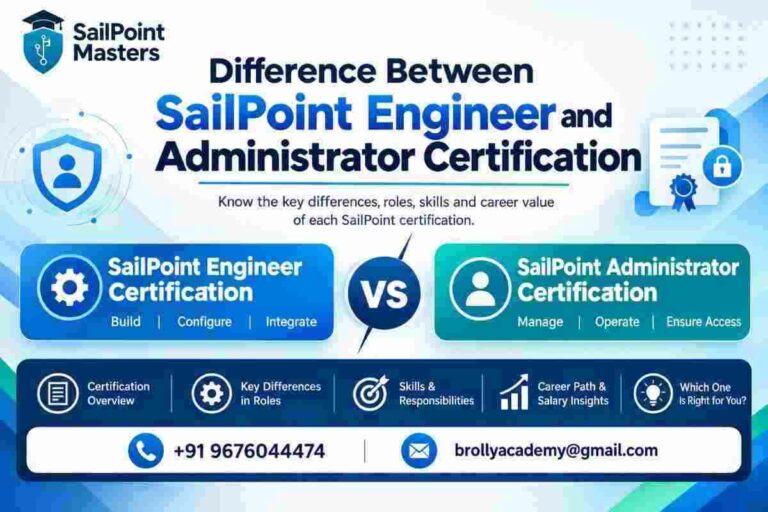
If you are exploring Identity and Access Management (IAM), you will soon notice two job titles that look similar but are not: SailPoint Engineer and SailPoint Administrator. Understanding the difference between SailPoint Engineer and Administrator certification helps you pick the right learning path before you spend months on the wrong one.
A SailPoint Engineer builds. They onboard applications, design workflows, write rules, connect systems through APIs and troubleshoot what breaks. A SailPoint Administrator runs. They keep the platform healthy, manage identities and access requests, run access certifications and handle day-to-day operations.
Why does this matter now? SailPoint itself has said that identity security talent is scarce, and that organizations are investing in certifications to validate skills. SailPoint announced a recertification program and a new Identity Security Administrator certification in February 2026 to address the cybersecurity skills gap. For learners in India, that points to a market where employers value people who can prove both knowledge and hands-on ability.
This guide explains both roles, both certification directions, the skills behind each, indicative salaries and realistic career paths in India. Certification requirements and product features change, so always confirm current details on SailPoint’s official certification page before you register.
Difference Between SailPoint Engineer and Administrator Certification
What Is a SailPoint Engineer?
Short answer: A SailPoint Engineer implements, customizes and integrates SailPoint platforms. The role centers on configuring identity governance, writing code where out-of-the-box features fall short, and fixing complex provisioning or integration failures.
Typical responsibilities include
- Implementation: Setting up IdentityIQ or Identity Security Cloud for a new client or business unit.
- Integrations: Onboarding applications, sources and connectors, including Active Directory, LDAP, databases and SaaS apps.
- Customization: Writing rules and workflows to handle approval logic, joiner-mover-leaver events and special provisioning cases.
- APIs and automation: Using REST APIs to automate tasks and connect SailPoint with ITSM, HR and other systems.
- Troubleshooting: Reading logs, tracing failed aggregations, and debugging provisioning errors.
- Identity lifecycle management: Designing how identities are created, changed and removed as people join, move and leave.
Practical example: HR sends a new joiner record. The engineer ensures the identity is created, birthright access is assigned, an Active Directory account is provisioned, and a manager approval workflow triggers for extra access. When one step fails at 2 a.m., the engineer finds out why.
What Is a SailPoint Administrator?
Short answer: A SailPoint Administrator operates and governs an existing SailPoint deployment. They manage identities and access requests, run access reviews, maintain source configurations, monitor health and provide operational support.
Core responsibilities include
- Platform administration: Managing configuration, schedules and system health.
- User and identity management: Resolving identity correlation issues and handling data quality problems.
- Access reviews and certifications: Launching campaigns, following up with reviewers and closing them on time for audit.
- Application/source configuration: Adjusting settings for onboarded sources using established patterns.
- Monitoring and troubleshooting: Checking aggregation and provisioning results and escalating issues that need engineering.
- Operational support: Answering access request queries and supporting audits.
Practical example: Before an audit deadline, the administrator launches a quarterly access certification for finance applications, tracks reviewer progress, and reports completion status to compliance.
Difference Between SailPoint Engineer and Administrator Certification
Short answer: Engineer certification validates your ability to build and extend the platform. Administrator certification validates your ability to operate and govern it. Engineer exams lean toward configuration depth, rules and workflows; Administrator exams lean toward platform management, lifecycle, access and governance.
The current certification landscape matters here. SailPoint’s certification listing shows an Identity Security Administrator exam requiring six months of industry experience, an Identity Security Engineer exam and an IdentityIQ Engineer exam each requiring one to three years, and an IdentityIQ Associate exam. The same listing says these exams are available to current SailPoint customers and partners. sailpoint
Two things follow from this
- The Administrator certification sits on the cloud side. The Identity Security Administrator exam validates administrator expertise in cloud-based identity security, covering platform management, virtual appliances, identity and lifecycle management, provisioning, access management and governance. sailpoint
- IdentityIQ is covered by Associate and Engineer exams. In the listing reviewed, there was no separate “IdentityIQ Administrator” exam. Check the official page for changes.
|
Certification |
Platform |
Experience listed |
Best suited for |
|
Identity Security Administrator |
Identity Security Cloud |
6 months |
Operations, governance, platform administration |
|
Identity Security Engineer |
Identity Security Cloud |
1–3 years |
Implementation, integrations, customization |
|
IdentityIQ Associate |
IdentityIQ |
Not listed |
Foundational IdentityIQ knowledge |
|
IdentityIQ Engineer |
IdentityIQ |
1–3 years |
Implementation, rules, workflows |
Because eligibility depends on being a SailPoint customer or partner, many learners in India reach these exams through an employer or partner organization. Verify this before planning your timeline.
SailPoint Engineer vs Administrator: Key Differences
Short answer: Engineers create and change how SailPoint behaves; administrators run and govern what has been built. Engineers code more, integrate more and debug deeper. Administrators handle operations, access governance and stakeholder coordination.
- Primary responsibilities: Build and extend vs. operate and govern.
- Technical skills: Java, BeanShell, XML, SQL, APIs vs. platform navigation, reporting and light scripting.
- Coding requirements: Significant for engineers; minimal to moderate for administrators.
- Platform configuration: Engineers design it; administrators maintain it.
- Integrations: Engineers build them; administrators monitor and adjust them.
- Identity lifecycle management: Engineers design lifecycle logic; administrators keep it running.
- Troubleshooting: Engineers resolve root causes in code and configuration; administrators triage and resolve operational issues.
- Automation: Engineers write it; administrators use it.
- Career focus: Implementation, architecture and consulting vs. operations, governance and support leadership.
- Typical experience: Engineer exams list 1–3 years; the Administrator exam lists 6 months.
The full side-by-side table appears in the Comparison Tables section below.
SailPoint IdentityIQ and Identity Security Cloud
IdentityIQ is SailPoint’s self-managed governance platform, built for deep customization with rules and workflows. Identity Security Cloud (ISC) is the SaaS platform, configured mostly through sources, transforms and APIs. Engineers usually go deeper on IdentityIQ code or ISC integrations; administrators focus on running governance on either. Read our Identity Security Cloud guide, the IdentityIQ architecture guide and the IdentityIQ vs IdentityNow workflows comparison for the full breakdown.
Skills Required for a SailPoint Engineer
- IAM fundamentals: Authentication, authorization, least privilege, RBAC and lifecycle concepts.
- SailPoint IdentityIQ and Identity Security Cloud: Product architecture and configuration.
- Java: IdentityIQ is Java-based, and understanding its object model helps.
- BeanShell: Used for rules in IdentityIQ.
- XML: IdentityIQ configuration objects are stored and exported as XML.
- SQL: For data analysis, JDBC sources and reporting.
- REST APIs: Central to ISC automation and integrations.
- Workflows, rules and transforms: Business logic implementation.
- Integrations and provisioning: Connectors, Active Directory, LDAP, databases and SaaS applications.
- Debugging: Logs, task results and structured problem-solving.
Skills Required for a SailPoint Administrator
- Identity administration: Correlation, identity attributes and data quality.
- Application/source configuration: Managing settings and schedules.
- Access requests and certifications: Running approvals and review campaigns.
- User lifecycle management: Understanding joiner, mover and leaver processes.
- Provisioning: Monitoring outcomes and fixing common failures.
- Troubleshooting: Triage and escalation.
- Identity governance concepts: Segregation of duties, policy and audit requirements.
- Platform administration: Health checks, virtual appliances (in ISC), scheduled tasks.
- Reporting: Producing compliance and operational reports.
- Basic scripting and technical knowledge: SQL basics, log reading and API familiarity.
SailPoint Engineer vs Administrator Certification Requirements
Short answer: Both directions need IAM fundamentals and hands-on platform practice. Engineers additionally need coding and integration depth. Certification supports your profile, but it does not replace project experience.
What to understand before you start:
- Prerequisites: SailPoint’s listing recommends training path completion and shows experience requirements of six months for the Administrator exam and one to three years for the Engineer exams. Also confirm the customer or partner access rule. sailpoint
- IAM fundamentals: Know the difference between authentication and authorization, and understand governance and audit.
- Platform experience: Use a lab or sandbox, or real work exposure, to see how sources, identity profiles and workflows behave.
- Hands-on projects: Onboard a source, build a joiner workflow, run a certification campaign.
- Exam preparation: Use official training and documentation first. Community members who have taken the IdentityIQ Engineer exam say practical questions matter, so lab practice is essential. Be cautious with “dump” sites; they are not a substitute for understanding.
- What employers look for: Real scenarios, troubleshooting stories and clear explanations of what you built.
SailPoint Engineer Career Opportunities and SailPoint Administrator Career Opportunities in India
Engineer-track roles include SailPoint Developer, Implementation Consultant, Integration Engineer and IAM Technical Consultant. Administrator-track roles include SailPoint Administrator, IAM Operations Analyst and Support Engineer. Industry and employer details are covered in our SailPoint careers guide.
SailPoint Engineer vs Administrator: Which Skills Should You Learn?
Neither path is universally better. Choose based on what you enjoy.
- If you like coding, integration and problem-solving, explore engineering and development-oriented roles.
- If you like operations, governance, audits and access management, explore administrator-oriented roles.
- If you are unsure, start with IAM fundamentals and basic platform administration. That foundation supports either direction.
Industries Hiring SailPoint Professionals in India
IGA needs exist wherever many users, many applications and regulatory pressure meet
- IT services and consulting
- Banking and financial services
- Insurance
- Healthcare
- Telecom
- Retail
- Manufacturing
- Technology companies
- Global enterprises with India-based capability centres
Companies Hiring SailPoint and IAM Professionals
Three types of organizations typically recruit
- Global system integrators and IT services firms that run IAM practices for clients.
- IAM-focused consultancies and product partners that implement SailPoint.
- Enterprises and global capability centres that operate identity programs in-house.
General industry demand and current job listings are different things. Listings change daily, so check live boards such as LinkedIn and Naukri before drawing conclusions about any specific company.
Why SailPoint Is Relevant to the IAM Career Market in India
- Identity security pressure: Verizon’s 2026 Data Breach Investigations Report found vulnerability exploitation (31%) overtook stolen credentials as the top breach entry point for the first time. Credentials still matter, though: the report shows credentials appeared as compromised data in 28% of breaches. Read the full DBIR for context on its global scope. VerizonDescope
- Compliance needs: Audits require evidence of who has access and why.
- Enterprise access governance: Large user populations need automation.
- Lifecycle automation: Fewer manual tickets and faster onboarding.
- Cloud and hybrid IT: Access spans on-premises and SaaS systems.
Certifications That Can Support a SailPoint Career
Relevant pathways, based on SailPoint’s current listing, are Identity Security Administrator, Identity Security Engineer, IdentityIQ Associate and IdentityIQ Engineer. Use the SailPoint University IdentityIQ Engineer path for preparation.
Certification works best when it complements
- Hands-on projects you can describe in interviews
- IAM knowledge across governance and access concepts
- Platform experience in real or lab environments
- Technical skills like SQL, scripting and APIs
- Interview preparation built on real scenarios
Certification alone does not guarantee employment. SailPoint’s recertification program extends certifications for two more years for those who passed the Identity Security Engineer, IdentityIQ Engineer or Identity Security Administrator exams, which shows that keeping skills current matters. barchart
Future Scope of SailPoint Engineering and Administration in India
- Cloud identity security and Identity Security Cloud: More organizations are moving governance to SaaS.
- AI-assisted identity operations: Expect help with access recommendations and anomaly spotting; human judgement still matters.
- Automation and API-driven integrations: Engineers who script and integrate become more valuable.
- Machine identities: Palo Alto Networks states that machine identities now outnumber human identities by more than 80 to 1. Treat this as a vendor claim, but the direction is clear. cxotoday
- Privileged access and identity convergence: Palo Alto Networks completed its acquisition of CyberArk, and CyberArk remains available as a standalone offering. IGA and PAM skills are increasingly discussed together. crnasia
- Zero Trust: NIST SP 800-207 frames identity as central to access decisions.
How to Start a SailPoint Career in India
Start with IAM fundamentals and identity lifecycle concepts. Then pick IdentityIQ, Identity Security Cloud or both, and practise in a lab. Add a project, prepare for the exam, and apply. Our SailPoint course for beginners covers the full path.
Comparison Tables
SailPoint Engineer vs Administrator: Full Comparison
|
Factor |
SailPoint Engineer |
SailPoint Administrator |
|
Main Focus |
Build, customize, integrate |
Operate, govern, support |
|
Daily Responsibilities |
Development, integration design, debugging |
Access requests, campaigns, monitoring, reports |
|
Coding Requirement |
Significant (Java, BeanShell, XML, SQL, APIs) |
Low to moderate (SQL, scripting basics) |
|
IAM Knowledge |
Deep, design-level |
Strong, governance and operations-level |
|
IdentityIQ Skills |
Rules, workflows, tasks, XML objects |
Console navigation, tasks, certifications |
|
Identity Security Cloud Skills |
Sources, transforms, workflows, APIs |
Platform management, virtual appliances, governance |
|
Integrations |
Designs and builds |
Monitors and adjusts |
|
Provisioning |
Designs logic and fixes complex failures |
Monitors and resolves common failures |
|
Troubleshooting |
Root-cause analysis |
Triage and escalation |
|
Automation |
Creates automation |
Uses and maintains automation |
|
Typical Career Path |
Engineer → Senior → Architect/Lead |
Administrator → Senior Admin → IAM Operations Lead |
|
Certification Focus |
Identity Security Engineer, IdentityIQ Engineer |
Identity Security Administrator |
Related Career Comparisons
|
Comparison |
Key distinction |
|
SailPoint Engineer vs IAM Engineer |
SailPoint Engineer is product-specific. IAM Engineer is broader and may span several IAM tools. |
|
SailPoint Engineer vs SailPoint Developer |
Titles overlap. “Developer” stresses coding; “Engineer” often includes implementation and integration design too. |
|
SailPoint Administrator vs IAM Administrator |
Similar operational work. IAM Administrator may cover directories, SSO or MFA tools beyond SailPoint. |
|
SailPoint vs CyberArk careers |
SailPoint centers on identity governance; CyberArk centers on privileged access management. See our CyberArk training and CyberArk jobs pages. |
|
SailPoint vs Microsoft Entra ID Governance |
Entra ID Governance fits Microsoft-centric environments. SailPoint is positioned for broad, multi-vendor governance. Skills transfer between them. |
Career Roadmaps
Career Path for a SailPoint Engineer
|
Stage |
Focus |
|
Beginner |
IAM fundamentals and SailPoint basics |
|
Intermediate |
IdentityIQ/ISC configuration and integrations |
|
Advanced |
Development, customization, APIs and automation |
|
Expert |
Architecture, implementation leadership and IAM strategy |
Career Path for a SailPoint Administrator
|
Stage |
Focus |
|
Foundation |
IAM fundamentals |
|
Early |
SailPoint administration and identity lifecycle management |
|
Intermediate |
Access governance, certification campaigns and troubleshooting |
|
Advanced |
Advanced platform administration and certification |
|
Leadership |
IAM operations leadership and governance program ownership |
Salary Information
Salary depends on experience, location, employer and project complexity. Development-heavy engineer roles often pay more than operations-focused administrator roles at the same experience level. See our SailPoint careers guide for ranges by experience and our Hyderabad salary guide for city-level figures.
Key Takeaways
- Engineers build, customize and integrate SailPoint; administrators operate and govern it.
- SailPoint’s Administrator exam sits on the Identity Security Cloud side, while IdentityIQ is covered by Associate and Engineer exams.
- Engineers need coding and integration depth; administrators need governance, operations and troubleshooting strength.
- Salary figures are indicative and vary widely by experience, employer and specialization.
- Certification supports, but never replaces, hands-on IAM experience.
Conclusion
The difference between SailPoint Engineer and Administrator certification is really a difference in the kind of work you want to do. Engineer certification points toward implementation, customization and integrations. Administrator certification points toward platform operations, access governance and audit support. Both are valuable, and neither is universally better.
What matters most is pairing a credential with real practice: onboarding a source, building a workflow, running an access review, fixing a failed provisioning task. Employers hire people who can explain what they built and how they solved problems, not just people who passed an exam.
Choose the path that matches your interests, build your IAM foundation, and start with hands-on labs. Ready to begin? Explore our SailPoint Identity Access Management guide and take your first step into SailPoint and Identity Governance today.
FAQ
- What is the difference between a SailPoint Engineer and Administrator?
A SailPoint Engineer implements, customizes and integrates the platform using workflows, rules and APIs. An Administrator operates and governs it day to day, handling access requests, certifications and support. Engineers code more; administrators focus on operations and governance. - Is SailPoint certification useful for an IAM career?
Yes, as a supporting credential. It validates platform knowledge and signals commitment. It works best alongside hands-on project experience and IAM fundamentals. It does not guarantee a job on its own, and employers still test practical skills in interviews. - What does a SailPoint Engineer do?
A SailPoint Engineer implements SailPoint solutions, onboards applications, writes rules and workflows, builds API integrations and troubleshoots provisioning problems. They design how identity lifecycle processes work across systems such as Active Directory, LDAP, databases and SaaS applications. - What does a SailPoint Administrator do?
A SailPoint Administrator manages the platform’s daily operation. They handle identity data quality, access requests, access certification campaigns, source settings, monitoring, reporting and user support, and escalate complex issues to engineers. - Does a SailPoint Engineer need coding skills?
Yes. Engineers typically need Java, BeanShell, XML, SQL and REST API skills, especially on IdentityIQ. Identity Security Cloud work relies more on transforms, workflows and APIs, but scripting and debugging ability remain important. - Does a SailPoint Administrator need programming knowledge?
Deep programming is usually not required. Administrators benefit from SQL basics, log reading, light scripting and API familiarity. Strong IAM concepts, governance understanding and troubleshooting discipline matter more. - Which SailPoint certification should beginners consider?
Beginners can look at foundational options such as IdentityIQ Associate, or the Identity Security Administrator exam once they have around six months of experience. Verify eligibility, since exams may be limited to SailPoint customers and partners. - What skills are required for SailPoint jobs in India?
Engineer roles typically need IAM fundamentals, SQL, Java, BeanShell, XML and REST APIs. Administrator roles lean on IAM concepts, governance, troubleshooting and light scripting. See the SailPoint careers guide for the full skills list. - What is the salary of a SailPoint Engineer in India?
Pay varies widely by experience, employer and platform skills. Development-heavy engineer roles usually sit above operations roles at the same level. See our SailPoint careers guide for current ranges. - Can a SailPoint Administrator become a SailPoint Engineer?
Yes. Many professionals move from administration into engineering by adding SQL, scripting, Java or API skills and working on integrations. Hands-on project exposure and, where eligible, an Engineer certification makes the move easier.
SailPoint Trainer
SailPoint Masters Editorial Team | 15+ Articles Published
We specialize in SailPoint Certification Training in Hyderabad, helping aspiring professionals and IT experts develop in-demand Identity and Access Management (IAM) skills. Our training covers SailPoint IdentityIQ, Identity Security Cloud, certification preparation, real-world projects, and career guidance to support success in cybersecurity and identity governance careers.
Share