
SailPoint vs Okta: Full IAM Comparison
SailPoint vs Okta comes down to focus: SailPoint leads in identity governance, access certification, and compliance depth for large, regulated enterprises. Okta leads in single sign-on, authentication, and fast cloud deployment across mid-market and enterprise workforces. Many organizations run both together rather than choosing one.
★★★★★
4.9/5 rated by 1329+ students · Google Verified
Table of Contents
Introduction
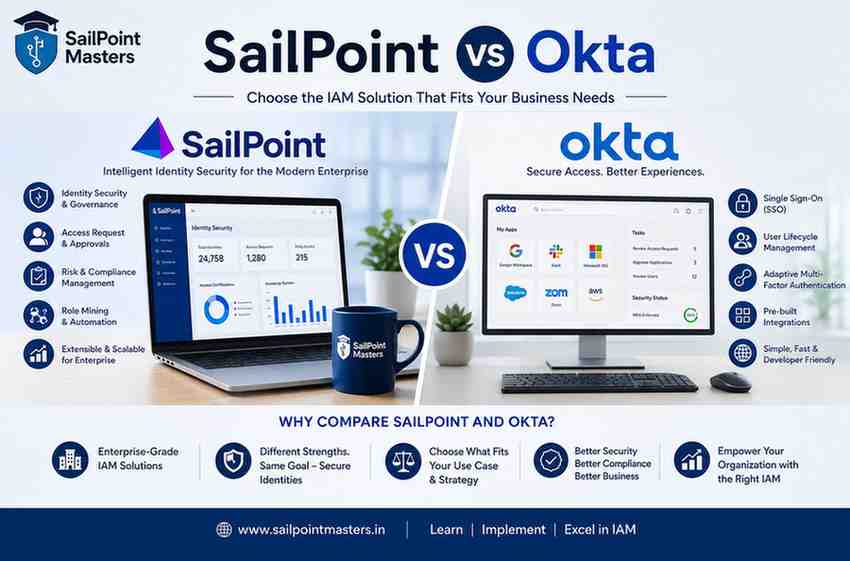
Every enterprise security conversation eventually arrives at the same question: who should have access to what, and how do you prove it? That question is why the SailPoint vs Okta comparison keeps coming up in IT strategy meetings, RFPs, and Gartner Peer Insights threads.
SailPoint and Okta are both Identity and Access Management (IAM) platforms, but they were built to solve different halves of the identity problem. SailPoint grew out of identity governance — the discipline of tracking who has access to what, why they have it, and whether that access is still appropriate. Okta grew out of authentication and access management — getting the right person logged into the right application quickly, securely, and with minimal friction.
Organizations compare these two platforms because the stakes of getting identity wrong keep climbing. By 2026, identity and access management has moved beyond a simple toolkit of multi-factor authentication and single sign-on into a structured, governance-driven discipline built around visibility, lifecycle control, and continuous monitoring. Choosing the wrong platform — or assuming one tool can do the job of both — can leave compliance gaps, slow down audits, or create friction for employees trying to get their work done. Choosing well strengthens security posture, keeps auditors satisfied, and supports growth without adding operational drag.
This guide breaks down what each platform actually does, where they overlap, where they diverge, and how to decide which one (or which combination) fits your organization. And if you’re reading this as someone building a career in IAM rather than buying for an enterprise, understanding both platforms side by side is exactly the kind of practical knowledge that sets job-ready SailPoint professionals apart.
SailPoint vs Okta
What is SailPoint?
Every large organization runs on access — thousands of employees, contractors, and systems all touching data they may or may not be authorized to see. SailPoint is the identity governance platform that keeps that access under control, making sure permissions match actual need rather than piling up unchecked over time.
Two products anchor the platform: IdentityIQ, built for organizations running complex, often on-premises infrastructure that needs deep customization, and Identity Security Cloud, a SaaS offering designed for teams that want faster deployment and built-in AI recommendations without managing servers themselves.
Rather than treating access as a one-time setup, SailPoint treats it as something that needs constant upkeep. It pulls identity data from HR systems, directories, and business applications, then runs that data through rules and role definitions to decide who should have what. When someone changes teams, needs temporary access, or leaves the company, the platform handles the request, approval, and eventual removal automatically — no manual chasing required.
What sets SailPoint apart is the paper trail it leaves behind. Every access decision gets logged with who approved it and when, which matters heavily to industries like finance and healthcare that face routine audits and strict data-handling rules. This kind of governance discipline aligns closely with established identity and access management frameworks used to prevent unauthorized access and privilege misuse.
For a closer look at how the two core products differ and which one fits your learning path better, check out our comparison of IdentityIQ and IdentityNow.
What is Okta?
Okta is a cloud-native identity and access management platform built around Workforce Identity Cloud and Customer Identity Cloud. Its core strengths are single sign-on (SSO), multi-factor authentication (MFA), and adaptive access policies that connect employees, partners, and customers to thousands of applications with minimal friction.
Okta is known for strong single sign-on, multi-factor authentication, and secure user lifecycle management, backed by thousands of pre-built integrations. Rather than focusing primarily on governance depth, Okta focuses on making authentication fast, contextual, and secure — verifying a user’s identity in real time based on device, location, network, and behavior signals, then granting or denying access accordingly.
Okta also offers its own governance layer (Okta Identity Governance), which has narrowed the gap with SailPoint for organizations whose access-review needs aren’t extremely complex.
SailPoint vs Okta: Key Differences
|
Dimension |
SailPoint |
Okta |
|
Core discipline |
Identity Governance and Administration (IGA) |
Identity and Access Management (IAM) / SSO |
|
Primary strength |
Access certification, audit trails, compliance |
Authentication, lifecycle simplicity, integrations |
|
Best fit |
Large, regulated enterprises |
Cloud-first mid-market and enterprise |
|
Deployment complexity |
Higher; longer time to full maturity |
Lower; faster initial rollout |
Feature Comparison: SailPoint vs Okta
|
Feature |
SailPoint |
Okta |
|
Primary Focus |
Identity governance & compliance |
Access management & authentication |
|
Identity Governance |
Deep, native |
Available via Okta Identity Governance, lighter-weight |
|
Access Management |
Supported |
Core strength |
|
SSO |
Basic |
Advanced, extensive app catalog |
|
MFA |
Supported |
Advanced, adaptive risk-based MFA |
|
User Provisioning |
Strong, policy-driven |
Strong, fast, SCIM-based |
|
Access Certification |
Deep, auditable, best-in-class |
Basic to moderate |
|
Role Management |
Advanced role mining and modeling |
Basic role assignment |
|
AI Capabilities |
AI-driven access recommendations, anomaly detection |
AI-driven risk scoring, adaptive authentication |
|
Compliance Features |
Extensive (SOX, HIPAA, GDPR, etc.) |
Moderate, improving |
|
Deployment Models |
Cloud, on-premises, hybrid |
Cloud-native |
|
Integrations |
Strong connector library for governance |
7,000+ pre-built integrations |
|
Scalability |
Built for large, complex enterprises |
Scales well across company sizes |
|
Ideal Customers |
Regulated, large enterprises |
Cloud-first organizations of many sizes |
Identity Governance vs Identity and Access Management
6Identity Governance and Administration (IGA) and Identity and Access Management (IAM) are related but distinct disciplines, and understanding the difference explains why SailPoint and Okta feel so different in practice.
IAM answers “can this user get in?” It covers authentication, single sign-on, and the mechanics of connecting a verified user to an application. IGA answers a slower, deeper question: “should this user have this access, and can we prove that decision was correct?” It covers certification campaigns, segregation-of-duties policies, and audit-ready reporting.
Okta is built IAM-first with governance features layered on top. SailPoint is built IGA-first, with strong provisioning and access-management capability supporting it. Neither framing is wrong — they’re just different starting points.
User Lifecycle Management Comparison
Both platforms manage the identity lifecycle — onboarding, role changes, and offboarding — but with different emphasis.
Okta’s lifecycle management is optimized for speed: new hires are provisioned into their required applications almost immediately after an HR trigger, and departures are de-provisioned quickly to close security gaps. SailPoint’s lifecycle management is optimized for accuracy and auditability: every provisioning event is tied to a policy, a role, and a record that governance teams can reference later.
Access Certification and Compliance Comparison
This is where SailPoint has historically had the clearest lead. SailPoint keeps the approval chain intact, so reviewers can walk backward through a decision, which gives auditors confidence. Large-scale certification campaigns — where managers periodically re-approve every entitlement their team holds — are a core SailPoint workflow.
Okta can list assignments and roles and supports its own certification campaigns through Okta Identity Governance, but very large certification programs may require the deeper governance capability that SailPoint provides.
Provisioning and Automation Capabilities
Both platforms automate provisioning, but the automation logic differs. SailPoint ties provisioning to governance policy — access is granted because a role or certification approved it. Okta ties provisioning to workflow speed and integration breadth — access is granted because a directory trigger or workflow rule is fired, often across a very wide app catalog.
Security Features Comparison
Okta’s security model centers on adaptive, risk-based authentication: contextual signals like device trust, location, and behavior feed into real-time access decisions. SailPoint’s security model centers on least-privilege enforcement over time: continuously identifying excess or stale access before it becomes a risk. Together, they cover both the front door (authentication) and the ongoing question of who still needs a key.
AI and Identity Intelligence Features
Both vendors have invested heavily in AI. SailPoint uses machine learning for role mining, anomaly detection in entitlements, and recommending whether an access request or certification decision should be approved. Okta uses AI primarily for adaptive risk scoring during authentication and for identifying anomalous sign-in behavior.
Industry-wide, AI-driven identity governance is becoming standard as manual access reviews and static role-based access control models show their age. Both platforms are racing to reduce the manual burden of access decisions with automation and machine learning.
Integration and Connector Ecosystem
Okta’s catalog is one of its most cited advantages — a network of more than 7,000 pre-built integrations makes connecting new SaaS applications comparatively fast. SailPoint’s connector ecosystem is smaller in raw count but built for governance depth: connectors are designed to pull rich entitlement data (not just login events) so certification campaigns and role models stay accurate.
Deployment Options (Cloud vs On-Premises)
Okta is cloud-native by design; there is no significant on-premises deployment path. SailPoint offers more flexibility: Identity Security Cloud for cloud-first organizations, and IdentityIQ for enterprises that need on-premises or hybrid deployment due to legacy systems, data residency requirements, or long migration timelines.
For a deeper technical breakdown of how the two SailPoint platforms differ under the hood, see our guide on the difference between IdentityIQ and IdentityNow workflows.
Scalability for Large Enterprises
Okta suits mid-market and enterprise organizations well, while SailPoint’s core target audience is large enterprise deployments with complex governance needs. Regulated enterprises with thousands of employees, a dedicated IAM team, and complex legacy systems are the clearest fit for SailPoint’s governance depth, role mining, and broad connector library — though that depth typically comes with a longer implementation timeline.
Pricing and Licensing Overview
Pricing for both platforms is quote-based and varies by module, user count, and deployment scope, so exact numbers require a vendor conversation. As a general pattern, Okta’s core workforce identity pricing is often discussed in the range of a few dollars per user per month for foundational SSO and MFA, scaling up with adaptive security add-ons. SailPoint’s governance platform is typically positioned as a larger, project-based enterprise investment, with implementation and professional services often representing a significant share of first-year cost — enterprise SailPoint deployments are commonly budgeted in the hundreds of thousands of dollars for year one, with a 12-month-plus path to full maturity.
Always request current, itemized quotes from both vendors — public estimates change frequently and depend heavily on your specific module mix.
SailPoint vs Okta for Different Business Sizes
- Small businesses: Okta’s lighter footprint and faster setup usually win; full SailPoint governance is often more than a small team needs.
- Mid-sized organizations: Okta remains a strong default; SailPoint becomes relevant once compliance obligations grow.
- Large enterprises: Both are common, often together — Okta for access, SailPoint for governance.
Which Industries Prefer SailPoint or Okta?
Heavily regulated industries — banking, insurance, healthcare, and government — tend to lean on SailPoint because of its audit-ready certification and compliance reporting. Technology, retail, and other cloud-first industries with large SaaS footprints often lean on Okta for its speed of integration and authentication experience. Manufacturing and other hybrid-infrastructure industries frequently need both: Okta for workforce access, SailPoint for governance over a mix of legacy and cloud systems.
If identity governance work in regulated industries interests you as a career path, our post on why SailPoint is good for cybersecurity careers covers the opportunity in more detail.
Business Use Case Comparison
|
Use Case |
Better Fit |
|
Small Businesses |
Okta |
|
Mid-Sized Organizations |
Okta (with governance add-ons as needed) |
|
Large Enterprises |
Both, often paired |
|
Highly Regulated Industries |
SailPoint |
|
Healthcare |
SailPoint |
|
Banking & Financial Services |
SailPoint |
|
Government |
SailPoint |
|
Manufacturing |
Both (hybrid environments) |
|
Retail |
Okta |
|
IT Services |
Okta |
Decision Matrix Table
|
Requirement |
Recommended Platform |
|
Compliance Requirements |
SailPoint |
|
Identity Governance Needs |
SailPoint |
|
Workforce Authentication |
Okta |
|
Hybrid Infrastructure |
SailPoint (or both) |
|
Cloud-First Organizations |
Okta |
|
Enterprise Scalability |
Both, depending on governance depth needed |
|
Budget Considerations |
Okta (lower entry cost); SailPoint (higher, governance-justified) |
Explaining the Core Concepts
Identity Governance and Administration (IGA) is the discipline of managing and certifying who has access to what across an organization, with an auditable record of every decision.
Identity and Access Management (IAM) is the broader category covering authentication, authorization, and access control — the mechanics of connecting verified users to systems.
Identity Lifecycle Management covers the full arc of a user’s access, from onboarding through role changes to offboarding.
Access Certification is the periodic review process where managers or owners re-confirm that existing access is still appropriate.
Role-Based Access Control (RBAC) assigns permissions based on a user’s role rather than granting access one-by-one. Want to see RBAC configured in a real SailPoint environment? Read our walkthrough on Role-Based Access Control in SailPoint IdentityIQ.
Single Sign-On (SSO) lets a user authenticate once and access multiple connected applications without re-entering credentials.
Multi-Factor Authentication (MFA) requires more than one verification method — something you know, have, or are — before granting access.
Privileged access concepts govern the small subset of accounts (admins, service accounts) that carry elevated risk and require tighter controls, often layered with Privileged Access Management (PAM) tools.
Compliance and audit reporting provide the documentation regulators and auditors require to prove access controls are working as designed.
AI-powered identity security uses machine learning to flag anomalous access, recommend certification decisions, and reduce manual review burden.
Cloud identity management extends these same principles to SaaS applications and cloud infrastructure rather than only on-premises systems.
Enterprise identity governance ties all of the above together at scale, across thousands of users, applications, and entitlements.
Why Identity Governance Is Critical for Modern Enterprises
Identity has become one of the most common attack paths into enterprise systems, which is why governance now sits at the center of security strategy rather than at the edge of it.
Regulatory compliance: Frameworks like SOX, HIPAA, and GDPR require organizations to prove — not just claim — that access is appropriately controlled and reviewed.
Risk reduction: Excess or stale access is one of the most common findings in security audits, and it’s exactly what certification campaigns are built to catch.
Insider threat prevention: Governance policies like segregation of duties prevent any single account from accumulating dangerous combinations of access.
Automated access reviews: Manual, spreadsheet-based certification doesn’t scale; automated governance keeps reviews current as roles and systems change.
Governance at scale: As organizations secure human users, privileged accounts, machine identities, APIs, and even autonomous AI agents, governance needs to operate across all of them consistently, not just for human employees.
Cloud security: As more infrastructure moves to the cloud, governance has to extend beyond on-premises directories to SaaS and cloud-native entitlements.
Operational efficiency: Good governance actually speeds up legitimate access requests, because policy-driven automation replaces slow manual approval chains.
Market Trends and Industry Insights
Identity security has moved from a supporting IT function to a strategic priority. A few trends are shaping how organizations evaluate platforms like SailPoint and Okta in 2026:
- AI-driven governance is becoming the default, not an add-on. Static RBAC models and manual reviews are increasingly seen as outdated compared with AI-assisted governance.
- Non-human identities are exploding. In a typical enterprise today, machine identities can outnumber human users by a wide margin — estimates range from roughly 50-to-1 in traditional environments up toward much higher ratios in cloud-native architectures. Governance platforms are being asked to manage service accounts, APIs, and AI agents alongside people.
- Zero Trust adoption keeps accelerating, with identity treated as a continuous signal rather than a one-time login check. Leading organizations are rebuilding their IAM architectures around continuous verification as a practical design requirement rather than an aspirational goal.
- Agentic AI is creating new governance requirements. Organizations are being encouraged to implement just-in-time, time-limited access for AI agents so permissions are only active when genuinely needed.
- Consolidation is reshaping the vendor landscape, with large security players acquiring identity and privileged-access specialists to offer more unified platforms.
For businesses, the practical takeaway is that identity platforms need to do more than manage human employees — they need a strategy for machine identities, AI agents, and continuous risk signals, not just static logins.
Pros and Cons of SailPoint
Pros
- Deep, auditable access certification
- Strong compliance and regulatory reporting
- Advanced role mining and modeling
- Flexible deployment (cloud, hybrid, on-premises)
Cons
- Higher implementation complexity and longer time to maturity
- Higher total cost, especially with professional services
- Steeper learning curve for administrators
Pros and Cons of Okta
Pros
- Fast, intuitive deployment
- Extensive pre-built integration catalog
- Strong adaptive authentication and MFA
- Scales well from mid-market to enterprise
Cons
- Governance depth is lighter than SailPoint’s for complex certification needs
- Additional modules needed for advanced compliance reporting
- Cost can rise quickly with add-on security features
SailPoint vs Okta: Which One Should You Choose?
If your organization’s biggest challenge is proving, in detail, that access is appropriate and staying audit-ready, SailPoint’s governance depth is the stronger foundation. If your biggest challenge is getting employees securely and quickly into the applications they need every day, Okta’s authentication and integration strengths are the better starting point.
Many large enterprises don’t choose one over the other — they run both, using Okta as the access and authentication layer and SailPoint as the governance layer sitting on top of it. Before committing, map your actual pain points: audit findings and compliance pressure point toward SailPoint; login friction and slow app onboarding point toward Okta.
If you’re evaluating SailPoint from a career angle rather than a buyer’s angle, our guide to SailPoint careers maps out roles from developer to architect.
Key Takeaways
- SailPoint and Okta solve different core problems: governance versus authentication.
- SailPoint is the stronger choice for deep compliance and access certification needs.
- Okta is the stronger choice for fast, broad authentication and SSO across many applications.
- Many large enterprises use both platforms together rather than picking one.
- AI-driven governance and non-human identity management are increasingly important factors in any 2026 IAM decision.
FAQ
- Is SailPoint the same as Okta?
No. SailPoint is primarily an identity governance platform, while Okta is primarily an identity and access management / SSO platform. They solve different, complementary problems.
- Can SailPoint and Okta work together?
Yes. It’s common for enterprises to use Okta for authentication and SSO while using SailPoint to govern and certify the access those logins provide.
- Which is better for compliance: SailPoint or Okta?
SailPoint generally offers deeper, more auditable compliance and certification capabilities, though Okta’s governance module has narrowed that gap for less complex requirements.
- Is Okta cheaper than SailPoint?
Okta’s entry-level workforce identity pricing is typically lower per user, while SailPoint is usually positioned as a larger enterprise investment given its implementation scope — but exact costs depend on modules and scale.
- Which platform is easier to implement?
Okta is generally faster and simpler to deploy. SailPoint’s implementation is more involved because it requires deeper mapping of roles, policies, and entitlements.
- Does SailPoint offer single sign-on?
SailPoint offers basic access management capabilities, but SSO is not its core strength; organizations typically pair it with a dedicated access management tool like Okta.
- Does Okta offer identity governance?
Yes, through Okta Identity Governance, though it’s generally considered lighter-weight than SailPoint for very large or complex certification programs.
- Which platform is better for small businesses?
Okta is usually the better fit for smaller organizations due to lower complexity and faster time to value.
- Which platform is better for regulated industries like banking and healthcare?
SailPoint tends to be the preferred choice in heavily regulated industries because of its audit trail and certification depth.
- What is the main difference between IAM and IGA?
IAM focuses on authenticating and authorizing access in real time; IGA focuses on governing, certifying, and auditing that access over time.
SailPoint Trainer
SailPoint Masters Editorial Team | 15+ Articles Published
We specialize in SailPoint Certification Training in Hyderabad, helping aspiring professionals and IT experts develop in-demand Identity and Access Management (IAM) skills. Our training covers SailPoint IdentityIQ, Identity Security Cloud, certification preparation, real-world projects, and career guidance to support success in cybersecurity and identity governance careers.
Share