
SailPoint Identity Security Cloud in 2026: Features, Careers & Certifications
SailPoint Identity Security Cloud (ISC) is SailPoint’s cloud-native, AI-driven SaaS platform for identity governance and administration. In 2026 it automates access requests, certifications, lifecycle management, and provisioning across cloud and on-premises applications. With identity-related breaches rising and the identity security market growing at roughly 14–15% a year, ISC skills have become one of the most in-demand and well-paid cybersecurity career paths in India and globally.
★★★★★
4.9/5 rated by 1329+ students · Google Verified
Table of Contents
Introduction of SailPoint Identity Security Cloud in 2026
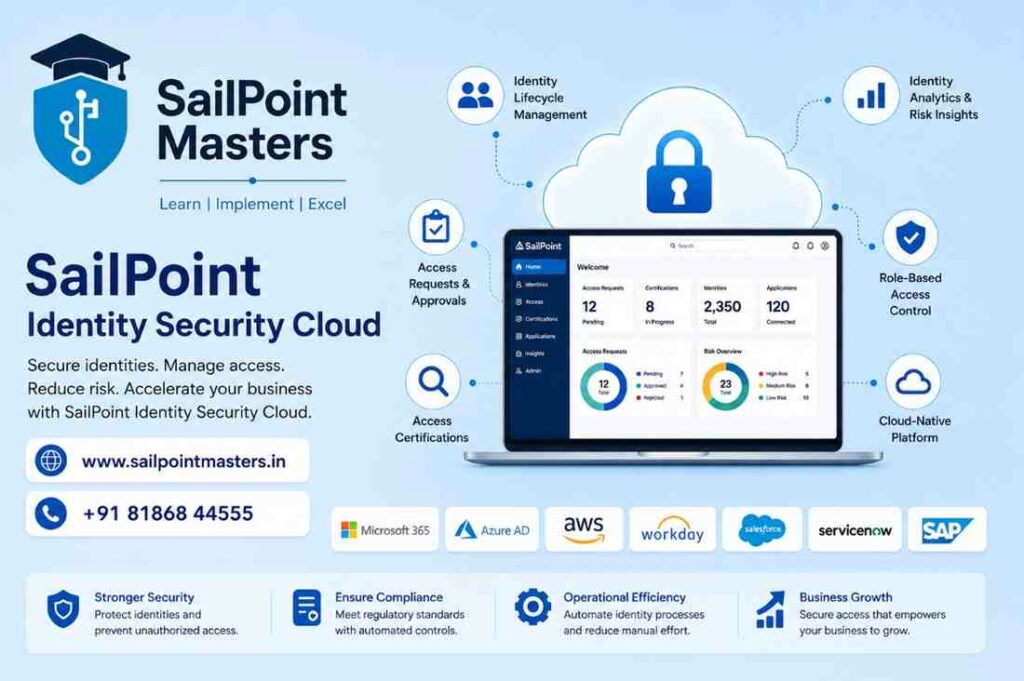
Every login, every access request, and every offboarding is now a security decision. As enterprises run more of their business across hundreds of SaaS and cloud applications, the hardest question in cybersecurity has become deceptively simple: does every identity have exactly the right access—and can we prove it?
SailPoint Identity Security Cloud (ISC) exists to answer that question. It is SailPoint’s cloud-native, AI-powered platform for identity governance and administration (IGA)—the discipline of deciding who gets access to what, automatically granting and removing that access, and continuously proving compliance.
Identity security has moved to the center of enterprise defense for a reason. The vast majority of modern breaches involve compromised or mismanaged identities, and regulators increasingly demand documented proof of who can access sensitive systems. That has turned identity governance from a back-office IT task into a board-level priority.
At the same time, organizations are abandoning slow, manual, on-premises tools in favor of cloud identity governance that deploys fast, scales elastically, and uses AI to make smarter access decisions. SailPoint Identity Security Cloud sits right at the front of that shift.
For professionals, this is a rare moment. The identity security industry is expanding at a double-digit annual rate, the talent pool is thin, and SailPoint careers—from Identity Security Engineer to IAM Architect—are among the best paid in cybersecurity. In India especially, where global enterprises run large identity programs out of Hyderabad, Bengaluru, Pune, and Chennai, demand for certified SailPoint professionals is surging.
This guide explains SailPoint Identity Security Cloud in 2026 end to end: what it is, how it works, its key features, how it compares to IdentityIQ and other IAM platforms, the industries that rely on it, salary expectations, certifications, and a practical roadmap to start learning it.
SailPoint Identity Security Cloud in 2026
What is SailPoint Identity Security Cloud?
SailPoint Identity Security Cloud (often shortened to SailPoint ISC) is a Software-as-a-Service (SaaS) identity security platform that governs digital identities and their access across an entire organization. It was formerly known as IdentityNow, and it represents SailPoint’s cloud-native approach to identity governance.
In plain terms, ISC does four things continuously:
- Connects to all your applications and systems—cloud and on-premises.
- Aggregates every identity and the access each one holds.
- Governs that access through policies, approvals, and reviews.
- Automates the granting and removal of access based on what each person should have.
Because it is delivered as a cloud service, ISC removes the need to install and maintain heavy infrastructure. SailPoint hosts, updates, and scales the platform, while customers focus on governance. It also layers in AI and machine learning to recommend access, detect risky outliers, and speed up decisions—capabilities that are difficult to replicate in older, on-premises tools.
ISC is the natural fit for cloud-first and hybrid enterprises that want fast deployment, lower maintenance, and modern, intelligent cloud identity governance. You can learn more directly from SailPoint’s official identity security resources.
How SailPoint Identity Security Cloud Works
At a high level, SailPoint ISC works in a continuous loop
- Connect sources. ISC connects to sources—applications and directories like Active Directory, HR systems, SAP, Salesforce, and hundreds more—using connectors and a lightweight virtual appliance that securely bridges cloud and on-premises systems.
- Aggregate identities. It pulls in every account and entitlement, building a single, unified view of who has access to what. An authoritative HR source (such as Workday or SuccessFactors) typically defines who is a valid identity.
- Model access. Access is organized into identity profiles, access profiles, and roles, so raw technical permissions become understandable, business-friendly bundles. This is the foundation of access modeling.
- Govern and automate. Policies, approval workflows, rules, and transforms drive automated provisioning, certifications, and access requests. When someone joins, moves, or leaves, ISC automatically adjusts their access everywhere.
- Analyze and improve. AI and analytics surface risk, recommend changes, and detect outliers—closing the loop and continuously improving the organization’s security posture.
This architecture is exactly what the SailPoint Certified Identity Security Engineer exam tests, covering sources, provisioning, virtual appliances, rules, transforms, and governance.
Benefits of SailPoint Identity Security Cloud for Enterprises
Enterprises adopt SailPoint ISC because it delivers measurable value
- Faster, safer onboarding: New joiners get the right access on day one—no waiting, no tickets.
- Zero orphaned accounts: Access is automatically revoked when people leave or change roles.
- Reduced risk: Least-privilege enforcement and outlier detection shrink the attack surface.
- Lower operational cost: Automation replaces repetitive manual provisioning work.
- Audit-ready compliance: Complete, exportable records satisfy auditors quickly.
- Scalability: A SaaS model scales effortlessly from thousands to hundreds of thousands of identities.
- Faster deployment: No heavy infrastructure means quicker time-to-value than legacy tools.
The result is stronger security, smoother operations, and a governance program that keeps pace with a fast-changing application landscape.
Identity Governance and Administration (IGA) Capabilities
Identity Governance and Administration is the heart of SailPoint ISC. Here are the core capabilities explained simply
- Identity Governance: The overall practice of controlling and proving who has access to what, and why.
- Access Certifications: Periodic campaigns where reviewers confirm or revoke each person’s access, keeping permissions accurate over time.
- Access Requests: Self-service requests that route through policy-aware approval workflows before access is granted.
- Role-Based Access Control (RBAC): Access mapped to job functions, so a “Finance Analyst” automatically gets the right bundle of access.
- Access Modeling: The process of designing roles and access profiles that reflect real business needs.
- Compliance Reporting: On-demand evidence of access, approvals, and reviews for auditors and regulators.
These capabilities are what separate true identity governance solutions from simple login or password tools. If you want to understand how governance differs across SailPoint’s products, see our breakdown of SailPoint IIQ vs IdentityNow.
AI-Driven Identity Security and Automation
The biggest leap in SailPoint Identity Security Cloud is its use of AI. In 2026, AI-based identity security is no longer a novelty—it’s an expectation.
ISC applies machine learning to
- Recommend access: Suggesting what a user likely needs based on peers and patterns.
- Detect outliers: Flagging access that’s unusual for someone’s role—a common sign of risk or error.
- Accelerate reviews: Helping certifiers focus on the risky 5% instead of rubber-stamping everything.
- Right-size permissions: Identifying and removing excessive or unused access.
This matters because manual governance simply cannot keep up with the scale of modern identity—especially as non-human identities like service accounts, bots, and AI agents now outnumber humans in many enterprises. Much of this automation runs through configurable, event-driven SailPoint workflows that handle onboarding, role changes, and offboarding without manual effort.
Lifecycle Management and Access Provisioning
Lifecycle management governs identity through every stage of the employment journey—commonly called the Joiner-Mover-Leaver (JML) process
- Joiner: A new hire is created in HR; ISC automatically provisions accounts and role-appropriate access.
- Mover: Someone changes roles; ISC adjusts their access, adding what’s needed and removing what isn’t.
- Leaver: Someone departs; ISC immediately deprovisions all access, eliminating orphaned accounts.
Provisioning is the act of creating accounts and granting access, while deprovisioning removes them. ISC automates both across every connected system, driven by policy and lifecycle events rather than manual tickets.
This is one of the highest-value capabilities in identity security, because it ties access directly to a person’s real status—and it’s a core skill every SailPoint professional must master.
Compliance, Audit, and Risk Management Features
SailPoint ISC is, at heart, a compliance and risk engine. Its key features here include
- Continuous access certification: Keeps access accurate and defensible year-round.
- Separation of Duties (SoD): Detects toxic access combinations—like someone who can both create and approve payments.
- Identity risk management: Scores and surfaces risky access so teams can act before it’s exploited.
- Compliance reporting: Generates audit-ready evidence for frameworks like SOX, GDPR, HIPAA, and ISO 27001.
- Complete audit trails: Every grant, change, approval, and revocation is logged and reportable.
By enforcing least privilege and supporting Zero Trust principles—aligned with the NIST Zero Trust Architecture (SP 800-207) model—ISC turns audit season from a fire drill into a routine export.
SailPoint Identity Security Cloud vs IdentityIQ
A common question for learners is whether to focus on Identity Security Cloud or IdentityIQ. Both are SailPoint IGA platforms, but they differ
- SailPoint IdentityIQ (IIQ): A highly customizable, primarily on-premises platform built on a Java extensibility model. It’s favored by large, complex organizations needing deep control and custom workflows, and is run inside the customer’s own infrastructure.
- SailPoint Identity Security Cloud (ISC): A cloud-native SaaS platform with faster deployment, lower maintenance, and built-in AI. It’s the natural fit for cloud-first and hybrid organizations.
The industry is steadily shifting toward ISC as enterprises move to the cloud, but IdentityIQ remains widely deployed—so understanding both is valuable. SailPoint even offers separate certifications for each. For a deeper, side-by-side look, read our SailPoint IIQ vs IdentityNow comparison.
SailPoint Identity Security Cloud vs Other IAM Platforms
How does ISC compare to other major IAM solutions? Here’s a high-level view.
|
Platform |
Type / Deployment |
Governance Strength |
AI & Automation |
Best Fit |
|---|---|---|---|---|
|
SailPoint Identity Security Cloud |
Cloud-native SaaS |
Excellent — purpose-built IGA, certifications, SoD |
Strong — AI access recommendations & outlier detection |
Enterprises needing deep, AI-driven cloud governance |
|
SailPoint IdentityIQ |
On-premises (customizable) |
Excellent — deep, highly configurable |
Good — rules-driven, less AI-native |
Large, complex on-prem/hybrid estates |
|
Microsoft Entra ID |
Cloud (Microsoft ecosystem) |
Good — strong access mgmt, governance add-ons |
Good within Microsoft stack |
Microsoft-centric organizations |
|
Okta |
Cloud SaaS |
Moderate — strong SSO/access, lighter deep IGA |
Good for SaaS automation |
Cloud-first access management focus |
|
Saviynt |
Cloud-native SaaS |
Strong — direct IGA competitor |
Strong — analytics-driven |
Cloud-first enterprise governance |
Note: capabilities evolve quickly; evaluate against your specific environment and compliance needs. SailPoint’s strength remains its depth of governance and breadth of connectivity.
Industries Using SailPoint Identity Security Cloud
SailPoint ISC is trusted across regulated, identity-heavy industries, including
- Banking & Financial Services: Strict SoD and audit requirements (SOX, regulatory compliance).
- Healthcare: Protecting patient data under HIPAA and similar mandates.
- Insurance: Governing access to sensitive policyholder and claims data.
- Technology & SaaS: Managing fast-changing access across sprawling cloud estates.
- Retail & E-commerce: Handling seasonal workforces and large contractor populations.
- Manufacturing & Energy: Securing access across OT, IT, and global operations.
- Government & Public Sector: Enforcing Zero Trust and strict access controls.
Wherever there are many identities, sensitive data, and regulatory pressure, identity governance is essential—and SailPoint is a market leader in serving them.
Career Opportunities in SailPoint Identity Security Cloud
Identity security is one of the fastest-growing corners of cybersecurity, and SailPoint jobs in India and worldwide are in high demand. Common roles include
- Identity Security Engineer / SailPoint Developer
- IAM Engineer / IAM Analyst
- SailPoint Consultant
- Access Governance Engineer
- Identity & Access Management Architect
- IAM Project Lead / Practice Lead
These roles exist across IT services firms, product companies, banks, consultancies, and global capability centers (GCCs)—many of which run large identity programs out of Indian hubs like Hyderabad, Bengaluru, Pune, and Chennai. Preparing for a role? Brush up with these common SailPoint interview questions and answers before you start applying.
Salary Table: SailPoint Professionals in India (2026 estimates)
|
Experience Level |
Approximate Salary Range (INR/year) |
|---|---|
|
Fresher (0–2 Years) |
₹4–8 lakhs |
|
Mid-Level (3–5 Years) |
₹9–16 lakhs |
|
Senior (6–10 Years) |
₹18–30 lakhs |
|
Architect / Lead (10+ Years) |
₹30–50+ lakhs |
These are market estimates for SailPoint IAM professionals and vary by city, employer, skills, and certifications. Highly specialized developers and architects—and roles at product companies—can earn considerably more, with senior SailPoint expertise reaching ₹25–40 lakhs and beyond.
Globally, experienced SailPoint professionals frequently command US$100,000–$180,000+, reflecting the worldwide shortage of identity security talent. To understand which roles pay the most and why, see our guide to SailPoint certification and high-paying IAM roles.
Skills Required to Become a SailPoint Professional
To build a strong SailPoint career, you’ll want a mix of conceptual and technical skills
Foundational knowledge
- Identity and Access Management (IAM) fundamentals
- Identity governance concepts (certifications, access requests, RBAC)
- Lifecycle management and the JML process
Technical skills
- SailPoint ISC (and ideally IdentityIQ) configuration
- Sources, connectors, and virtual appliances
- Rules and transforms (Java/BeanShell for IIQ; transforms for ISC)
- REST APIs and integrations (AD, SAP, Workday, SaaS apps)
- Provisioning workflows and access modeling
Supporting skills
- Basic Java, XML, and JSON
- Understanding of directories (LDAP/Active Directory)
- Cloud fundamentals (AWS/Azure) and Zero Trust concepts
- Compliance awareness (SOX, GDPR, HIPAA, ISO 27001)
You don’t need all of these on day one. A structured learning path builds them in the right order.
Learning Roadmap Table
|
Stage |
Skills to Learn |
Expected Outcome |
|---|---|---|
|
Beginner |
IAM & IGA fundamentals, identity lifecycle (JML), ISC navigation, core terminology |
Understand what identity governance is and how ISC is structured |
|
Intermediate |
Sources/connectors, identity & access profiles, roles, access requests, certifications, basic provisioning |
Configure ISC for a basic organization and run governance tasks |
|
Advanced |
Workflows, rules & transforms, SoD policies, APIs, integrations (AD/SAP/Workday) |
Build end-to-end IGA solutions and automate the JML lifecycle |
|
Expert |
Architecture, multi-source orchestration, AI-driven governance, non-employee risk, certification prep |
Architect and lead enterprise SailPoint deployments |
SailPoint Identity Security Cloud Certifications
Certifications validate your expertise and dramatically improve hiring prospects. SailPoint (Nasdaq: SAIL) offers a structured program of knowledge credentials (training-path based, unproctored) and role-based certifications (rigorous, proctored exams).
Key certifications in 2026 include
- SailPoint Certified Identity Security Engineer: A role-based certification proving real-world engineering expertise in cloud-based identity security (ISC). It covers identity and lifecycle management, provisioning, access management, virtual appliances, sources, architecture, rules, and transforms. Around one year of hands-on experience is recommended.
- SailPoint Certified Identity Security Administrator: A newer administrator-level certification (introduced in early 2026) validating cloud identity security administration skills, with roughly six months of hands-on experience recommended.
- SailPoint Certified IdentityIQ Engineer: Focused on IdentityIQ—installation, build and deployment, Lifecycle Manager, governance, custom development, application onboarding, and access modeling.
- Knowledge Credentials: Such as the Identity Security Leader and Identity Security Professional paths, ideal for building foundational knowledge.
SailPoint has also introduced a Recertification Program that extends certifications for additional years, encouraging continuous learning. Explore the official options on the SailPoint Identity Security Engineer certification page and the broader SailPoint certifications and credentials catalog.
Why SailPoint Identity Security Cloud is a Top Cybersecurity Career Choice in 2026
If you’re choosing a cybersecurity specialization in 2026, identity security—and SailPoint specifically—deserves serious consideration. Here’s why
- Identity is the new perimeter. The overwhelming majority of breaches are identity-related, making IGA a top enterprise priority and a recession-resistant skill.
- The market is booming. SailPoint notes the identity security industry is expected to grow at roughly 14.5% annually through 2028, and broader IGA market estimates put the sector near $10 billion and climbing.
- Talent is scarce. Specialized identity security skills are rare, so certified professionals enjoy strong leverage and pay.
- The pay is excellent. SailPoint roles are among the best-compensated in cybersecurity, in India and globally.
- AI is expanding the field, not replacing it. AI-driven governance and the explosion of non-human identities are creating more demand for skilled architects, not less.
- India is a global hub. With GCCs and IT services firms running enterprise identity programs from Indian cities, local demand is exceptionally strong.
In short, SailPoint Identity Security Cloud combines a growing market, scarce talent, high pay, and durable relevance—a rare combination for a career choice.
Future of SailPoint Identity Security Cloud in 2026 and Beyond
Several trends will shape ISC’s trajectory
- AI-driven governance becomes standard. Access recommendations, anomaly detection, and automated reviews move from differentiator to baseline.
- Non-human identity governance surges. Service accounts, bots, and AI agents now outnumber humans, and governing them is a fast-growing priority.
- Zero Trust everywhere. Identity-centric security becomes the default architecture for enterprises.
- Deeper SaaS and cloud governance. As app sprawl grows, ISC extends visibility and control across SaaS and multi-cloud entitlements.
- Convergence of identity disciplines. IGA, access management, and entitlement management increasingly unify into a single identity security fabric.
The direction is clear: identity security is becoming more automated, more intelligent, and more central—and ISC is built for that future.
How to Start Learning SailPoint Identity Security Cloud
Here’s a practical path to get started
- Build IAM foundations. Learn core IGA concepts—identities, access, certifications, RBAC, and the JML lifecycle.
- Get hands-on with ISC. Practice in a real environment: configure sources, build access profiles and roles, and run certifications.
- Learn the technical layer. Pick up rules, transforms, APIs, and integrations with AD, SAP, and SaaS apps.
- Work on projects. Real-world scenarios—onboarding automation, SoD policies, access reviews—cement your skills.
- Earn a certification. Target the SailPoint Certified Identity Security Engineer (or Administrator) to validate your expertise.
- Keep learning. Identity security evolves fast; stay current with AI governance and Zero Trust trends.
The fastest route is structured, hands-on training with real projects and certification guidance. Our SailPoint Certification Training in Hyderabad covers ISC and IdentityIQ with live labs, real-time projects, and full job support. Already working in IT and need flexible timings? The SailPoint course for working professionals runs weekend and live online batches built around real enterprise scenarios.
Key Takeaways
- SailPoint Identity Security Cloud (ISC) is SailPoint’s cloud-native, AI-driven IGA platform—formerly IdentityNow—built to automate access governance across cloud and on-premises systems.
- Core capabilities include access certifications, access requests, RBAC, lifecycle management, provisioning, SoD, and AI-driven insights, all delivered as a fast-deploying SaaS.
- Identity is the new security perimeter. With most breaches being identity-related and the market growing ~14–15% annually, identity governance is a top enterprise priority.
- SailPoint careers are in high demand and well paid—from ₹4–8 lakhs for freshers to ₹30–50+ lakhs for architects in India—with strong opportunities in Hyderabad, Bengaluru, Pune, and Chennai.
- Certifications accelerate your career. Target the SailPoint Certified Identity Security Engineer (or Administrator) and pair it with hands-on project experience to stand out.
Conclusion
SailPoint Identity Security Cloud in 2026 sits at the intersection of two unstoppable trends: the move to cloud-based, AI-driven security, and the rise of identity as the central control point of enterprise defense. For organizations, ISC delivers faster, smarter, audit-ready governance across an ever-expanding application estate. For professionals, it opens the door to one of the most in-demand, future-proof, and well-compensated careers in cybersecurity.
The opportunity is real, the demand is rising, and the talent pool is thin—which means now is the ideal time to build these skills. Start by learning the fundamentals of identity governance, get hands-on with Identity Security Cloud, work through real enterprise scenarios, and earn a recognized SailPoint certification to validate your expertise.
FAQ
1. What is SailPoint Identity Security Cloud?
SailPoint Identity Security Cloud (ISC), formerly IdentityNow, is SailPoint’s cloud-native SaaS platform for identity governance and administration. It automates access requests, certifications, lifecycle management, and provisioning across cloud and on-premises applications, with AI-driven access recommendations and risk detection.
2. Is SailPoint Identity Security Cloud the same as IdentityNow?
Yes. Identity Security Cloud is the current name for what was previously called SailPoint IdentityNow. It’s SailPoint’s cloud-based IGA platform, distinct from the on-premises IdentityIQ product.
3. What is the difference between Identity Security Cloud and IdentityIQ?
Identity Security Cloud is cloud-native SaaS with faster deployment, lower maintenance, and built-in AI. IdentityIQ is a primarily on-premises, highly customizable platform run in the customer’s own infrastructure. ISC suits cloud-first organizations; IIQ suits complex on-prem/hybrid estates.
4. Is SailPoint a good career in 2026?
Yes. With identity-related breaches rising, the identity security market growing at double-digit rates, and a global shortage of skilled professionals, SailPoint is one of the most in-demand and well-paid cybersecurity career paths in 2026—especially in India.
5. What is the salary of a SailPoint professional in India?
SailPoint professionals in India typically earn around ₹4–8 lakhs as freshers, ₹9–16 lakhs at mid-level, and ₹18–30 lakhs or more as seniors, with architects and specialists earning ₹30–50+ lakhs. Salaries vary by city, skills, and certifications.
6. Which SailPoint certification should I get?
For cloud-focused roles, the SailPoint Certified Identity Security Engineer is the flagship certification, with a newer Identity Security Administrator certification for admin-level skills. For IdentityIQ roles, pursue the SailPoint Certified IdentityIQ Engineer.
7. Do I need coding skills to learn SailPoint?
Basic Java, XML, and JSON help—especially for IdentityIQ rules and ISC transforms—but you don’t need to be an expert developer. Strong understanding of IAM concepts, configuration, and integrations matters most.
8. What skills are required to become a SailPoint engineer?
Key skills include IAM and IGA fundamentals, ISC/IIQ configuration, sources and connectors, rules and transforms, REST APIs, provisioning workflows, access modeling, and a working knowledge of directories, cloud platforms, and compliance frameworks.
9. Which industries use SailPoint Identity Security Cloud?
Banking, financial services, healthcare, insurance, technology, retail, manufacturing, energy, and government all use SailPoint ISC—any industry with many identities, sensitive data, and strict compliance requirements.
10. How long does it take to learn SailPoint Identity Security Cloud?
With focused, hands-on training, many learners gain job-ready ISC skills in a few months. Reaching certification-level expertise typically requires several months of study plus practical project experience.
SailPoint Trainer
SailPoint Masters Editorial Team | 15+ Articles Published
We specialize in SailPoint Certification Training in Hyderabad, helping aspiring professionals and IT experts develop in-demand Identity and Access Management (IAM) skills. Our training covers SailPoint IdentityIQ, Identity Security Cloud, certification preparation, real-world projects, and career guidance to support success in cybersecurity and identity governance careers.
Share