
SailPoint course online vs classroom training
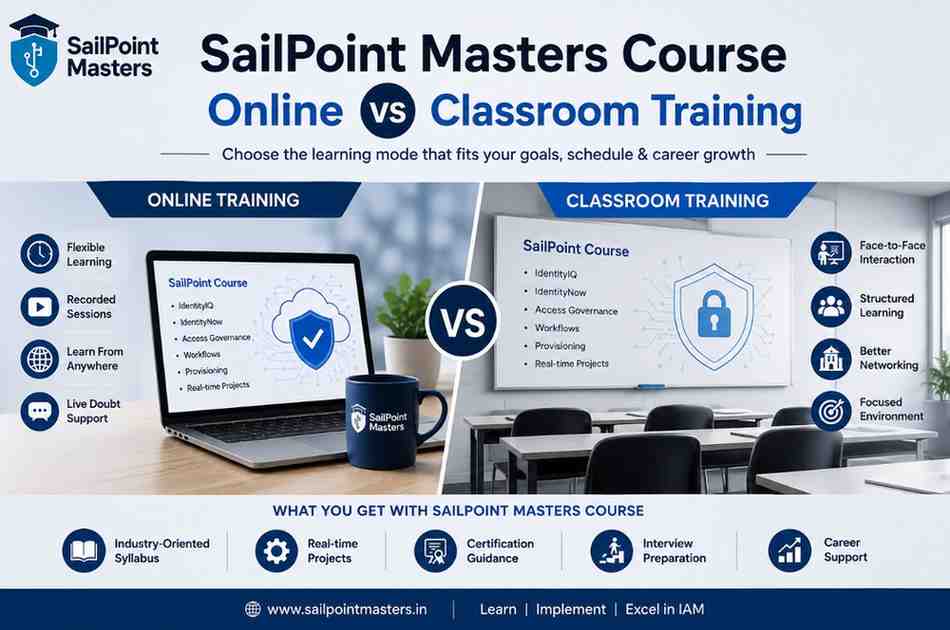
Choosing between a SailPoint course online vs classroom training depends on your schedule, budget, and learning style. Online training offers flexibility and lower cost, while classroom training provides structured mentorship and live interaction. Both formats prepare you for a high-demand IAM career. For learners in India, SailPoint certification training in Hyderabad offers both modes with placement support — making it one of the strongest starting points for an identity governance career in 2026.
★★★★★
4.9/5 rated by 1329+ students · Google Verified
Table of Contents
SailPoint Course Online vs Classroom Training: Which Is Better for Your IAM Career in India?
The question every aspiring identity governance professional in India eventually asks is this: should I enroll in SailPoint Certification Training in Hyderabad via online or classroom format? It is not a trivial decision. Your learning format can influence how quickly you land a job, how well you retain technical concepts, and how much you pay for training.
SailPoint is the global leader in Identity and Access Management (IAM) and Identity Governance and Administration (IGA). Every large enterprise — from banks to global IT services companies — depends on SailPoint to manage who has access to what, ensure regulatory compliance, and protect critical data. With cybersecurity incidents rising sharply and major IT employers headquartered in Hyderabad actively hiring, the demand for certified SailPoint professionals has never been stronger.
The career opportunity is real and it is growing. IAM professionals in India earn competitive salaries from day one, and experienced SailPoint architects command packages that rival the best in the IT industry. But to get there, you need the right training — and choosing between online and classroom delivery is the first important decision you will make on that journey.
This guide gives you an honest comparison of both formats, covers career opportunities, salary benchmarks, tools, certifications, and helps you build a clear roadmap to becoming a SailPoint professional in India.
SailPoint course online vs classroom training
What Is SailPoint and Identity Governance?
SailPoint Technologies is an Austin, Texas-based company that builds enterprise-grade identity governance software. Its two flagship products — SailPoint IdentityIQ and SailPoint IdentityNow — are used by hundreds of global enterprises to manage user identities, control access to applications, and automate compliance processes.
Identity Governance and Administration (IGA) is the discipline of managing digital identities across an organization — deciding who gets access to which systems, ensuring those rights are appropriate, and revoking them automatically when employees leave or change roles. Without a robust IGA platform, enterprises struggle with over-provisioned accounts, orphan credentials, audit failures, and breach risk from excessive access.
SailPoint addresses this by providing a centralized platform that automates user provisioning and deprovisioning, runs access certification campaigns, enforces Separation of Duties (SoD) policies, integrates with cloud platforms and enterprise directories through pre-built connectors, and provides risk scoring to flag unusual access patterns early.
According to the NIST Cybersecurity Framework, identity management is one of the five core functions every organization must implement as part of a mature cybersecurity posture. SailPoint is the industry’s leading tool for fulfilling this mandate at enterprise scale.
SailPoint IdentityIQ vs IdentityNow — A Quick Primer
IdentityIQ (IIQ) is SailPoint’s on-premises platform. It offers deep customization, extensive workflow configuration, and is the dominant solution in large banking, insurance, and government deployments. IIQ uses BeanShell scripting and XML-based workflow rules.
IdentityNow is SailPoint’s cloud-native SaaS platform. It delivers the same core governance capabilities through an API-first, multi-tenant cloud architecture, deploys faster, and receives automatic updates. Most new SailPoint investments trend toward IdentityNow.
Most comprehensive SailPoint training programs cover both platforms. For a workflow-level breakdown of how the two differ in practice, read our guide on the difference between IdentityIQ and IdentityNow workflows.
Why SailPoint Is a High-Demand Skill in India
India is one of the largest markets for enterprise IT services globally. Tens of thousands of IT professionals work for companies that provide identity governance services to clients across North America, Europe, and Asia-Pacific. The demand for SailPoint talent in India is being driven by several converging forces.
Regulatory pressure is intensifying. Global regulations — including GDPR in Europe, SOX in the US, and India’s own DPDP Act — require organizations to demonstrate precise control over who accesses personal data. SailPoint implementations are a primary mechanism through which enterprises meet these requirements.
Cloud adoption is accelerating access sprawl. As enterprises move workloads to AWS, Azure, and Google Cloud, the number of identities and entitlements they must manage explodes. SailPoint professionals who understand both on-premises IIQ and cloud-native IdentityNow have a significant competitive advantage.
India’s talent supply is still thin. Despite strong demand, there are relatively few deeply skilled SailPoint professionals in India compared to open roles. This supply-demand gap keeps salaries elevated and makes it a genuinely attractive specialization for IT professionals.
According to SailPoint’s identity research, identity-related breaches now account for a majority of all enterprise security incidents globally, reinforcing why organizations prioritize IAM investments.
SailPoint Course Online vs Classroom Training: A Detailed Comparison
When evaluating a SailPoint course online vs classroom training, there is no universally right answer. The best format depends on your current job situation, how you learn best, your location, and how quickly you need to get certified. Let us break down the key differences systematically.
Online Training
- Learn from anywhere, anytime
- Lower cost; no travel or accommodation
- Recorded sessions available for replay
- Ideal for working professionals
- Access to global instructors
- Requires self-discipline
Classroom Training
- Structured schedule with fixed timings
- Live interaction and real-time Q&A
- Peer networking and group learning
- Hands-on lab environment on-site
- Easier to stay accountable
- Higher cost; location-dependent
|
Parameter |
Online Training |
Classroom Training |
|
Cost (India) |
₹25,000 – ₹45,000 |
₹35,000 – ₹60,000 |
|
Schedule |
Flexible / self-paced |
Fixed weekday / weekend batches |
|
Interaction |
Chat, doubt sessions, forums |
Real-time, face-to-face |
|
Lab Access |
Cloud lab environment |
On-site lab infrastructure |
|
Recording Access |
Yes (lifetime in most cases) |
Limited or none |
|
Best For |
Working professionals, outstation learners |
Students, fresher, career changers |
|
Duration |
45–90 days (self-paced) |
45–60 days (structured) |
|
Networking |
Limited to virtual cohorts |
Strong in-person peer network |
|
Placement Support |
Available at reputable institutes |
Available at reputable institutes |
|
Certificate |
Yes (course completion + exam prep) |
Yes (course completion + exam prep) |
Which Format Should You Choose?
Choose online training if you are currently employed and cannot leave your job, you live outside a major metro city, or you prefer learning at your own pace with the ability to revisit recorded sessions before an exam.
Choose classroom training if you are a recent graduate, making a complete career switch, or find that you retain information better through in-person instruction and peer interaction. Classroom environments also offer stronger daily accountability, which can help you complete the course faster.
The hybrid advantage: The best SailPoint training institutes in Hyderabad and other Indian cities now offer blended programs — live instructor sessions delivered online, supplemented by weekend on-site lab days. This model combines the flexibility of online delivery with the hands-on depth of classroom learning. If you have access to this format, it is worth serious consideration.
Top Companies Hiring SailPoint Experts in India
If you are planning your SailPoint career in India, these are the organizations most actively hiring trained professionals
|
Company |
Type |
Typical Roles |
|
Infosys |
IT Services |
SailPoint Developer, IAM Analyst, IGA Consultant |
|
Wipro |
IT Services |
SailPoint Engineer, IAM Lead, IGA Architect |
|
TCS (Tata Consultancy Services) |
IT Services |
Identity Governance Analyst, SailPoint Admin |
|
HCL Technologies |
IT Services |
SailPoint Consultant, IAM Practice Lead |
|
Capgemini |
IT Consulting |
SailPoint Architect, Senior Developer |
|
Deloitte |
Professional Services |
IAM Senior Consultant, Identity Governance Lead |
|
Accenture |
IT Consulting |
Security Analyst – IAM, SailPoint SME |
|
IBM |
IT Services |
IAM Specialist, SailPoint IdentityNow Developer |
|
Cognizant |
IT Services |
SailPoint Developer, Access Management Engineer |
|
HDFC Bank / ICICI Bank |
BFSI |
IAM Engineer, Identity Governance Manager |
SailPoint Roles and Responsibilities
Understanding what the job actually involves helps you train for the right things. Here is a breakdown of the primary SailPoint roles and what each one does day to day.
SailPoint Developer / IGA Analyst
- Configure and maintain SailPoint IdentityIQ or IdentityNow instances
- Build and test connectors for applications like Active Directory, SAP, and Salesforce
- Write BeanShell rules and workflow customizations in IIQ
- Execute and monitor access certification campaigns
SailPoint Consultant / Senior Engineer
- Lead SailPoint implementation projects for enterprise clients
- Translate business access requirements into technical governance rules
- Design role models and RBAC frameworks for client environments
- Conduct SoD analysis, access reviews, and remediation
SailPoint Architect / IAM Solution Architect
- Design end-to-end identity governance programs for complex enterprise environments
- Evaluate and recommend IAM tools including PAM and CIAM platforms
- Provide technical leadership to development and consulting teams
- Present architecture decisions to CISOs and executive stakeholders
SailPoint Salary in India
Salaries vary by experience level, employer, location, and certification status. The table below provides realistic benchmarks for the Indian market.
|
Experience Level |
Role |
Salary Range (LPA) |
Key Skills at This Level |
|
Fresher (0–2 Years) |
IGA Analyst / Junior Developer |
₹4 – ₹7 LPA |
SailPoint basics, connector setup, access reviews |
|
Mid-Level (3–5 Years) |
SailPoint Developer / Consultant |
₹10 – ₹18 LPA |
Workflow rules, RBAC design, full implementations |
|
Senior (6–10 Years) |
Senior Consultant / Lead Engineer |
₹20 – ₹35 LPA |
Architecture, client delivery, SoD, cloud IAM |
|
Lead / Architect (10+ Years) |
IAM Architect / Practice Lead |
₹35 – ₹60+ LPA |
Enterprise strategy, multi-product IAM, leadership |
Salaries are also influenced by certification status — certified professionals consistently command higher offers at every experience level.
Skills Required to Become a SailPoint Professional
SailPoint is a technical domain. While you do not need to be an expert programmer to start, certain foundational skills will significantly accelerate your learning and your job search.
Technical Skills
- Identity and Access Management concepts: Authentication, authorization, provisioning, deprovisioning, access governance
- SailPoint IdentityIQ or IdentityNow product knowledge: Core modules, configuration, administration
- Java and BeanShell scripting: Essential for IIQ rule writing and workflow customization
- Active Directory and LDAP: Most implementations involve AD as a key target system
- SQL basics: For identity data queries and aggregation troubleshooting
- REST API understanding: Critical for IdentityNow integrations and custom connectors
- XML and JSON: SailPoint configuration files and API payloads
- Cloud platforms (AWS / Azure): Growing importance as enterprises move to cloud IAM
Soft Skills
- Problem-solving: Provisioning failures and SoD conflicts require methodical root-cause analysis
- Client communication: Consultant roles require translating technical requirements into business language
- Documentation: Identity programs require detailed design documents, runbooks, and compliance evidence
SailPoint Tools and Technologies You Must Learn
A comprehensive SailPoint training program covers not just the core platform but the surrounding technology ecosystem. Here are the key tools and concepts every SailPoint professional must understand.
Core SailPoint Components
- IdentityIQ (IIQ): On-premises identity governance platform with deep workflow customization
- IdentityNow: Cloud-native SaaS identity governance and access management platform
- SailPoint AI / Identity Security Cloud: AI-driven access recommendations, peer group analysis, and risk scoring
IAM and IGA Concepts
- Role-Based Access Control (RBAC): Assigning access rights based on organizational roles rather than individual entitlements — a foundational governance mechanism that reduces over-provisioning and simplifies access reviews. Learn more in our guide on RBAC in SailPoint IdentityIQ.
- Access Governance: Policies, workflows, and controls that ensure users have only the access they need (least privilege)
- Workflow Automation: Automated provisioning/deprovisioning, approval chains, and lifecycle event handling
- Separation of Duties (SoD): Controls that prevent any single user from having conflicting access rights that could enable fraud
- Access Certification: Periodic campaigns where managers review and approve or revoke user access rights
- Privileged Access Management (PAM): Controls for highly privileged accounts — often paired with SailPoint in enterprise deployments
Cloud and Integration Technologies
- Microsoft Azure Active Directory / Entra ID: Key integration target for most SailPoint deployments
- AWS IAM: Cloud entitlement management in AWS environments
- SCIM (System for Cross-domain Identity Management): Standard protocol for user provisioning across cloud applications
- SAML / OAuth / OpenID Connect: Federated identity and SSO protocols
- REST APIs and Postman: Used extensively in IdentityNow development and testing
The official SailPoint documentation portal is an essential reference that every SailPoint professional should bookmark and use regularly throughout their career.
SailPoint Career Roadmap
Career progression in SailPoint follows a well-defined path. Understanding each stage helps you set realistic milestones and build skills strategically.
|
Stage |
Timeline |
Focus Areas |
Target Role |
|
Beginner |
0–6 months |
IAM fundamentals, SailPoint IIQ basics, connector setup, access reviews, lab practice |
IGA Analyst / Junior Developer |
|
Intermediate |
6 months – 2 years |
Workflow automation, BeanShell rules, RBAC design, IdentityNow introduction, first live project |
SailPoint Developer / Analyst |
|
Advanced |
2–5 years |
Full implementation ownership, SoD design, cloud IAM, SailPoint certification, client delivery |
Senior Consultant / Lead Engineer |
|
Expert |
5+ years |
Architecture design, multi-product IAM strategy, pre-sales, team leadership, emerging AI-driven IGA |
IAM Architect / Practice Lead |
SailPoint Certifications and Their Importance
Official SailPoint certifications validate your hands-on product expertise and give you a significant advantage during hiring. Unlike generic cybersecurity certifications, SailPoint credentials are product-specific and signal to employers that you can contribute from day one.
SailPoint’s official certification programs are available through the SailPoint University platform and include
- SailPoint Certified IdentityIQ Engineer: Validates ability to configure and deploy IIQ. High value in enterprises with on-premises SailPoint deployments.
- SailPoint Certified IdentityNow Engineer: Validates expertise in the cloud SaaS platform. Increasingly preferred as cloud adoption accelerates.
- SailPoint Certified Administrator: Covers administrative functions and daily operations. A solid entry-level credential.
Why certifications matter: Many enterprise clients contractually require implementation partners to maintain certified professionals on engagements. Certification increases your billability and your value in consulting roles. Pair your training with a focused exam preparation plan to maximise your chances on the first attempt.
Why SailPoint Is One of the Best Career Choices in Identity and Access Management in India
The IAM market is crowded — CyberArk, Azure AD, Okta, and Ping Identity all compete for enterprise deployments. Why does SailPoint specifically represent such a strong career choice?
SailPoint vs Key IAM Competitors
|
Feature / Dimension |
SailPoint |
CyberArk |
Azure AD / Entra ID |
Okta |
|
Primary Focus |
Identity Governance (IGA) |
Privileged Access Management (PAM) |
Cloud SSO / Directory |
Cloud SSO / Workforce Identity |
|
On-Premises Option |
Yes (IIQ) |
Yes |
No |
No (SaaS only) |
|
Cloud SaaS Option |
Yes (IdentityNow) |
Yes (Cloud) |
Yes |
Yes |
|
Access Certification |
Core capability |
Limited |
Access Reviews |
Not native IGA |
|
Enterprise IGA Depth |
Market leader |
PAM-focused |
Limited IGA |
Limited IGA |
|
India Job Market Demand |
Very High |
High |
High |
Moderate |
|
Salary Premium |
High |
High |
Moderate |
Moderate |
SailPoint’s differentiation lies in its depth as a purpose-built IGA platform. CyberArk leads in privileged access management but does not compete in mainstream IGA. Azure AD and Okta excel at authentication and SSO but lack the lifecycle governance, SoD management, and access certification depth that regulated enterprises require. From a career perspective, SailPoint skills tend to be stickier — implementations are complex and long-lived, creating durable demand for professionals with deep product expertise.
Future Scope of SailPoint in India
The future scope of SailPoint in India is strong, supported by multiple structural trends that are not reversing anytime soon.
IAM market growth: The global IAM market is growing steadily, driven by cloud adoption, regulatory complexity, and rising cybersecurity spending. India, as a major IT services hub, captures a significant share of global enterprise IAM project work.
Cloud identity expansion: As enterprises migrate to AWS, Azure, and GCP, the number of cloud entitlements multiplies rapidly. SailPoint IdentityNow, with its native cloud integrations and API-first architecture, is positioned to grow significantly. Professionals who combine core SailPoint skills with cloud IAM knowledge will be most competitive.
AI-driven identity security: SailPoint has made significant investments in AI-powered access recommendations and risk scoring. The SailPoint developer platform supports extensibility through APIs and AI Services, creating new specialization opportunities for technically strong professionals.
Regulatory tailwinds: India’s Digital Personal Data Protection (DPDP) Act and alignment with global compliance frameworks are pushing domestic enterprises to invest in identity governance. This creates fresh demand beyond IT services into banking, healthcare, and government sectors.
Zero-trust adoption: Zero-trust security architectures treat identity as the new perimeter and require robust IGA as their foundation. This structural shift sustains SailPoint demand across all industries.
Understanding which platform your target employer uses — IIQ or IdentityNow — should shape your specialization early. Most hiring companies indicate this clearly in their job descriptions.
How to Start a Career in SailPoint
Here is a practical step-by-step roadmap, whether you are entering from scratch or specializing from an existing IT background.
- Step 1 — Build IAM foundations (Weeks 1–2): Learn core concepts first — provisioning lifecycle, authentication vs authorization, and compliance frameworks like SOX and GDPR. This context makes every subsequent product training session click faster.
- Step 2 — Enroll in the right format (Week 2–3): Choose your training format based on schedule and learning style. Look for a program that covers both IIQ and IdentityNow with structured lab access and placement support.
- Step 3 — Prioritize lab hours (Weeks 3–12): Hands-on practice building connectors, configuring workflows, and writing BeanShell rules separates hireable candidates from those who only attended training passively.
- Step 4 — Prep for certification (Weeks 10–14): Work through our SailPoint IIQ exam preparation guide to map your knowledge against exam objectives. Use the SailPoint Compass community for documentation and practice scenarios.
- Step 5 — Build a portfolio and apply: Before your first interview, work through our SailPoint interview questions and answers to prepare for common technical rounds.
- Step 5 — Build a portfolio and apply: Document your lab implementations as case studies. A simulated IIQ project with AD, RBAC, and access certification is a compelling portfolio item for entry-level roles.
For a full picture of where your SailPoint career can go, explore our SailPoint careers guide covering roles, growth paths, and hiring trends.
Key Takeaways
- Online vs classroom is a lifestyle decision, not a quality decision. Both formats, when delivered by a reputable institute, produce job-ready SailPoint professionals. Choose based on your schedule, location, and learning style.
- SailPoint skills are in high demand across India. IT services, BFSI, healthcare, and government sectors are all actively hiring — and the supply of certified professionals lags demand, keeping salaries competitive.
- SailPoint IdentityNow is the future. While IIQ skills remain valuable for large enterprise projects, investing time in IdentityNow and cloud IAM concepts positions you for the highest-growth area of the market.
- Hands-on lab practice matters more than theory. Employers hire for the ability to configure, troubleshoot, and deliver — not just for knowledge of concepts. Prioritize a training program with substantial lab time.
- Certifications accelerate hiring and salary growth. Official SailPoint certifications from SailPoint University are recognized globally and often required on enterprise engagements. Pursuing certification should be part of your plan from day one of training.
Conclusion
The debate over SailPoint course online vs classroom training ultimately comes down to knowing yourself as a learner and being honest about your current constraints. If you have a full-time job and cannot commit to fixed training hours, a well-structured online program with strong lab access is the smarter choice. If you are a fresher who benefits from structure, routine, and in-person mentoring, enrolling in SailPoint certification training in Hyderabad may accelerate your progress significantly.
What is not up for debate is the career opportunity itself. SailPoint sits at the intersection of cybersecurity and cloud — two of the fastest-growing areas in enterprise technology — and demand for skilled professionals in India consistently outpaces supply. Whether you come from a development background, system administration, or are transitioning from a non-technical role into IT security, SailPoint offers a well-defined path with strong earning potential and long-term career durability.
FAQ
-
Is online SailPoint training better than classroom training?
Online SailPoint training offers flexibility and affordability, while classroom training provides direct guidance. Choose based on your learning style, budget, and schedule. -
How long does it take to complete a SailPoint course?
Most SailPoint courses take 45–60 days with 60–80 learning hours. Weekend or self-paced options may finish sooner or extend based on availability. -
What is the cost of SailPoint certification training in India?
SailPoint training in India typically costs ₹25,000–₹60,000. Certification exam fees are separate and paid directly through SailPoint’s official platform. -
What is the starting salary for a SailPoint professional in India?
Freshers usually earn ₹4–7 LPA, while experienced professionals receive significantly higher packages based on skills, certifications, and project expertise. -
Which companies hire SailPoint professionals in India?
Top recruiters include IT service firms, consulting companies, and major banks. Demand remains high across enterprise identity and security projects. -
Is SailPoint difficult to learn for beginners?
SailPoint has a manageable learning curve. Beginners can succeed with structured training that covers IAM basics, product concepts, and practical exercises. -
What is the difference between SailPoint IdentityIQ and IdentityNow?
IdentityIQ is an on-premises IAM solution with deep customization, while IdentityNow is a cloud-based platform offering faster deployment and easier management. -
What certifications does SailPoint offer?
SailPoint provides IdentityIQ Engineer, IdentityNow Engineer, and Administrator certifications that validate product expertise and improve career opportunities. -
What skills are required to become a SailPoint professional?
Essential skills include IAM fundamentals, SailPoint products, Java, SQL, REST APIs, Active Directory, and strong analytical and communication abilities. -
What is the future scope of SailPoint in India?
SailPoint demand continues growing due to cloud adoption, zero-trust security, and compliance needs, creating excellent long-term career opportunities in India.
SailPoint Trainer
SailPoint Masters Editorial Team | 15+ Articles Published
We specialize in SailPoint Certification Training in Hyderabad, helping aspiring professionals and IT experts develop in-demand Identity and Access Management (IAM) skills. Our training covers SailPoint IdentityIQ, Identity Security Cloud, certification preparation, real-world projects, and career guidance to support success in cybersecurity and identity governance careers.
Share