
Ping Identity vs SailPoint: A Complete IAM Comparison Guide
Ping Identity vs SailPoint comes down to focus: Ping Identity is primarily an access management and authentication platform (SSO, MFA, adaptive access), while SailPoint is an identity governance and administration (IGA) platform (provisioning, certifications, compliance). They aren’t strict competitors — many enterprises run both together, using Ping for “who can log in” and SailPoint for “who should have access to what.”
★★★★★
4.9/5 rated by 1329+ students · Google Verified
Table of Contents
Introduction
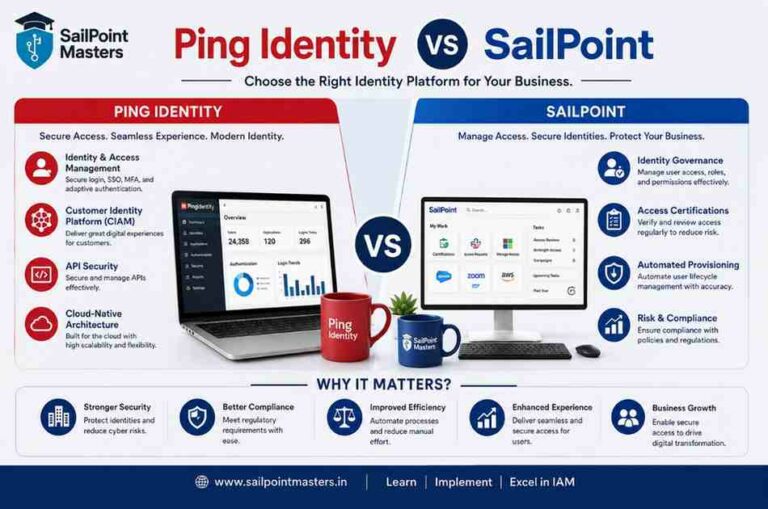
If you’ve searched for ping identity vs sailpoint, you’re probably trying to solve one of two problems: choosing an Identity and Access Management (IAM) platform for your organization, or figuring out which technology to build a career around. Either way, the confusion is understandable — both companies operate in the identity security space, both are recognized as market leaders, and both show up in the same enterprise RFPs.
But Ping Identity and SailPoint aren’t really solving the same problem. Ping Identity is built around authentication and access — verifying who someone is and letting them sign in securely across applications. SailPoint is built around identity governance — deciding who should have access to what, and proving that access stays clean over time.
Understanding this distinction matters because it’s the difference between identity access/authentication (can this person log in right now?) and identity governance (should this person still have this access, and can we prove it to an auditor?). A modern enterprise IAM architecture typically needs both capabilities, which is why the “vs” in this comparison is often more about complementary roles than head-to-head competition.
Choosing the right platform — or the right combination of platforms — affects security posture, compliance readiness, user experience, and IT operational overhead. Get it wrong, and you end up with either weak governance (users accumulating access nobody reviews) or clunky authentication (constant login friction that pushes users toward workarounds). This guide breaks down both platforms in detail, compares their capabilities feature by feature, and looks at what each means for IT professionals building a career in identity security.
Ping Identity vs SailPoint
What is Ping Identity?
Ping Identity is an enterprise access management and authentication platform. Its core job is verifying identities and controlling how users — employees, partners, or customers — sign in to applications securely.
Ping Identity was taken private by Thoma Bravo in 2022 and, in August 2023, merged with ForgeRock in a deal valued at roughly $2.3 billion, with both companies operating under Thoma Bravo ownership. The combined company continues to operate under the Ping Identity brand, and ForgeRock’s cloud identity platform was rebranded as PingOne Advanced Identity Cloud.
Ping’s product suite centers on
- PingOne — a cloud-based platform for SSO, MFA, and adaptive authentication
- PingFederate — a self-managed federation server for enterprise SSO
- PingAccess — policy-based access control for web applications and APIs
- PingDirectory — a high-performance directory service
- PingOne Advanced Identity Cloud (formerly ForgeRock Identity Cloud) — a broader identity platform that also includes some governance and orchestration capability
Ping Identity is generally used for workforce authentication, customer identity and access management (CIAM), and securing sign-in experiences across web, mobile, and API-based applications.
What is SailPoint?
SailPoint is an identity security and governance platform. Its core job is answering a different question: not “can this person log in,” but “should this person have this access, and is that access still appropriate?”
SailPoint, founded in 2005 and headquartered in Austin, Texas, was taken private by Thoma Bravo in 2022 in a deal valued at roughly $6.9 billion, then returned to the public markets through an IPO. Its flagship offering is SailPoint Identity Security Cloud, built on its Atlas platform, alongside IdentityIQ, a customer-hosted option for organizations that need on-premises deployment.
SailPoint’s core capabilities include
- Identity lifecycle management — automating onboarding, role changes, and offboarding
- Access certifications — periodic reviews confirming users still need the access they hold
- Provisioning and deprovisioning — granting and revoking access to applications and systems
- Separation of duties (SoD) controls — preventing conflicting access combinations
- Identity analytics and AI-driven access insights — flagging unusual or risky access patterns
- Non-human identity management — governance for service accounts, bots, and AI agents
SailPoint is generally used by enterprises that need to prove — to auditors, regulators, or their own security teams — exactly who has access to what, why they have it, and when it was last reviewed. If you’re weighing which SailPoint product to learn or deploy first, this breakdown of IdentityIQ vs Identity Security Cloud explains how the two differ and which suits which use case.
Ping Identity vs SailPoint: Key Differences
At the highest level, the difference between Ping Identity and SailPoint is
authentication versus governance.
- Ping Identity answers: “Is this really the person they claim to be, and should they be allowed to log in right now?”
- SailPoint answers: “Should this person have this level of access in the first place, and can we prove it stays appropriate over time?”
This distinction runs through nearly every part of the comparison. Ping’s strength is in real-time decisioning at the point of login — SSO sessions, MFA challenges, risk-based step-up authentication. SailPoint’s strength is in ongoing lifecycle and compliance decisioning — who gets access when they join, what changes when they move roles, what gets revoked when they leave, and how all of that gets audited.
Neither platform fully replaces the other. Many mature IAM programs run Ping (or a comparable access management tool) alongside SailPoint (or a comparable IGA tool), because authentication and governance are genuinely different disciplines that require different data models, workflows, and stakeholders.
Ping Identity vs SailPoint: Feature Comparison
|
Feature |
Ping Identity |
SailPoint |
|
Primary Focus |
Access management & authentication |
Identity governance & administration |
|
IAM Capabilities |
Strong (SSO, MFA, adaptive access) |
Moderate (governance-first, some access features) |
|
Identity Governance |
Limited/emerging |
Core strength |
|
SSO |
Core strength |
Not a primary focus |
|
Authentication |
Core strength |
Not a primary focus |
|
MFA |
Core strength |
Supports but doesn’t lead here |
|
Provisioning |
Basic/via integrations |
Core strength |
|
Deprovisioning |
Basic/via integrations |
Core strength |
|
Access Certification |
Not a primary focus |
Core strength |
|
Role Management |
Limited |
Core strength |
|
Compliance |
Supports via logs/policies |
Core strength (audit-ready reporting) |
|
Identity Lifecycle |
Partial (via orchestration) |
Core strength |
|
Cloud Support |
Strong (PingOne is cloud-native) |
Strong (Identity Security Cloud is cloud-native) |
|
Hybrid Environment |
Strong (PingFederate, PingDirectory on-prem) |
Strong (IdentityIQ for on-prem/hybrid) |
|
Integrations |
Broad app and API integrations |
Broad connector library for enterprise systems |
|
Automation |
Authentication flow automation (DaVinci orchestration) |
Workflow automation for access decisions |
|
Best Use Case |
Workforce/customer authentication, SSO |
Governance, compliance, access certification |
|
Career Opportunities |
Growing (access/authentication engineers) |
Strong and growing (IGA is in high demand) |
This table isn’t a “winner” scorecard — it’s meant to show that the two platforms are strong in different, largely non-overlapping columns.
Ping Identity vs SailPoint for Identity and Access Management
Identity and Access Management (IAM) is the umbrella discipline covering both authentication and governance. Within that umbrella, Ping Identity leans heavily toward the “access” side — controlling and securing the moment a user tries to reach a system. SailPoint leans toward the “identity” side — managing the full lifecycle of who a user is, what roles they hold, and what that should entitle them to.
If your organization’s biggest pain point is fragmented logins, weak MFA, or inconsistent session security, Ping Identity addresses that directly. If your biggest pain point is stale access, failed audits, or no visibility into who has admin rights across dozens of applications, SailPoint is the more direct fit.
SailPoint Identity Security Cloud vs IdentityIQ Latest Version
|
Aspect |
Identity Security Cloud (ISC) |
IdentityIQ 8.5 |
|
Deployment |
SaaS, multi-tenant |
On-premises, private cloud, or hybrid |
|
Update cadence |
Continuous, no version numbers |
Periodic major/minor releases |
|
Customization |
Configuration-driven |
Deep customization via code |
|
AI agent governance |
Native, expanding |
Limited, add-on dependent |
|
Maintenance burden |
Managed by SailPoint |
Managed by customer IT team |
|
Best fit |
Cloud-first enterprises |
Regulated, highly customized environments |
Beyond the deployment model, the two platforms also differ in how they handle day-to-day operations — you can see how IdentityIQ and IdentityNow differ at the workflow level if you’re planning provisioning or certification processes.
Ping Identity vs SailPoint for Identity Governance
Identity Governance and Administration (IGA) is the practice of managing the full lifecycle of digital identities and ensuring access stays appropriate, auditable, and policy-compliant. This is SailPoint’s home turf. Its certification campaigns, SoD policy engine, and identity analytics are built specifically for governance workflows.
Ping Identity, especially post-ForgeRock, has some adjacent governance functionality, but it isn’t positioned as a full IGA replacement for SailPoint in large, compliance-heavy enterprises. Organizations with strict regulatory obligations (finance, healthcare, government) typically still deploy a dedicated IGA tool like SailPoint even if Ping Identity handles their authentication layer.
Ping Identity vs SailPoint for Single Sign-On and Authentication
Single Sign-On (SSO) lets a user authenticate once and access multiple connected applications without re-entering credentials. Multi-Factor Authentication (MFA) adds a second (or third) verification factor — a code, biometric, or hardware key — beyond a password. Adaptive authentication goes further, adjusting the level of verification required based on risk signals like location, device, or behavior.
This is where Ping Identity is purpose-built. PingOne and PingFederate are designed around SSO and federation standards, and Ping’s orchestration engine (DaVinci) lets organizations design adaptive authentication journeys without heavy custom development.
SailPoint doesn’t compete directly here — its role is upstream of the login event, deciding whether the access being authenticated into is appropriate in the first place.
Ping Identity vs SailPoint for Provisioning and Deprovisioning
User provisioning is the automated process of creating accounts and granting access when someone joins an organization or changes roles. Deprovisioning is the reverse — removing access when someone leaves or no longer needs it.
SailPoint is built around this lifecycle. Its automated provisioning/deprovisioning workflows connect to HR systems, directories, and hundreds of target applications, ensuring access changes happen on schedule and get logged for audit purposes.
Ping Identity can trigger some provisioning actions through orchestration and integrations, but this isn’t its primary strength — it’s more focused on the authentication experience once an account already exists. For a closer look at how these workflows are actually configured, SailPoint’s official documentation covers provisioning policy setup in detail.
Ping Identity vs SailPoint for Access Certifications
Access certifications are periodic reviews where managers or application owners confirm that a user’s existing access is still appropriate. This is a compliance requirement in many regulated industries and a core SailPoint capability — certification campaigns, reviewer dashboards, and automated reminders are central to its platform.
Ping Identity doesn’t offer a comparable certification workflow; this is one of the clearest areas where the “vs” framing breaks down, because most organizations simply need SailPoint (or a similar IGA tool) for this function regardless of which access management platform they use.
Ping Identity vs SailPoint for Role Management
Role-Based Access Control (RBAC) assigns permissions based on job role rather than individual-by-individual configuration, reducing complexity and error. Role management — designing, maintaining, and cleaning up those roles over time — is a governance function, and it sits squarely in SailPoint’s domain, supported by role mining and analytics tools that help identify overlapping or outdated roles.
Ping Identity can enforce access policies tied to roles at the authentication layer, but the design and lifecycle management of the roles themselves is typically handled by a governance platform like SailPoint. The RBAC model both platforms build on traces back to NIST’s role-based access control standard.
Ping Identity vs SailPoint for Compliance and Governance
Compliance in IAM means being able to demonstrate — to internal audit, regulators, or customers — that access controls are enforced consistently and reviewed regularly. SailPoint’s audit trails, certification history, and policy violation reporting are built specifically to support compliance frameworks like SOX, HIPAA, and GDPR-adjacent access requirements.
Ping Identity contributes to compliance indirectly, through strong authentication logs, MFA enforcement, and session security, but it isn’t marketed as a compliance reporting platform in the way SailPoint is.
Ping Identity vs SailPoint for Cloud and Hybrid Environments
Cloud IAM refers to identity services delivered as SaaS, while hybrid IAM combines cloud services with on-premises infrastructure — common in large enterprises with legacy systems that can’t fully migrate to the cloud.
Both platforms support cloud and hybrid deployment. Ping offers PingOne as its cloud-native option and PingFederate/PingDirectory for self-managed or on-prem needs. SailPoint offers Identity Security Cloud as its SaaS platform and IdentityIQ for organizations requiring customer-hosted deployment. Neither company forces an all-or-nothing cloud migration, which matters for enterprises with complex legacy footprints.
Ping Identity vs SailPoint: Integration Capabilities
Both platforms rely heavily on integrations. Ping Identity connects to directory services like Active Directory and LDAP, supports API integrations for custom applications, and offers pre-built connectors for common SaaS applications used in SSO scenarios.
SailPoint maintains a large connector library aimed at provisioning and governance use cases — HR systems, cloud infrastructure, SaaS applications, and on-premises systems that need lifecycle and certification coverage.
In practice, integration depth matters most in the context each platform is used for: Ping’s integrations are optimized for authentication flows, while SailPoint’s are optimized for access lifecycle and governance data. Developers building custom connectors or automating governance workflows can reference SailPoint’s developer portal for API specifications.
Ping Identity vs SailPoint: Security Features
Ping Identity’s security value comes from reducing authentication risk — strong MFA, adaptive risk-based authentication, and session-level protections that make it harder for attackers to exploit stolen credentials.
SailPoint’s security value comes from reducing access risk — identifying excessive or unused permissions, flagging risky access combinations through SoD controls, and using identity analytics to surface anomalies before they become incidents.
Both are part of a broader Zero Trust security strategy, as defined in NIST’s Zero Trust Architecture (SP 800-207), which assumes no user or device should be implicitly trusted and instead requires continuous verification of both identity (Ping’s domain) and appropriateness of access (SailPoint’s domain).
Ping Identity vs SailPoint: Pricing Considerations
Neither vendor publishes simple flat-rate pricing for enterprise deployments; both typically involve custom, quote-based pricing tied to user counts, modules, and deployment model. As a general pattern, Ping Identity has offered lower-tier entry pricing for smaller-scale access management needs, while SailPoint’s governance platform tends to be positioned and priced for mid-size to large enterprises with dedicated compliance requirements. Organizations evaluating either platform should request a tailored quote rather than relying on published list pricing, since enterprise identity deals are rarely standardized.
Ping Identity vs SailPoint: Which One is Better?
Is Ping Identity better than SailPoint? Not universally — it’s better for authentication and access management use cases like SSO, MFA, and adaptive login experiences.
Is SailPoint better than Ping Identity? Also not universally — it’s better for identity governance use cases like access certifications, provisioning workflows, and compliance reporting.
The honest answer is that “better” depends entirely on the problem you’re solving. An organization struggling with inconsistent login security needs Ping Identity’s capabilities. An organization struggling with audit failures or unclear access ownership needs SailPoint’s capabilities. Many enterprises need both, deployed side by side rather than chosen as an either/or.
Ping Identity vs SailPoint Career Opportunities
Both ecosystems offer solid, growing career paths, but they lead to different day-to-day work.
Ping Identity careers tend to involve configuring SSO integrations, building authentication journeys, managing federation between systems, and troubleshooting login and session issues. These roles sit closer to application security and DevOps-adjacent identity engineering.
SailPoint careers tend to involve configuring governance workflows, building certification campaigns, mapping roles and entitlements, and supporting compliance audits. These roles sit closer to identity governance, risk, and compliance functions. For a deeper look at whether this path is worth pursuing, see this analysis of is SailPoint good for cybersecurity careers.
Ping Identity vs SailPoint Certifications
Ping Identity offers certification paths tied to its core products, generally covering PingFederate, PingOne, and PingAccess administration and implementation. SailPoint offers certifications tied to IdentityIQ and Identity Security Cloud, covering implementation engineering and platform administration, available through SailPoint University.
Certifications from either vendor are useful for validating hands-on product knowledge, but they work best alongside real deployment experience — enterprise IAM environments are configuration-heavy and rarely match textbook scenarios exactly. Once you’ve cleared a SailPoint exam, this guide on what to do after SailPoint certification covers the practical next steps for turning it into a job offer.
Skills Required for Ping Identity and SailPoint Careers
For Ping Identity / access management roles, useful skills include
- Understanding of SSO protocols (SAML, OAuth 2.0, OpenID Connect)
- MFA and adaptive authentication configuration
- Directory services (Active Directory, LDAP)
- API integration and scripting
- Federation and identity orchestration concepts
For SailPoint / governance roles, useful skills include:
- Identity lifecycle and provisioning workflow design
- Role-based access control (RBAC) and role mining
- Access certification and audit reporting
- Segregation of Duties (SoD) policy design
- Familiarity with connectors to HR, ERP, and SaaS systems
Before interviewing for either type of role, it’s worth reviewing a set of common SailPoint interview questions to see how these skills actually get tested in practice.
Future Scope of Ping Identity and SailPoint in India
India’s IT services and enterprise security market has been steadily investing in identity security as cloud adoption, regulatory expectations, and Zero Trust initiatives increase. Global system integrators and GCCs (global capability centers) based in India frequently support IAM implementation, managed services, and support work for both Ping Identity and SailPoint deployments used by their international clients.
This creates demand across major IT hubs — Hyderabad, Bengaluru, Pune, Chennai, and Mumbai — for professionals who can implement, configure, and support enterprise IAM platforms. Rather than one technology “winning” over the other in India, the trend has been toward professionals developing skills across both access management and governance, since large enterprise clients typically run a layered IAM stack rather than a single vendor. For a city-specific view of what this demand translates to in compensation, see current SailPoint salary trends in Hyderabad.
How to Choose Between Ping Identity and SailPoint
A practical way to decide is to start with the problem, not the product
- If your priority is secure, seamless login experiences for employees or customers — start with Ping Identity.
- If your priority is proving who has access to what and passing compliance audits — start with SailPoint.
- If you need both — which most mature enterprises eventually do — plan an architecture where the two integrate rather than trying to force one platform to do the other’s job.
Practical Enterprise Scenario
Consider a mid-size financial services company. Employees log in each morning through Ping Identity’s SSO, protected by adaptive MFA that steps up verification if someone logs in from an unrecognized device. Behind the scenes, SailPoint manages the governance side: when a new employee joins, SailPoint automatically provisions their baseline access; when they move from the credit team to the compliance team, SailPoint triggers a role change and revokes access no longer needed; and every quarter, SailPoint runs certification campaigns so managers confirm their teams’ access is still appropriate.
Neither platform alone would cover this full picture. Ping secures the front door; SailPoint manages who’s allowed to have a key and audits that decision over time.
Why IAM is a Strong IT Career in India
|
Role |
Typical Responsibilities |
Required Skills |
Experience Level |
Career Growth Potential |
|
Ping Identity Developer |
Build and customize SSO/authentication flows |
SAML, OAuth, OIDC, scripting |
Entry–Mid |
Strong, growing with CIAM demand |
|
Ping Identity Engineer |
Deploy, configure, and maintain Ping infrastructure |
PingFederate/PingOne administration, directories |
Mid |
Strong |
|
IAM Engineer |
Support broader IAM stack across vendors |
SSO, MFA, provisioning basics |
Mid |
Strong, vendor-agnostic path |
|
SailPoint Developer |
Build custom connectors and governance workflows |
IdentityIQ/Identity Security Cloud scripting |
Entry–Mid |
Strong, high demand |
|
SailPoint Engineer |
Configure certifications, provisioning, SoD policies |
SailPoint platform administration |
Mid |
Strong |
|
SailPoint Consultant |
Lead client implementations and governance design |
Business analysis + SailPoint expertise |
Mid–Senior |
High, consulting premium |
|
IAM Architect |
Design end-to-end IAM strategy across platforms |
Cross-platform IAM/IGA knowledge, Zero Trust |
Senior |
Very high, leadership track |
Career Roadmap Table
|
Level |
Learning Focus |
Skills |
Career Opportunities |
|
Beginner |
IAM fundamentals, SSO/MFA basics, directory services |
Active Directory, LDAP basics, SAML/OAuth concepts |
IAM support analyst, junior identity engineer |
|
Intermediate |
Platform-specific configuration (Ping or SailPoint) |
Product administration, workflow design |
Ping/SailPoint developer or engineer |
|
Advanced |
Governance design, provisioning automation, compliance reporting |
RBAC, SoD, certification campaign design |
IAM consultant, senior identity engineer |
|
Expert |
Enterprise IAM architecture across multiple platforms |
Zero Trust strategy, cross-platform integration |
IAM architect, identity security lead |
If you want to go deeper into any one stage of this table, this full SailPoint career roadmap breaks each level down into specific skills, tools, and learning resources.
Key Takeaways
- Ping Identity focuses on authentication and access management (SSO, MFA, adaptive login); SailPoint focuses on identity governance (provisioning, certifications, compliance).
- Neither platform is universally “better” — the right choice depends on whether your priority is secure login experiences or auditable access governance.
- Many enterprises deploy both platforms together as complementary layers of a single IAM architecture rather than choosing one over the other.
- Career paths differ accordingly: Ping-focused roles lean toward authentication engineering, while SailPoint-focused roles lean toward governance, risk, and compliance.
- India’s IT hubs, including Hyderabad, Bengaluru, Pune, Chennai, and Mumbai, show growing demand for professionals skilled in both access management and identity governance.
Conclusion
The ping identity vs sailpoint comparison isn’t really about picking a winner — it’s about understanding that these platforms solve different problems within the same IAM discipline. Ping Identity secures the moment someone logs in; SailPoint governs whether they should have the access they’re logging into in the first place. Enterprises with mature identity security programs frequently run both, using each for what it does best rather than forcing one tool to cover the other’s job.
If you’re evaluating platforms for your organization, start by identifying your actual pain point — weak authentication or poor access governance — and let that drive the decision, rather than treating this as a simple head-to-head contest. And if you’re building a career in identity security, both ecosystems offer strong, complementary skill paths worth exploring as IAM continues to grow in importance across enterprise IT. Start with the fundamentals of SSO, MFA, and identity governance, and build hands-on experience with whichever platform matches the roles you’re targeting.
Since governance-focused roles make up the larger share of IAM hiring in India, SailPoint is often the stronger starting point for a hands-on career in identity security. If you’re ready to move from reading about identity governance to actually configuring it, SailPoint Certification Training in Hyderabad at SailPoint Masters covers IdentityIQ, Identity Security Cloud, and real-time projects with placement support — a practical next step if this comparison has you leaning toward the governance side of IAM.
FAQ
- What is the difference between Ping Identity and SailPoint?
Ping Identity focuses on authentication and access — SSO, MFA, and adaptive login security. SailPoint focuses on identity governance — provisioning, access certifications, and compliance reporting.
- Is Ping Identity better than SailPoint?
Neither is universally better. Ping Identity is stronger for authentication use cases; SailPoint is stronger for governance and compliance use cases.
- Is SailPoint an IAM tool?
Yes, but specifically an Identity Governance and Administration (IGA) tool, a subset of the broader IAM category focused on managing and auditing access over time.
- What is Ping Identity mainly used for?
Ping Identity is mainly used for single sign-on, multi-factor authentication, and adaptive authentication for workforce and customer identities.
- What is SailPoint mainly used for?
SailPoint is mainly used for identity lifecycle management, access certifications, provisioning/deprovisioning, and compliance auditing.
- Which is better for identity governance?
SailPoint, since governance and certification workflows are its core product focus.
- Which is better for SSO and authentication?
Ping Identity, given its dedicated SSO, MFA, and adaptive authentication capabilities.
- Can Ping Identity and SailPoint be used together?
Yes. Many enterprises use Ping Identity for authentication and SailPoint for governance as complementary layers of one IAM architecture.
- Which has better career opportunities in India?
Both have growing demand, particularly in Hyderabad, Bengaluru, Pune, Chennai, and Mumbai, often within global capability centers supporting international clients. Demand tends to track which capability — access management or governance — a given employer has prioritized.
- Should I learn Ping Identity or SailPoint?
It depends on your interest: choose Ping Identity for authentication/access engineering roles, or SailPoint for governance, compliance, and identity analyst roles. Many senior IAM architects eventually learn both.
SailPoint Trainer
SailPoint Masters Editorial Team | 15+ Articles Published
We specialize in SailPoint Certification Training in Hyderabad, helping aspiring professionals and IT experts develop in-demand Identity and Access Management (IAM) skills. Our training covers SailPoint IdentityIQ, Identity Security Cloud, certification preparation, real-world projects, and career guidance to support success in cybersecurity and identity governance careers.
Share