
SailPoint Developer Roles and Responsibilities: A Complete Career Guide
A SailPoint Developer is the hands-on engineer inside the IAM team — the one writing the rules, connectors, and workflows that turn a company’s access policy into working software. If you want the bigger career picture first, start with our SailPoint Roadmap. They handle user provisioning, access management, workflow automation, and connector development. High demand in India; average salary ranges from ₹6–20 LPA based on experience. Essential skills include Java, SQL, REST APIs, and BeanShell scripting.
★★★★★
4.9/5 rated by 1329+ students · Google Verified
Table of Contents
Introduction
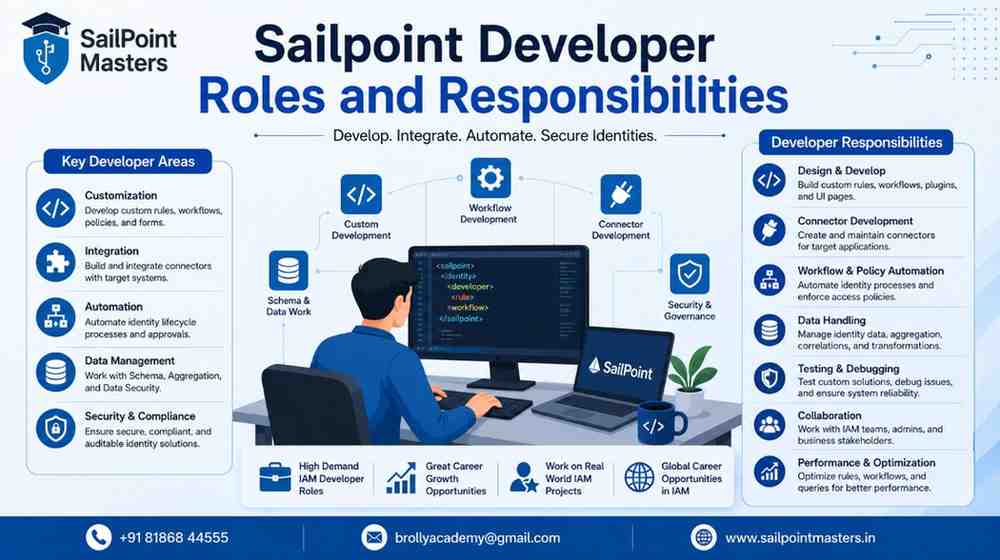
The digital identity and access management (IAM) landscape has transformed dramatically over the past decade. Organizations worldwide are racing to secure their identity infrastructure, and at the heart of this transformation is a growing army of skilled professionals: SailPoint developers.
A SailPoint developer is an identity and access management specialist who leverages SailPoint’s powerful platforms—IdentityIQ (IIQ) and Identity Security Cloud (ISC)—to design, implement, and maintain enterprise-grade identity governance solutions. These professionals are critical to enterprise security, managing everything from user provisioning and access requests to certification workflows and compliance reporting.
In India, SailPoint development has emerged as one of the most lucrative and in-demand IAM career paths. With Fortune 500 companies actively hiring and cloud transformation accelerating across industries, professionals pursuing SailPoint Certification Training in Hyderabad are positioning themselves for exceptional career growth and premium compensation.
This comprehensive guide walks you through everything you need to know about SailPoint developer roles, daily responsibilities, required skills, career progression, and the immense opportunities waiting in India’s thriving tech hub.
New to SailPoint entirely? Start with SailPoint Roadmap 2026 or explore free certification resources
SailPoint Developer Roles and Responsibilities
What is a SailPoint Developer?
A SailPoint developer is a specialized IAM engineer who possesses deep expertise in SailPoint’s identity governance and administration (IGA) platforms. These professionals bridge the gap between business requirements and technical implementation, translating organizational security policies into functional, automated identity workflows.
On a typical day, a Developer spends time inside Eclipse/IntelliJ writing BeanShell rules, testing connectors in a sandbox tenant, and debugging failed provisioning tasks in the IIQ logs — very different from an Analyst’s day running certification campaigns. See how the two roles differ in our SailPoint Interview Questions & Answers guide. They’re responsible for building custom connectors that integrate SailPoint with legacy and cloud-based enterprise systems, writing complex business logic in BeanShell and Java, and ensuring compliance with regulatory frameworks like SOX, HIPAA, and GDPR.
Core Responsibilities Overview
|
Developer Task |
What It Involves |
|
Unit Testing of Custom Rules |
Testing BeanShell/Java rules individually before pushing them to production, to catch logic errors early |
|
Version Control (Git) |
Managing BeanShell/Java code changes in Git — commits, branches, and merge tracking for team collaboration |
|
Peer Code Reviews |
Reviewing teammates’ rule/workflow code for quality, security, and standards compliance before deployment |
Note: These are practical, day-to-day Developer tasks most guides skip. For the full syllabus breakdown, see SailPoint Masters Syllabus.
Career Path & Progression
For the complete career-stage salary breakdown across all IAM roles, see our detailed SailPoint Course Salary in Hyderabad guide.
Essential Technical Skills
reading and writing XML configuration files (rules.xml, workflow.xml) and using Postman for REST API testing — core daily tools. Reference: BeanShell official docs and internal link to SailPoint IIQ and IdentityNow — which module to learn first.
SailPoint Certifications
Professional certifications significantly boost career prospects and earning potential
Not sure which certification path fits a Developer role, or want free resources before paying for one? See SailPoint Certification and Free Resources to Get Started.
Job Market & Salary Summary
These salary multipliers, plus a full city-wise comparison, are covered in depth in SailPoint Course Salary in Hyderabad.
Conclusion
Ready to specialize as a Developer specifically (not Admin or Analyst)? Our How to Become a SailPoint Developer guide walks through the exact 6-month learning path with project ideas. The combination of high compensation, job security, clear career progression, and the opportunity to work on mission-critical infrastructure makes it an outstanding choice for ambitious IT professionals.
Ready to launch your SailPoint developer career? Develop a strong foundation in Java, BeanShell, and Identity & Access Management (IAM). Learn SailPoint technologies, earn industry-recognized certifications, and build practical expertise through real-time projects and enterprise-level implementations. Professional training programs significantly accelerate this learning curve.
FAQ
1. What are the roles and responsibilities of a SailPoint Developer?
A SailPoint Developer designs, develops, customizes, and maintains Identity and Access Management (IAM) solutions using SailPoint IdentityIQ or Identity Security Cloud. Their responsibilities include application integration, workflow development, access provisioning, role management, connector configuration, and security compliance.
2. What skills are required to become a SailPoint Developer?
To become a successful SailPoint Developer, you should have knowledge of:
Rule debugging using IIQ’s built-in Debug Console, and Ant/Maven for build deployment.
SailPoint Interview Questions and Answers
3. Is Java mandatory for SailPoint Development?
Yes. Java is one of the most important programming languages for SailPoint Development. It is widely used for creating custom rules, workflows, plugins, connectors, and integrations within SailPoint IdentityIQ.
4. What is the difference between a SailPoint Developer and a SailPoint Administrator?
A SailPoint Developer focuses on customization, coding, integrations, workflows, and automation, whereas a SailPoint Administrator manages user provisioning, certifications, access requests, role administration, and daily platform operations.
5. Which SailPoint platform should beginners learn first?
Most beginners start with SailPoint IdentityIQ because it provides a strong understanding of IAM concepts. Learning Identity Security Cloud (ISC) afterward helps build expertise in modern cloud-based identity governance.
6. What is the salary of a SailPoint Developer in India?
Salary figures vary by city and role — see the full 2026 breakdown in SailPoint Course Salary in Hyderabad
7. Which certifications are useful for SailPoint Developers?
Full certification roadmap + free-resource options: SailPoint Certification and Free Resources.
8. What tools do SailPoint Developers commonly use?
SailPoint Developers frequently work with:
- SailPoint IdentityIQ
- SailPoint Identity Security Cloud (ISC)
- Eclipse or IntelliJ IDEA
- Visual Studio Code
- GitHub
- Postman
- Apache Tomcat
- SQL Server or Oracle Database
- Active Directory
- LDAP
9. Is SailPoint Development a good career in 2026?
Yes. SailPoint Development continues to be a high-demand career because organizations are investing heavily in Identity Governance and Administration (IGA), Zero Trust Security, and compliance. Skilled SailPoint Developers are sought after across banking, healthcare, IT services, telecom, and government sectors.
10. What projects should a SailPoint Developer work on to gain experience?
Beginners should build projects such as:
- User Lifecycle Management
- Joiner-Mover-Leaver (JML) Automation
- Access Request Workflows
- Role-Based Access Control (RBAC)
- Active Directory Integration
- HR Application Integration
- Certification Campaign Automation
- Custom Connector Development
11. How long does it take to become a SailPoint Developer?
With consistent learning and practical experience, most learners can gain job-ready skills within 3–6 months. Mastering advanced integrations and enterprise implementations may take additional hands-on experience.
12. How can I start a career as a SailPoint Developer?
Start by learning IAM fundamentals, Java, and BeanShell scripting. Then study SailPoint IdentityIQ and Identity Security Cloud, complete real-time projects, earn relevant certifications, and practice interview questions to build a strong portfolio.
SailPoint Trainer
SailPoint Masters Editorial Team | 15+ Articles Published
We specialize in SailPoint Certification Training in Hyderabad, helping aspiring professionals and IT experts develop in-demand Identity and Access Management (IAM) skills. Our training covers SailPoint IdentityIQ, Identity Security Cloud, certification preparation, real-world projects, and career guidance to support success in cybersecurity and identity governance careers.
Share