
How to Become a SailPoint Developer: The Complete 2026 Career Guide for India
To become a SailPoint Developer, learn Java, SQL, XML, BeanShell, and REST APIs, then master SailPoint IdentityIQ and Identity Security Cloud along with Identity Governance concepts like RBAC, provisioning, and access certifications. Complete structured training, earn official SailPoint certifications, build hands-on lab projects, and target IAM roles across banking, IT services, healthcare, and Fortune 500 enterprises hiring across India.
★★★★★
4.9/5 rated by 1329+ students · Google Verified
Table of Contents
Introduction: Why This Career Path Matters in 2026
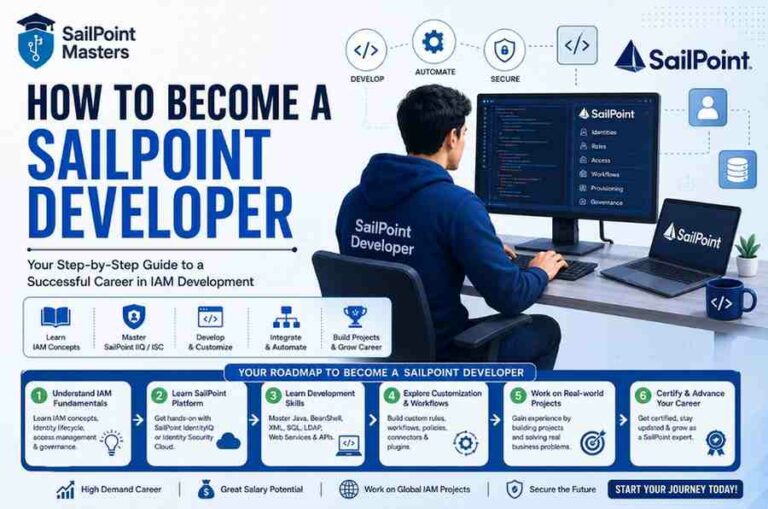
Identity has quietly become the front line of enterprise security. Every time an employee joins, changes departments, moves to a partner team, or leaves, someone has to answer a hard question: what systems should they touch, and can you prove that decision to an auditor months later? Multiply that across tens of thousands of workforce identities, contractors, service accounts, and cloud applications, and you get one of the most difficult problems in modern IT — the exact problem SailPoint Developers are paid well to solve.
A SailPoint Developer is the engineer who builds, customizes, and maintains identity governance solutions on top of the SailPoint Identity Security platform. That means writing rules, workflows, and connectors that automate joiner–mover–leaver processes, enforce Role-Based Access Control, and provide the audit evidence security and compliance teams need for SOX, HIPAA, GDPR, and India’s DPDP Act. It is a role that sits at the intersection of software engineering, cybersecurity, and business process design — and it is one of the few IT paths where demand in India is genuinely outrunning supply.
If you’re serious about breaking into this field, the fastest, most structured route is a hands-on lab-driven program like the SailPoint Certification Training in Hyderabad at SailPoint Masters. This guide walks you through everything you need to know to plan the journey: what the job actually involves, what you’ll earn, which technologies to learn in what order, and how to turn a general IT background into a SailPoint Developer offer letter.
How to Become a SailPoint Developer
What is a SailPoint Developer?
A SailPoint Developer is a specialized Identity and Access Management engineer who designs, configures, and extends SailPoint’s IGA products — primarily IdentityIQ (on-premises) and Identity Security Cloud (SaaS, formerly IdentityNow) — to fit an organization’s access, provisioning, and compliance needs. Unlike a general application developer, SailPoint Developers work at the layer where HR systems, directories, business applications, and cloud platforms meet: they connect them, normalize their data, and enforce policy across all of them.
Day to day, a SailPoint Developer might build a custom connector to a legacy in-house app, write a BeanShell rule that maps HR attributes to entitlements, design an access request workflow, tune aggregation performance across millions of accounts, or configure quarterly access certification campaigns. They partner with IAM architects, cybersecurity leads, business owners, and audit teams, and their code becomes part of an organization’s compliance backbone. For a deeper look at the day-to-day, see our detailed breakdown of SailPoint Developer roles and responsibilities.
Why SailPoint Development is a High-Demand Career in India
Three forces are converging on Indian IT that make SailPoint expertise unusually valuable right now. First, digital transformation has multiplied the number of applications every enterprise runs — SaaS tools, cloud workloads, custom apps, and legacy systems all need governed access. Second, regulators worldwide, including India’s own DPDP Act framework, are demanding provable, auditable identity controls. Third, Zero Trust architecture — where every access decision is verified, not assumed — has moved from buzzword to board mandate, and identity is its foundation.
The market data reflects this. According to Grand View Research’s IGA market report, the global Identity Governance and Administration market was valued at approximately USD 7.95 billion in 2024 and is projected to reach USD 27.11 billion by 2033, growing at a CAGR of 14.9%. India is capturing a disproportionately large share of the implementation and services work behind that growth because global banks, insurance groups, and technology companies have massive delivery centers here. SailPoint itself re-listed on Nasdaq as SAIL in February 2025 following its Thoma Bravo take-private phase, signaling a maturing but still fast-expanding market.
SailPoint Developer Career Opportunities in India
SailPoint Developer roles in India show up under many job titles, and understanding this landscape helps you position your CV correctly. Common titles include SailPoint IdentityIQ Developer, SailPoint IIQ Consultant, IAM Engineer (SailPoint), Identity Governance Engineer, IGA Developer, SailPoint Solution Consultant, and, at senior levels, SailPoint Technical Architect or IAM Practice Lead.
Hyderabad, Bengaluru, Pune, Chennai, Mumbai, and Gurugram are the primary hiring hubs — Hyderabad in particular hosts a disproportionate share of global capability centers running SailPoint programs for US and European parents. Remote and hybrid work is common for experienced developers, and Indian professionals often work directly with client teams in London, Zurich, New York, or Singapore. For a full landscape view, our SailPoint careers overview maps the roles and the typical progression across them.
Industries Hiring SailPoint Developers
SailPoint’s customer base skews toward heavily regulated industries where the cost of an audit failure — or a breach traceable to over-privileged accounts — is severe. In India, the hiring is concentrated across
- Banking, Financial Services, and Insurance (BFSI): Global banks, private-sector Indian banks, insurance groups, and stock exchanges use SailPoint to enforce segregation of duties and pass SOX and RBI audits.
- Information Technology and Consulting Services: TCS, Infosys, Wipro, Cognizant, HCLTech, Accenture India, Deloitte, and KPMG all run large SailPoint delivery practices staffing client projects worldwide.
- Healthcare and Life Sciences: Pharma majors and healthcare providers use SailPoint to meet HIPAA and GxP compliance.
- Retail and E-commerce: High-volume access lifecycle for seasonal workforces and third-party sellers.
- Telecommunications and Media: Managing subscriber, partner, and workforce identities at scale.
- Manufacturing and Energy: OT/IT convergence is putting identity governance on plant floors.
- Government and Public Sector: Growing adoption as digital-identity mandates mature.
Top Companies Hiring SailPoint Developers in India
The employers actively recruiting SailPoint talent in India fall into three buckets. Global consulting and systems integrators — Accenture, Deloitte, PwC, EY, KPMG, IBM, Capgemini, DXC, and Kyndryl — hire in bulk for both India-based and onsite delivery. Indian IT majors including TCS, Infosys, Wipro, Cognizant, Tech Mahindra, and HCLTech run large SailPoint IdentityIQ and ISC practices. Finally, product companies and end-customer enterprises — global banks with GCCs in India, US retailers, pharma companies, hyperscalers, and SailPoint partners themselves — hire experienced developers directly, often at premium salaries.
SailPoint Developer Roles and Responsibilities
The day-to-day responsibilities of a SailPoint Developer typically span the following areas
- Configuring and customizing SailPoint IdentityIQ or Identity Security Cloud based on business requirements.
- Building and maintaining connectors that pull identity and account data from Active Directory, LDAP, HR systems (SuccessFactors, Workday), SAP, Oracle, ServiceNow, and dozens of SaaS applications.
- Writing BeanShell, Java, and rule logic to transform attributes, correlate identities, and enforce joiner–mover–leaver policy.
- Designing access request workflows, approval chains, and provisioning policies.
- Implementing Role-Based Access Control models, role mining, and access reviews.
- Running scheduled aggregations, tuning performance, and troubleshooting failures.
- Supporting audit and compliance teams with certification campaigns, evidence, and reporting.
- Integrating with SIEM, PAM, and cloud identity platforms as part of a broader Zero Trust roadmap.
SailPoint Developer Salary in India
SailPoint salaries in India are consistently among the highest in the IAM stack, driven by talent scarcity and the criticality of the systems SailPoint governs. The ranges below reflect market observations across BFSI, IT services, and product companies as of 2026 and vary with location, employer type, and cloud vs on-prem specialization.
|
Experience Level |
Typical Role |
Average Annual Salary (INR) |
|
Fresher (0–2 Years) |
Junior IAM/SailPoint Engineer |
₹4.5 – ₹8 LPA |
|
Mid-Level (3–5 Years) |
SailPoint IIQ Developer / IGA Engineer |
₹9 – ₹18 LPA |
|
Senior (6–10 Years) |
Senior SailPoint Developer / Lead Consultant |
₹18 – ₹30 LPA |
|
Lead / Architect (10+ Years) |
SailPoint Architect / IAM Practice Lead |
₹30 – ₹55+ LPA |
Contract and independent consultants working with global clients frequently earn well above these ranges. For a Hyderabad-specific salary picture, see our detailed guide on SailPoint course and salary trends in Hyderabad.
Skills Required to Become a SailPoint Developer
Becoming a SailPoint Developer requires a layered skill stack. You need core programming fundamentals, working knowledge of enterprise data and integration, and depth on SailPoint’s own object model and configuration. Here is how the skill set typically breaks down
|
Category |
Core Skills |
Why It Matters |
|
Programming |
Java, BeanShell, basic Groovy |
SailPoint rules, custom tasks, and extensions are Java-based; BeanShell is used inside rules and workflows. |
|
Data & Integration |
SQL, XML, JSON, REST APIs, SOAP |
Identity and account data flows through relational stores, XML configs, and API integrations. |
|
Directories & Protocols |
Active Directory, LDAP, Kerberos, SAML, OAuth 2.0, OIDC |
Directories are the primary source and target of identity data. |
|
SailPoint Products |
IdentityIQ, Identity Security Cloud (ISC), Lifecycle Manager, Access Certifications |
The platforms you’ll actually configure and extend. |
|
Cloud & DevOps |
AWS or Azure basics, Git, CI/CD pipelines |
ISC is SaaS; on-prem IIQ deployments increasingly use DevOps patterns. |
|
Security & Compliance |
RBAC, SoD, Zero Trust, SOX, HIPAA, GDPR, DPDP Act |
You’ll implement controls that map directly to auditable frameworks. |
Java is the single most-asked-about prerequisite; if you’re worried about that, we have a full write-up on whether you can learn SailPoint without Java knowledge.
SailPoint Technologies Every Developer Should Learn
Below is the practical technology map every serious SailPoint Developer builds fluency in. Each item links to deeper reading where we’ve written about it in detail.
- SailPoint IdentityIQ (IIQ): The on-premises IGA workhorse — this is where most enterprise engineering work still happens. Understand its architecture, application object model, and identity cube.
- SailPoint Identity Security Cloud (ISC): The SaaS platform (formerly IdentityNow) built on Atlas. Read our overview of SailPoint Identity Security Cloud for how it differs.
- Identity Governance and Administration (IGA): The category itself — policy, certification, request, and provisioning. See our primer on SailPoint IGA.
- Lifecycle Manager: The module handling joiner–mover–leaver and access requests.
- Role-Based Access Control (RBAC): Learn how business, IT, and entitlement roles are modeled — start with RBAC in SailPoint IdentityIQ.
- Access Request & Approval Workflows: Business processes that fulfill user access with policy checks.
- Provisioning and Deprovisioning: Automated account creation, updates, and removal across target systems.
- Aggregation and Correlation: Pulling data from sources and linking it to identities — see aggregation in SailPoint.
- Access Certifications and Policies: Periodic reviews plus Separation of Duties rules.
- Connectors: AD, LDAP, JDBC, delimited file, and web services connectors — reference our SailPoint connectors list and setup guide.
- Enterprise Integrations: Especially SailPoint integration with SAP, plus Oracle EBS, ServiceNow, and Workday.
- Developer Tooling: The official SailPoint Developer Portal for APIs, SDKs, and integration recipes, and SailPoint product documentation for authoritative configuration reference.
SailPoint Developer Career Roadmap
Here is a stage-based learning path that mirrors how successful candidates actually progress from zero to lead architect.
|
Stage |
Learning Focus |
Outcome |
|
Beginner (0–3 months) |
IAM fundamentals, Java basics, SQL, XML, Active Directory concepts, an overview of what SailPoint is. |
Ready to install a lab and follow along with tutorials. |
|
Intermediate (3–6 months) |
IdentityIQ setup, aggregation, correlation rules, basic BeanShell, application onboarding, delimited/JDBC connectors, lifecycle events. |
Can configure a small IIQ environment end-to-end. |
|
Advanced (6–12 months) |
Custom rules and workflows, provisioning, access request customization, RBAC modeling, certifications, performance tuning, REST API integrations, and an IdentityIQ vs Identity Security Cloud comparison. |
Ready to interview for Developer/Consultant roles. |
|
Expert (12+ months) |
Solution design, architecture patterns, cloud migration to ISC, multi-source correlation strategies, DevOps for IIQ, PAM/SIEM integration, mentoring juniors. |
Lead/Architect track; certification specializations. |
Our full SailPoint career and learning roadmap expands each stage into weekly milestones.
SailPoint Certifications That Enhance Your Career
Certifications matter in this field because SailPoint projects are often sold on certified headcount. The credentials most recruiters and staffing partners look for include the SailPoint Certified IdentityIQ Engineer, SailPoint Certified IdentityIQ Consultant, SailPoint Certified Identity Security Cloud Engineer, and SailPoint Certified Identity Security Cloud Consultant. Advanced roles benefit from architect-level and vertical-specific credentials. Official training paths and exams are hosted on SailPoint University. For exam-day preparation strategies, see our guide to SailPoint IIQ exam preparation, and for planning your next credential, our post on what to do after your SailPoint certification.
Future Scope of SailPoint Development in India
Three trend lines will define SailPoint careers over the next five years. First, cloud identity migrations — moving from IdentityIQ to Identity Security Cloud — will remain a major project stream, and developers who understand both platforms will lead them. Second, Zero Trust adoption, framed by NIST’s Zero Trust Architecture guidance (SP 800-207), is expanding identity’s mandate from access management to continuous verification. Third, machine identity, non-human accounts, and AI agents are creating a whole new category of governed identities that today’s IGA platforms are being extended to cover. Developers who invest in these areas early will command outsized salaries by 2028–2030.
How to Become a SailPoint Developer: The Step-by-Step Path
Here is the practical sequence that has worked for thousands of Indian professionals transitioning into SailPoint from Java development, system administration, cybersecurity, or fresher backgrounds. Following this path with focus, most learners are interview-ready in six to nine months of consistent effort. Enrolling in a structured, mentor-led SailPoint training program in Hyderabad compresses that timeline further.
- Assess your baseline. Audit your comfort with Java, SQL, and basic scripting. If any is weak, spend two to four weeks strengthening it before touching SailPoint.
- Master IAM fundamentals. Understand authentication vs authorization, directory services, provisioning lifecycles, and compliance frameworks. Read our overview of what SailPoint is and how it fits into IAM.
- Set up a lab. Install IdentityIQ in a personal lab (VirtualBox or a cloud VM). Point it at a small Active Directory and a delimited-file application. This single step separates hobbyists from serious learners.
- Learn the object model. Identities, accounts, entitlements, applications, roles, policies — memorize how these objects relate. Study the IdentityIQ architecture until you can draw it from memory.
- Practice aggregation and correlation. Load real-looking data, write correlation rules, and debug them.
- Build workflows and rules. Start with the out-of-the-box lifecycle events, then customize them. Write BeanShell rules to transform data.
- Onboard applications. Configure a JDBC connector, a delimited connector, and a web services connector against test targets.
- Design an RBAC model. Model business, IT, and entitlement roles for a fictional company and implement it in your lab.
- Run certification campaigns. Configure a manager certification, complete it, and generate audit reports.
- Explore Identity Security Cloud. Sign up for the free SailPoint Developer sandbox where available; understand the API-first model.
- Join the community. Ask and answer questions on the SailPoint Developer Community forums. Recruiters actively watch active contributors.
- Earn a certification. Sit for the IdentityIQ Engineer or ISC Engineer exam once your lab work is solid.
- Interview strategically. Practice with real questions from our SailPoint interview questions and answers bank, target IT services and BFSI first, and use those roles as launchpads to product-company positions.
SailPoint Developer vs CyberArk Developer
|
Dimension |
SailPoint Developer |
CyberArk Developer |
|
Primary Domain |
Identity Governance & Administration (workforce identity, access lifecycle) |
Privileged Access Management (secrets, credentials, session control) |
|
Core Products |
IdentityIQ, Identity Security Cloud |
CyberArk PAS, Conjur, EPM |
|
Technologies Used |
Java, BeanShell, XML, SQL, REST APIs, LDAP |
REST APIs, PowerShell, Python, PSM plugins |
|
Typical Users |
All employees, contractors, and applications |
Admins, DBAs, service accounts, secrets consumers |
|
Career Opportunities |
Very high across BFSI, IT services, healthcare |
High, especially in BFSI and cybersecurity practices |
|
Salary Potential (India, Mid-Level) |
₹9 – ₹18 LPA |
₹8 – ₹16 LPA |
|
Best Use Case |
Govern who has access to what, with audit evidence |
Protect and rotate privileged credentials |
SailPoint Developer vs Saviynt Developer
|
Dimension |
SailPoint Developer |
Saviynt Developer |
|
Primary Domain |
IGA, cloud identity security, workforce and machine identity |
IGA plus native cloud PAM in a converged platform |
|
Core Products |
IdentityIQ, Identity Security Cloud |
Saviynt Enterprise Identity Cloud (EIC) |
|
Deployment Style |
Mature on-prem (IIQ) plus SaaS (ISC) |
Cloud-native SaaS-first |
|
Extensibility |
Java, BeanShell, workflows, REST APIs |
Analytics-first configuration, REST APIs, JSON |
|
Market Position |
Category leader with the deepest enterprise footprint |
Strong challenger, especially for cloud-first buyers |
|
Career Opportunities |
Broadest talent demand and largest project base |
Growing quickly; premium for early specialists |
|
Salary Potential (India, Mid-Level) |
₹9 – ₹18 LPA |
₹9 – ₹17 LPA |
For a side-by-side platform comparison beyond salary and job-title framing, our post on SailPoint vs Saviynt covers the architecture and licensing differences in depth.
SailPoint Developer vs Okta Developer
|
Dimension |
SailPoint Developer |
Okta Developer |
|
Primary Domain |
Identity Governance & Administration |
Access Management (SSO, MFA, lifecycle federation) |
|
Core Products |
IdentityIQ, Identity Security Cloud |
Okta Workforce Identity Cloud, Auth0, Okta Governance |
|
Focus |
Governance, certifications, provisioning, policy |
Authentication, SSO, adaptive access, developer identity |
|
Technologies Used |
Java, BeanShell, REST APIs, SQL, XML |
SAML, OIDC, OAuth 2.0, JavaScript, REST APIs |
|
Career Opportunities |
Enterprise-heavy, BFSI-led, larger deal sizes |
Product companies, SaaS-first businesses, developer platforms |
|
Salary Potential (India, Mid-Level) |
₹9 – ₹18 LPA |
₹8 – ₹16 LPA |
|
Best Use Case |
Prove who should have what access and audit it |
Let users sign in securely and seamlessly |
Why SailPoint Development is One of the Best IT Careers in India
Look at the field through the lens of five things every IT professional actually cares about — pay, stability, demand, work style, and long-term growth — and SailPoint Development scores unusually high on all of them.
High salary potential: Even mid-level SailPoint Developers routinely earn more than general full-stack developers with the same years of experience, because talent is scarce and projects are business-critical. Job stability: Compliance never disappears, and SailPoint installations are multi-year commitments. Global demand: Indian SailPoint Developers regularly work on projects for US, UK, EU, and APAC clients. Hybrid and remote flexibility: Many senior positions are fully remote, and even fresher roles offer flexible hybrid schedules. Cloud identity transformation: Every ISC migration is a new project. Cybersecurity budget growth: Identity consistently ranks as a top-three CISO spending priority. Fortune 500 exposure: Junior developers get to work on architectures used by the world’s largest enterprises.
Key Takeaways
- Start with fundamentals, then specialize. Java, SQL, XML, and IAM basics come before any SailPoint-specific training. Skipping this step is the number-one cause of stalled learners.
- Build a lab, not just notes. Employers hire on demonstrated configuration skill. A working IdentityIQ lab with real connectors is worth more than any certificate on paper.
- Learn IdentityIQ and Identity Security Cloud together. The market is bifurcated — projects exist on both, and dual fluency doubles your addressable roles.
- Certify strategically, not compulsively. One well-earned SailPoint credential paired with real project artifacts beats three certifications with no lab evidence.
- Position for BFSI and IT services first. These sectors hire in volume and train juniors; product companies typically hire from that pool later at higher pay.
Conclusion: Your Move
Becoming a SailPoint Developer is not a shortcut career — it demands real engineering discipline, patience with a complex object model, and the willingness to sit in front of a lab environment until things click. But the payoff is unusually generous: high starting salaries, uncommon job security, global project exposure, and a runway that keeps expanding as identity becomes the security perimeter for every enterprise on earth. If you follow the roadmap in this guide — fundamentals first, lab-driven learning, strategic certification, targeted interview prep — you can realistically go from beginner to a well-paying SailPoint Developer role inside a year.
The single biggest accelerator is structured, mentor-led training paired with real project scenarios. That is exactly what SailPoint Masters by Brolly Academy is built for. Explore our program, book a free demo class, and start your journey into IAM’s most in-demand career today.
Contact: Phone: 81868 44555 | Email: brollyacademy@gmail.com | Website: www.sailpointmasters.in
FAQ
1. Can a fresher become a SailPoint Developer without prior IT experience?
Yes, but the path is longer. Freshers typically need six to nine months of structured training covering Java, SQL, XML, IAM concepts, IdentityIQ configuration, and hands-on lab work before they are interview-ready. Programs that pair mentored labs with mock interviews shorten the ramp significantly, and BFSI and IT services companies do hire trained freshers into junior IAM engineer roles.
2. Is Java mandatory to become a SailPoint Developer?
Working knowledge of Java is strongly recommended because SailPoint rules, custom tasks, and extensions are Java-based, and BeanShell (a Java-syntax scripting language) is used throughout IdentityIQ. You don’t need to be a Java expert, but you should be comfortable reading Java code, writing basic classes, working with collections, and understanding exception handling.
3. How long does it take to become job-ready as a SailPoint Developer?
For someone with basic Java and SQL fundamentals, three to six months of focused training and lab work is typical. Absolute beginners should plan for six to nine months. Working professionals who study part-time usually take eight to twelve months to reach interview readiness while balancing their current job.
4. Which SailPoint certification should I pursue first?
The SailPoint Certified IdentityIQ Engineer is the most widely recognized entry credential and aligns with the largest volume of active projects in India. If your target roles are cloud-first — especially in product companies or with SaaS-heavy customers — the SailPoint Certified Identity Security Cloud Engineer is a better starting point. Both are hosted on SailPoint University.
5. What is the average salary of a SailPoint Developer in India in 2026?
Freshers typically earn ₹4.5–8 LPA, mid-level developers with three to five years earn ₹9–18 LPA, senior developers earn ₹18–30 LPA, and architects with ten-plus years frequently cross ₹30–55 LPA. Product companies and global banks pay at the top of these ranges.
6. Which is better to learn first — IdentityIQ or Identity Security Cloud?
IdentityIQ is generally the better starting platform because its object model is explicit, its documentation is exhaustive, and understanding it makes ISC concepts easier. Once you can configure IdentityIQ end-to-end, moving to ISC takes only a few weeks. That said, if your target employer is committed to ISC, start there and reverse the sequence.
7. What kind of projects will I work on as a SailPoint Developer?
Typical projects include greenfield IdentityIQ or ISC implementations, cloud migrations from IIQ to ISC, custom connector development, RBAC design and role mining, access certification campaigns, workflow customization, HR-driven joiner–mover–leaver automation, integration with SAP, ServiceNow, and Workday, and audit remediation programs.
8. Do I need cloud (AWS/Azure) knowledge to become a SailPoint Developer?
Basic cloud literacy is now expected, especially for Identity Security Cloud work. You do not need to be a certified cloud engineer, but you should understand IAM in AWS or Azure, how SaaS services expose APIs, how identity federation works, and the fundamentals of virtual networking. This baseline is enough for most SailPoint projects.
9. How do I prepare for SailPoint Developer interviews?
Focus on the object model (identities, accounts, entitlements, applications, roles, policies), aggregation and correlation, BeanShell rule writing, workflow customization, connector configuration, and troubleshooting scenarios. Practice explaining projects from your lab or previous work in problem-solution-outcome format. Our curated SailPoint interview questions and answers guide covers the most-asked patterns.
10. Is SailPoint Development a good long-term career choice?
Yes. The IGA category is growing at a 14.9% CAGR globally, identity is central to Zero Trust, regulators keep raising the bar on access controls, and India is one of the largest supply markets for SailPoint delivery talent. Skills built on SailPoint transfer well to adjacent identity, security, and cloud roles, so the long-term optionality is strong even for professionals who eventually move into architecture or CISO tracks.
SailPoint Trainer
SailPoint Masters Editorial Team | 15+ Articles Published
We specialize in SailPoint Certification Training in Hyderabad, helping aspiring professionals and IT experts develop in-demand Identity and Access Management (IAM) skills. Our training covers SailPoint IdentityIQ, Identity Security Cloud, certification preparation, real-world projects, and career guidance to support success in cybersecurity and identity governance careers.
Share