
SailPoint Provisioning vs Deprovisioning: A Complete Guide to Identity Lifecycle Management
SailPoint provisioning grants users access to systems and applications when they join a company or change roles, while deprovisioning removes that access when they leave or no longer need it. Together, these processes form the backbone of identity lifecycle management, reducing security risk, supporting compliance, and streamlining onboarding and offboarding across the enterprise.
★★★★★
4.9/5 rated by 1329+ students · Google Verified
Table of Contents
Introduction
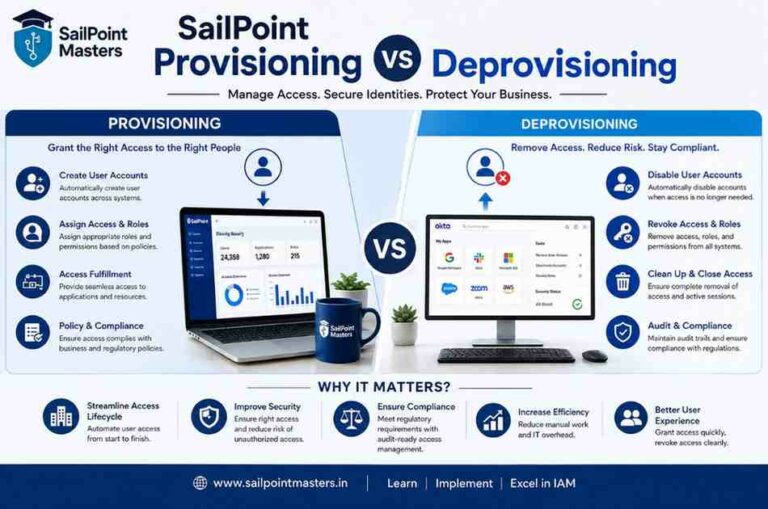
Every organization runs on identities. Employees, contractors, and even machine accounts all need access to applications, systems, and data to do their jobs — and just as importantly, that access needs to disappear the moment it’s no longer needed. This is the essence of the ongoing conversation around sailpoint provisioning vs deprovisioning, two sides of the same coin that together define how identity governance works in practice.
Provisioning and deprovisioning sound like simple IT tasks, but in reality they sit at the heart of enterprise security and compliance. A new hire who can’t log into their email on day one creates frustration. A departing employee whose accounts stay active for weeks after they leave creates risk. SailPoint, one of the leading identity security platforms on the market, was built specifically to solve this balancing act at scale.
In this guide, we’ll break down what provisioning and deprovisioning mean inside SailPoint, how the two processes differ, why they matter so much for security and compliance, and how organizations can use automation to get both right — consistently, every time.
SailPoint Provisioning vs Deprovisioning
What is Provisioning in SailPoint?
Provisioning is the process of granting a user the access they need to do their job. In SailPoint, this typically happens the moment someone joins an organization, moves into a new role, or requests access to a specific application or resource.
Provisioning can be triggered in a few different ways
- HR-driven provisioning — access is granted automatically based on data from an HR system, such as a new employee record or a job title change.
- Self-service access requests — users request access to applications or entitlements through SailPoint’s request catalog, which then routes to the appropriate approver.
- Birthright access — a baseline set of access rights automatically assigned to everyone in a particular department, location, or role, so new employees can start working immediately.
SailPoint connects to the underlying applications and systems — think Active Directory, Workday, Salesforce, or countless other enterprise tools — through connectors, which are pre-built or custom integrations that let SailPoint create accounts, assign entitlements, and update permissions without manual intervention. If you’re new to the platform, it helps to first understand what SailPoint is and how it fits into IAM before diving into provisioning specifics.
What is Deprovisioning in SailPoint?
Deprovisioning is the reverse process: removing or reducing a user’s access when it’s no longer needed. This happens most commonly when an employee leaves the organization, but it also applies to role changes, contractor contract expirations, and access that’s simply no longer justified.
Deprovisioning in SailPoint generally covers
- Full deprovisioning — disabling or deleting all of a user’s accounts and entitlements, typically triggered when someone’s employment ends.
- Partial deprovisioning — removing specific entitlements that are no longer relevant, such as when an employee moves from Finance to Marketing and loses access to financial systems.
- Automated deprovisioning — access removal that’s triggered directly by an HR event or a policy violation, without requiring a help desk ticket.
Timely deprovisioning is one of the most important controls in identity security. Orphaned accounts — active accounts that belong to no current employee — are a well-known attack vector, and auditors consistently flag delayed deprovisioning as a top compliance gap.
SailPoint Provisioning vs Deprovisioning
At a glance, provisioning and deprovisioning are opposite actions, but they’re deeply connected as part of the same identity lifecycle. Provisioning is about enablement — getting people working quickly and securely. Deprovisioning is about risk reduction — making sure access doesn’t linger past its usefulness.
The two processes also differ in urgency and visibility. Provisioning delays are usually noticed right away, since a new employee who can’t access their tools will raise the issue. Deprovisioning delays, on the other hand, often go unnoticed until an audit or a security incident brings them to light, which is exactly why automation matters so much for offboarding.
In SailPoint, both processes rely on the same underlying framework — identity governance policies, connectors, and workflows — but they’re triggered by different events and carry different risk profiles. Getting provisioning wrong slows the business down. Getting deprovisioning wrong opens the door to security breaches.
Why Provisioning and Deprovisioning Matter in Identity Security
Identity has become the primary perimeter for modern enterprises. With cloud applications, remote work, and third-party contractors all part of the picture, the traditional network firewall no longer defines where a company’s risk boundary sits — identity does.
That makes provisioning and deprovisioning foundational security controls, not just IT convenience features. A well-managed provisioning process ensures every user gets exactly the access they need — no more, no less — following the principle of least privilege access. A well-managed deprovisioning process ensures that access disappears the instant it’s no longer justified, closing the window of opportunity for misuse.
Together, these processes also support segregation of duties (SoD), a control that prevents any single user from having conflicting access rights that could enable fraud — for example, the ability to both create a vendor and approve payments to that vendor. This is closely tied to Role-Based Access Control in SailPoint IdentityIQ, which defines the roles and entitlements that SoD policies check against.
How SailPoint Automates User Lifecycle Management
SailPoint’s core value proposition is automating what used to be manual, ticket-based IT work. Instead of a help desk agent manually creating accounts or an IT admin remembering to disable access when someone leaves, SailPoint ties identity actions directly to business events.
This is often referred to as the Joiner-Mover-Leaver (JML) process:
- Joiner — a new employee is hired, and SailPoint automatically provisions birthright access along with any role-specific entitlements.
- Mover — an employee changes roles or departments, and SailPoint adjusts their access, granting new entitlements and revoking ones no longer relevant.
- Leaver — an employee exits the organization, and SailPoint automatically triggers full deprovisioning across connected systems.
SailPoint also supports access certification, a periodic review process where managers or application owners confirm that existing access is still appropriate, catching anything that automation alone might miss. Under the hood, this automation runs on the SailPoint IdentityIQ architecture, which ties together identity data, policies, and connectors into a single governance engine.
Provisioning Workflow in SailPoint
A typical provisioning workflow in SailPoint follows a predictable sequence
- A trigger event occurs — a new hire record appears in the HR system, or a user submits an access request.
- SailPoint evaluates the request against defined policies, including role-based access control (RBAC) rules and SoD constraints.
- If approval is required, the request routes to a manager or application owner through an approval workflow.
- Once approved, SailPoint’s connectors provision the account and entitlements directly in the target systems.
- The action is logged for audit purposes, and the user’s identity profile is updated to reflect their current access.
This workflow can run in seconds for straightforward requests or take longer when multiple approvals are required, but the key advantage is consistency — every request follows the same governed path. Much of this depends on accurate identity data, which is why it’s worth understanding how account aggregation works in SailPoint before configuring provisioning rules.
Deprovisioning Workflow in SailPoint
Deprovisioning workflows mirror the provisioning process but run in reverse
- A trigger event occurs — an HR termination record, a role change, or a manual request.
- SailPoint identifies every account and entitlement tied to that identity across connected systems.
- Policies determine what happens next — immediate disablement, a grace period, or partial revocation depending on the scenario.
- Connectors execute the removal or disablement of accounts in each target system.
- The action is logged, creating an audit trail that proves access was removed promptly.
Because deprovisioning often needs to happen instantly — particularly for involuntary terminations — many organizations configure SailPoint to trigger same-day or same-hour deprovisioning tied directly to HR events, removing the dependency on manual IT tickets. If you’re building or customizing these processes yourself, this beginner’s guide to SailPoint workflows is a good next step.
Benefits of Automated Provisioning and Deprovisioning
Automating both sides of the identity lifecycle delivers measurable benefits
- Faster onboarding — new employees get access on day one instead of waiting days for manual account creation.
- Reduced security risk — orphaned and stale accounts are eliminated quickly, shrinking the attack surface.
- Stronger compliance posture — automated logging creates a clear audit trail for regulations like SOX, HIPAA, and GDPR.
- Lower operational cost — fewer manual tickets means less help desk workload and fewer errors.
- Better user experience — employees spend less time waiting on access requests and more time being productive.
Common Challenges and Best Practices
Even with automation, organizations run into recurring challenges
- Incomplete connector coverage — if an application isn’t connected to SailPoint, it falls outside automated provisioning and deprovisioning, creating a manual gap.
- Overly broad birthright access — granting too much access by default undermines least privilege principles.
- Delayed HR data feeds — if HR systems don’t update promptly, automated triggers can lag behind real-world events.
- Poorly defined approval workflows — vague or overly complex approval chains slow down provisioning and frustrate users.
Best practices to address these challenges include auditing connector coverage regularly, tightening birthright access to only what’s truly universal, integrating HR systems as close to real time as possible, and periodically reviewing approval workflows for unnecessary complexity.
Provisioning vs Deprovisioning Comparison Table
|
Aspect |
Provisioning |
Deprovisioning |
|
Purpose |
Grants access |
Removes access |
|
Primary Trigger |
New hire, role change, access request |
Termination, role change, policy expiration |
|
Urgency |
Noticed quickly if delayed |
Often unnoticed if delayed |
|
Risk if Mismanaged |
Productivity loss |
Security and compliance risk |
|
Key SailPoint Feature |
Access request catalog, birthright access |
Automated termination workflows |
|
Audit Focus |
Was access appropriate? |
Was access removed on time? |
Real-World Use Cases Across Industries
- Financial services — banks use SailPoint to enforce segregation of duties between trading and settlement functions, reducing fraud risk while satisfying regulatory examiners.
- Healthcare — hospitals rely on rapid deprovisioning to ensure former staff can no longer access electronic health records, supporting HIPAA compliance.
- Retail — large retailers with seasonal workforces use automated provisioning to onboard temporary staff quickly and automated deprovisioning to remove access the moment seasonal contracts end.
- Technology — software companies use role-based provisioning to give engineers access to production systems only when justified by their current project.
- Manufacturing — global manufacturers use SailPoint connectors to manage access across a sprawling mix of legacy and cloud systems spanning multiple regions.
Compliance and Security Benefits
Regulatory frameworks increasingly expect organizations to prove that access is both appropriate and time-bound. SailPoint’s provisioning and deprovisioning capabilities directly support several major compliance requirements
- SOX — requires strong controls over financial systems access, including evidence of timely deprovisioning for departing employees.
- HIPAA — mandates that access to protected health information be limited to those who need it, and removed promptly when no longer needed.
- GDPR — expects organizations to minimize unnecessary access to personal data, aligning with least privilege principles.
- ISO 27001 — requires documented access control processes, which automated provisioning and deprovisioning workflows naturally support through audit logs.
These requirements are exactly what Identity Governance and Administration (IGA) frameworks are designed to enforce — you can go deeper into how SailPoint structures this in Master SailPoint IGA.
How SailPoint Integrates with Enterprise Applications
SailPoint’s provisioning and deprovisioning capabilities depend heavily on its connector ecosystem. Connectors act as the bridge between SailPoint’s governance engine and the actual applications where accounts live — whether that’s Active Directory, Azure AD, Workday, SAP, ServiceNow, or countless SaaS applications.
SailPoint offers both out-of-the-box connectors for common enterprise systems and the flexibility to build custom connectors for proprietary or legacy applications. This is what allows a single governance platform to manage identity across a sprawling, heterogeneous IT environment — from on-premises directories to modern cloud platforms. For a full breakdown of what’s supported, see this SailPoint connectors list and setup guide.
Two primary SailPoint products handle this work: IdentityIQ and Identity Security Cloud (ISC), each suited to different deployment needs. If you’re deciding between the two, this dedicated comparison of IdentityIQ vs Identity Security Cloud breaks down the trade-offs in detail.
Future of Identity Lifecycle Automation
Identity governance continues to evolve alongside broader security trends. A few directions are shaping where provisioning and deprovisioning are headed
- Zero Trust security, as defined by NIST, is pushing organizations toward continuous verification of access rather than one-time approval, making dynamic provisioning and deprovisioning even more important.
- AI-assisted access decisions are beginning to help predict which access requests are low-risk and can be auto-approved, versus which need closer human review.
- Cloud identity management is accelerating as more workloads move off-premises, increasing reliance on SaaS-based platforms like Identity Security Cloud.
- Machine and non-human identities — service accounts, bots, and API keys — are becoming a growing share of what needs to be provisioned and deprovisioned, expanding the scope of identity governance beyond just human users. This shift is covered in more depth in SailPoint machine identity security.
As these trends mature, the gap between manual and automated identity management will keep widening, making platforms like SailPoint increasingly central to enterprise security strategy.
Key Takeaways
- Provisioning grants access when someone joins, moves within, or requests something from an organization, while deprovisioning removes access when it’s no longer needed.
- SailPoint automates both processes through the Joiner-Mover-Leaver framework, connectors, and policy-driven workflows.
- Delayed deprovisioning is a bigger security risk than delayed provisioning, since it often goes unnoticed until an audit or incident.
- Automation improves onboarding speed, reduces orphaned accounts, and strengthens compliance with frameworks like SOX, HIPAA, and GDPR.
- The future of identity lifecycle management includes Zero Trust principles, AI-assisted access decisions, and growing coverage of non-human identities.
FAQ
- What is the main difference between SailPoint provisioning and deprovisioning?
Provisioning grants a user access to systems and applications, while deprovisioning removes that access when it’s no longer needed, such as after an employee leaves.
- Why is deprovisioning considered a bigger security risk than provisioning?
Delayed deprovisioning often goes unnoticed, leaving orphaned accounts active and vulnerable to misuse, whereas provisioning delays are usually caught quickly because they affect productivity.
- What is the Joiner-Mover-Leaver process in SailPoint?
It’s a framework that ties identity actions to three key employment events: joining the organization, moving into a new role, and leaving the organization, automating the corresponding access changes for each.
- What is birthright access in SailPoint?
Birthright access is a baseline set of entitlements automatically granted to every user in a specific department, role, or location, allowing new employees to start working without delay.
- How does SailPoint support Role-Based Access Control (RBAC)?
SailPoint uses defined roles to determine what entitlements a user should have, streamlining provisioning by assigning access based on role membership rather than individual manual grants.
- What is the difference between SailPoint IdentityIQ and Identity Security Cloud?
They’re SailPoint’s two core deployment options, built for different infrastructure needs and scaling requirements — see the comparison linked above for a full breakdown.
- How does automated provisioning improve employee onboarding?
It allows new hires to receive the access they need on their first day automatically, instead of waiting on manual IT tickets and help desk requests.
- What role do connectors play in SailPoint provisioning and deprovisioning?
Connectors link SailPoint to target applications and systems, allowing it to create, update, or remove accounts and entitlements directly without manual intervention.
- How does SailPoint support compliance requirements like SOX and HIPAA?
SailPoint creates detailed audit logs of every access change, proving that provisioning and deprovisioning happened appropriately and on time, which auditors rely on for compliance verification.
- What is access certification in SailPoint?
Access certification is a periodic review process where managers or application owners confirm that a user’s existing access is still appropriate, catching issues that automated policies alone might miss.
Conclusion
The debate over sailpoint provisioning vs deprovisioning ultimately comes down to two sides of the same identity lifecycle: enabling people to work efficiently while making sure access disappears the moment it’s no longer justified. Provisioning gets employees moving fast. Deprovisioning keeps the organization secure long after that access is no longer needed.
Together, these processes form the backbone of modern identity governance — reducing risk, supporting compliance, and cutting the operational overhead that comes with manual account management. As enterprises continue shifting toward cloud environments, Zero Trust architectures, and increasingly complex identity landscapes, mastering both provisioning and deprovisioning isn’t optional anymore — it’s foundational.
For IT and security professionals looking to build a career in identity governance, understanding SailPoint’s approach to provisioning and deprovisioning is a strong place to start. It’s a skill set that sits squarely at the intersection of security, compliance, and business enablement — and one that will only grow more valuable as identity continues to define the modern security perimeter. If you’re ready to take the next step, explore SailPoint career paths to see where these skills can take you.
If you’d rather learn these concepts hands-on with live projects and mentor support, our SailPoint Certification Training in Hyderabad covers provisioning, deprovisioning, and the full identity lifecycle in depth — with both online and classroom batches available.
SailPoint Trainer
SailPoint Masters Editorial Team | 15+ Articles Published
We specialize in SailPoint Certification Training in Hyderabad, helping aspiring professionals and IT experts develop in-demand Identity and Access Management (IAM) skills. Our training covers SailPoint IdentityIQ, Identity Security Cloud, certification preparation, real-world projects, and career guidance to support success in cybersecurity and identity governance careers.
Share