
SailPoint IIQ Curriculum: A Complete Learning Guide for 2026
A SailPoint IIQ Curriculum is a structured learning path that covers SailPoint IdentityIQ architecture, Identity Governance (IGA), installation, provisioning, role management, workflows, BeanShell rules, application onboarding, integrations, and real-world projects. It equips learners with the practical skills required for SailPoint IIQ Developer and IGA Engineer roles. Enrolling in SailPoint Certification Training in Hyderabad helps professionals gain hands-on experience, industry-recognized knowledge, and job-ready expertise, opening opportunities in India’s rapidly growing identity security and enterprise IAM market.
★★★★★
4.9/5 rated by 1329+ students · Google Verified
Table of Contents
What is SailPoint IIQ Curriculum?
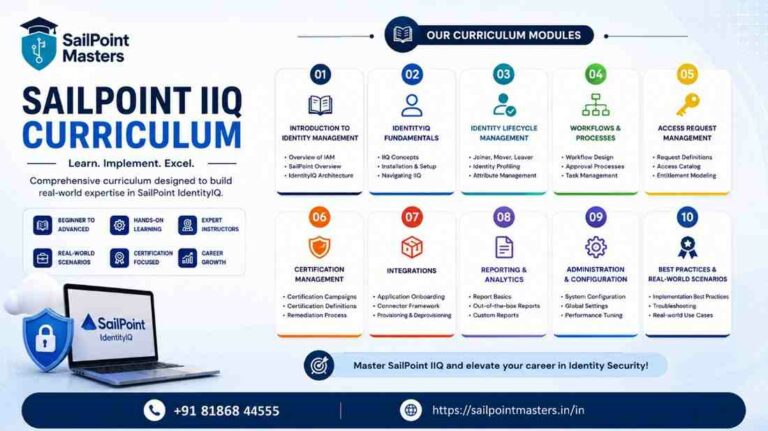
The SailPoint IIQ curriculum is the organised sequence of topics, labs and projects that takes a learner from identity fundamentals to confident, hands-on IdentityIQ implementation. Rather than a random list of features, a good curriculum follows the natural flow of a real project: understand governance, install the platform, connect applications, aggregate identity data, automate provisioning, run certifications, and customize behaviour with rules and workflows.
A complete curriculum is layered. The foundation covers identity concepts and the IIQ object model. The middle layers cover connectors, lifecycle events and access reviews. The advanced layers cover BeanShell scripting, workflow development, REST integrations and performance tuning. Each layer is reinforced with practice so the knowledge sticks.
SailPoint IIQ Curriculum
Why Learn SailPoint IdentityIQ?
SailPoint is consistently recognised as a leader in identity security, and IdentityIQ remains the workhorse for large on-premises and hybrid deployments. Learning it gives you three durable advantages: a niche, high-demand skill; exposure to security and compliance that touches every enterprise system; and a career that is hard to automate away because it blends configuration, scripting and business judgement.
- Scarcity: Trained IIQ engineers are far fewer than open roles, which keeps compensation strong.
- Stickiness: Identity projects run for years, creating stable, long-term assignments.
- Breadth: You work across HR systems, Active Directory, databases and cloud apps, building rare full-stack visibility.
SailPoint IIQ Course Modules
Most quality programs organise the SailPoint IIQ course into progressive modules. The exact naming varies, but the spine is consistent
- Module1: Introduction to IAM & IGA – Learn how organizations secure digital identities, control user access, and manage permissions throughout the entire user lifecycle using Identity Governance concepts.
- Module2: SailPoint IdentityIQ Overview – Get familiar with what IdentityIQ does, how it’s structured, and the key capabilities it offers.
- Module3: Installation & Environment Setup – Configure all required software, dependencies, and deploy SailPoint IdentityIQ in a fully operational environment.
- Module4: IdentityIQ Architecture – Dive into the platform’s building blocks and how its objects relate to one another.
- Module5: Application Onboarding – Link your organization’s applications to IdentityIQ through supported connectors.
- Module6: Aggregation – Pull in accounts, groups, and entitlements from every connected system.
- Module7: Identity Mapping – Match individual accounts to the right identities to ensure accurate governance.
- Module8: Provisioning – Streamline account creation, modification, and removal across all target systems.
- Module9: Lifecycle Manager – Handle access at every stage of the employee journey — onboarding, transfers, and offboarding.
- Module10: Roles Management – Design and maintain business and technical roles that make access easier to govern.
- Module11: Access Request Management – Let users submit access requests and route them through defined approval flows.
- Module12: Certifications – Run scheduled access reviews to keep the organization compliant and audit-ready.
- Module13: Policies Management – Set up and enforce rules that catch and flag access violations.
- Module14: Risk Management – Track and evaluate risk levels tied to identities and applications enterprise-wide.
- Module15: Rules Development – Build and customize SailPoint rules using scripting to automate processes and meet business-specific requirements.
- Module16: Workflow Development – Build automated processes that handle approvals and provisioning end to end.
- Module17: Forms Development – Design interactive forms that gather the input needed during workflows.
- Module18: Tasks & Scheduling – Set routine operations to run automatically through scheduled jobs.
- Module19: Reports Management – Produce ready-made and tailored reports to support audits and compliance.
- Module20: Email Templates – Set up automatic email alerts triggered by IdentityIQ activity.
- Module21: Workgroups & Populations – Group users logically to make administration faster and cleaner.
- Module22: QuickLinks – Add shortcuts that make everyday IdentityIQ actions quicker to reach.
- Module23: Debugging & Logging – Analyze application logs and apply debugging techniques to detect, investigate, and fix system issues efficiently.
- Module24: Database & XML Objects – Learn how database structures and XML configuration files support the storage, customization, and operation of SailPoint IdentityIQ.
- Module25: REST API Integration – Connect IdentityIQ to outside systems through REST-based APIs.
- Module26: Active Directory Integration – Keep identities in sync and govern access within Active Directory.
- Module27: ServiceNow Integration – Wire up IdentityIQ with ServiceNow to automate ticketing and approvals.
- Module28: Custom Development – Expand IdentityIQ’s features with Java customizations and plugin development.
- Module29: Real-Time Project Implementation – Put everything into practice through a full enterprise deployment project.
- Module30: Interview & Certification Preparation – Get ready for interviews and certification with practical scenarios and expert guidance.
Core Concepts Covered in the SailPoint IIQ Curriculum
Beyond modules, the curriculum drills into a set of core concepts that appear again and again in real projects: identities, accounts, entitlements, applications, policies, roles, certifications and workflows. Understanding how these objects relate to one another is the single biggest predictor of how quickly a learner becomes productive. The curriculum deliberately revisits these concepts from multiple angles — first as theory, then through the UI, then through configuration, and finally through code.
SailPoint IIQ Architecture Explained
IdentityIQ is a Java-based web application that typically runs on an application server (such as Apache Tomcat) backed by a relational database. At a high level, the architecture has a presentation layer (the web UI), a business logic layer (the IdentityIQ engine, task scheduler and workflow engine), and a data layer (the IIQ database storing identities, links, entitlements and audit records).
Connectors sit between IIQ and target systems, reading and writing account data. The aggregation engine pulls data in; the provisioning engine pushes changes out. Rules and workflows let you inject custom logic at almost every step. Grasping this flow early makes every later topic — from onboarding to debugging — far easier to reason about.
Identity Governance and Administration (IGA) Fundamentals
IGA is the discipline of managing digital identities and their access in a way that is secure, compliant and auditable. It answers three questions continuously: who has access, should they have it, and how do we prove it. IdentityIQ operationalises IGA by centralising identity data, enforcing policy, automating joiner-mover-leaver events, and producing the evidence auditors demand. According to Grand View Research, the global IGA market was valued at USD 7.95 billion in 2024 and is projected to reach USD 27.11 billion by 2033, growing at a 14.9% CAGR — a clear signal of long-term demand.
Identity Lifecycle Management
Lifecycle management automates what happens when a person joins, changes role, or leaves. A new hire is auto-provisioned with birthright access; a transfer triggers an access recalculation; a termination revokes everything immediately. Done well, this reduces risk and manual effort dramatically.
Access Request
Access request lets users ask for additional entitlements through a self-service catalogue, routed through approval chains before anything is granted. The curriculum covers how to configure the request UI, approval policies and fulfilment.
Access Certification
Certifications are periodic reviews where managers or application owners confirm that existing access is still appropriate. They are the backbone of compliance for frameworks like SOX, and IIQ automates their scheduling, reminders and revocation.
SailPoint IIQ Installation and Configuration
The installation module turns abstract architecture into a working environment. Learners set up the database schema, deploy the IIQ application to Tomcat, configure the iiq.properties file, and run the initial system setup. From there, they configure identity attributes, application definitions and the identity cube — the consolidated view of a person across all systems. Getting comfortable here removes the fear of “breaking” the platform and builds the confidence to experiment.
Application Onboarding in SailPoint IIQ
Application onboarding is the heart of day-to-day IIQ work. It means connecting a target system, mapping its accounts and entitlements into IIQ, and defining how data flows in and out. The curriculum walks through choosing the right connector, configuring connection parameters, building account and group schemas, and setting correlation rules so accounts attach to the correct identity.
Aggregation
Aggregation is the process of reading accounts and entitlements from a connected application into IIQ. Account aggregation pulls user accounts; group aggregation pulls entitlements. Scheduled aggregations keep the identity warehouse current.
Connector Framework
The connector framework is the standardised layer that lets IIQ talk to diverse systems — directories, databases, cloud apps and flat files — through a consistent interface, with both out-of-the-box and custom connectors.
Provisioning and De-Provisioning
Provisioning is the automated creation, modification and removal of access on target systems. When a role is assigned, IIQ generates a provisioning plan and executes it through the relevant connector; de-provisioning reverses that on departure. The curriculum covers provisioning policies, the provisioning engine, manual work items for systems without automated connectors, and how to track fulfillment end to end. Mastering provisioning is what makes an IIQ engineer genuinely valuable.
Certifications and Access Reviews
This module deepens the certification concept into practice. Learners configure manager certifications, application owner certifications and role membership reviews; design certification campaigns; handle delegations and reassignments; and automate revocation of access that reviewers reject. Because access reviews are central to audit readiness, this is one of the most career-relevant modules in the entire curriculum.
Role Management and Lifecycle Manager
Roles bundle entitlements into business-friendly packages so access can be granted by job function rather than by individual permission. The curriculum covers business roles, IT roles, role modelling, role mining and how Lifecycle Manager uses roles to drive automated provisioning. For a deeper treatment of access models, our guide to Role-Based Access Control in SailPoint IdentityIQ is a strong companion to this section.
Role-Based Access Control (RBAC)
RBAC grants access based on roles rather than assigning permissions one by one. It simplifies administration, improves consistency and makes audits cleaner. The U.S. NIST RBAC standard formalised the model, and IIQ implements it through its role engine.
Workflow Development in SailPoint IIQ
Workflows orchestrate multi-step business processes inside IIQ — approvals, notifications, provisioning and custom logic — using a sequence of steps defined in XML. The curriculum covers the workflow library, standard workflows such as LCM Provisioning, custom workflow steps, and how to debug execution. If you want to see how orchestration differs across SailPoint products, compare it with our breakdown of the difference between IdentityIQ and IdentityNow workflows.
Rules, BeanShell, and Customization
Where configuration ends, code begins. IIQ is extensively customisable through rules written in BeanShell, a lightweight Java scripting language.
BeanShell Rules
BeanShell rules let you inject custom logic at specific extension points — build map rules, correlation rules, provisioning policy rules and more. Because BeanShell is Java-like, comfort with basic Java pays off immediately.
Java Basics
You do not need to be a Java developer, but understanding variables, conditionals, loops, objects and the SailPoint API classes makes rule writing far smoother. If you are unsure whether coding is a barrier, our article on whether you can learn SailPoint without Java knowledge addresses exactly this concern.
XML
IIQ objects — applications, workflows, rules, roles — are represented as XML. Reading and editing this XML through the debug pages is an everyday skill, so the curriculum builds XML fluency early.
Debugging
Debugging covers reading logs, using the IIQ console, inspecting objects in the debug interface, and tracing provisioning plans. Strong debugging skill is what employers quietly value most.
Reporting and Compliance Features
IIQ ships with a reporting engine that produces identity, entitlement, certification and audit reports, plus the ability to build custom reports. The curriculum covers out-of-the-box reports, report customisation, and how reporting supports compliance evidence for regulations and internal audits.
Reporting
Learners configure report templates, schedule recurring reports, and export results for auditors and stakeholders — turning raw identity data into governance insight.
SQL
Because IIQ stores data in a relational database, basic SQL helps with troubleshooting, custom reports and validating data. The curriculum introduces the key tables and safe query practices.
Integration with Active Directory, LDAP, and HR Systems
Real deployments connect IIQ to the systems that define and consume identity. This module is where many of the most valuable, billable skills live.
Active Directory Integration
AD is the most common target system. Learners configure the AD connector, aggregate users and groups, and provision account creation, group membership and password changes back to AD.
LDAP Integration
LDAP directories follow similar patterns. The curriculum covers connecting to LDAP, mapping schemas and handling directory-specific quirks.
HRMS Integration
HR systems are usually the authoritative source for identity. Learners build HR feeds (often via flat file or database) that trigger joiner-mover-leaver events, making HR the engine that drives the whole identity lifecycle. For enterprise application patterns, our guide to SailPoint integration with SAP and enterprise applications extends this topic.
REST API and Web Services Integration
Modern environments increasingly integrate over APIs. IIQ exposes and consumes REST web services, allowing it to connect to cloud applications and custom systems that lack a native connector.
REST APIs
The curriculum covers calling external REST endpoints from IIQ, exposing IIQ data through its own APIs, handling authentication and JSON payloads, and using the Web Services connector for SaaS targets. The official SailPoint Developer portal is the reference learners use to go deeper.
SailPoint IIQ Projects and Hands-on Practice
Theory alone does not get you hired. The strongest curricula are anchored by realistic projects, such as
- Onboard Active Directory end to end, with aggregation and provisioning.
- Build an HR-driven joiner-mover-leaver lifecycle.
- Configure a manager certification campaign with automated revocation.
- Model business and IT roles, then automate role-based provisioning.
- Write BeanShell rules for correlation and attribute population.
- Develop a custom approval workflow for access requests.
Each project mirrors something a consultant would actually deliver, which is why hands-on practice is non-negotiable. The official SailPoint documentation is an excellent companion reference while you build, and the SailPoint Developer Community is a valuable place to ask questions and learn from real implementations.
Skills Required to Become a SailPoint IIQ Developer
A job-ready IIQ developer combines product knowledge with a handful of supporting technical skills
- Solid grasp of IGA concepts and the IIQ object model
- Java basics and BeanShell scripting
- XML reading and editing
- Working knowledge of Active Directory, LDAP and databases
- Basic SQL for troubleshooting and reporting
- REST/JSON for modern integrations
- Methodical debugging and documentation habits
To self-assess and prepare for interviews, work through our curated SailPoint interview questions and answers.
SailPoint IIQ Career Opportunities in India
India is a global hub for identity and access management delivery. Roles span SailPoint developer, IIQ engineer, IAM consultant, identity governance analyst and IGA architect. Demand is concentrated in Hyderabad, Bengaluru, Pune, Chennai and the NCR, driven by global capability centres, banks, IT services firms and consulting practices. Because IIQ implementations are long-running and specialised, professionals enjoy strong job security and frequent opportunities to move into higher-paying roles. Explore the full landscape in our overview of SailPoint careers.
Top Companies Hiring SailPoint Professionals
SailPoint talent is hired across multiple sectors: major IT services and consulting firms, global banks and financial institutions, healthcare and pharma companies, large product organisations, and the captive technology centres of multinational enterprises. Within these, IIQ skills are needed both for greenfield implementations and for the ongoing operations of mature deployments — meaning opportunities exist for new entrants and experienced specialists alike.
SailPoint IIQ Salary in India
Compensation for SailPoint IIQ professionals is consistently above the IT-industry average because the skill is specialised and the supply is limited. The figures below are indicative market ranges; actual packages vary by city, employer and depth of hands-on experience.
|
Experience |
Average Salary (₹ / year) |
|
Fresher (0–2 Years) |
₹4 – 7 LPA |
|
Mid-Level (3–5 Years) |
₹8 – 14 LPA |
|
Senior (6–10 Years) |
₹15 – 25 LPA |
|
Lead / Architect (10+ Years) |
₹26 – 40+ LPA |
For a city-specific deep dive, see our breakdown of SailPoint course salary in Hyderabad. Choosing a well-structured SailPoint training path is the most reliable way to reach the higher bands faster.
SailPoint IIQ Career Roadmap
Progression in this field is refreshingly clear. The roadmap below maps the typical journey from beginner to expert.
|
Stage |
Focus |
Typical Outcome |
|
Beginner |
IGA concepts, IIQ UI, installation, basic onboarding |
Junior IIQ engineer / support |
|
Intermediate |
Provisioning, certifications, roles, AD/LDAP integration |
SailPoint developer |
|
Advanced |
Workflows, BeanShell rules, REST integrations, tuning |
Senior developer / consultant |
|
Expert |
Solution design, architecture, governance strategy |
IGA architect / lead |
For a broader view of the journey, including adjacent skills and certifications, see the full SailPoint roadmap.
SailPoint IIQ Certifications
Certification validates your skills to employers and strengthens your profile. SailPoint offers professional certifications for IdentityIQ that test configuration, implementation and administration knowledge. A good curriculum aligns with these certification objectives so your learning doubles as exam preparation. Use our focused guide to SailPoint IIQ exam preparation to plan your attempt, and learn more about the platform itself on the official SailPoint IdentityIQ product page.
Future Scope of SailPoint IdentityIQ
IdentityIQ continues to anchor large hybrid and on-premises environments, while SailPoint’s cloud platform expands the broader portfolio. For learners, this means IIQ skills remain in demand for years to come, and they transfer naturally to cloud identity work. To understand where the platform is heading, read our overview of SailPoint Identity Security Cloud and our guide on what comes after SailPoint certification.
Comparing SailPoint IIQ With Other Platforms
Understanding where IIQ fits relative to other identity tools helps you position your skills. The comparisons below are educational summaries.
|
Aspect |
SailPoint IIQ |
SailPoint IdentityNow (ISC) |
|
Deployment |
On-premises / hybrid |
Cloud (SaaS) |
|
Customisation |
Deep, via XML & BeanShell |
Configuration-led, cloud rules |
|
Best for |
Complex, on-prem heavy enterprises |
Cloud-first organisations |
|
Aspect |
SailPoint IIQ |
CyberArk |
|
Primary focus |
Identity governance (IGA) |
Privileged access management (PAM) |
|
Core question |
Who should have access? |
How are privileged accounts secured? |
|
Overlap |
Complementary — many enterprises run both together |
|
|
Aspect |
SailPoint IIQ |
Okta |
|
Primary focus |
Governance & lifecycle |
Access management & SSO/MFA |
|
Strength |
Certifications, roles, provisioning depth |
Authentication and single sign-on |
|
Overlap |
Often deployed alongside each other |
|
For a SailPoint-specific module comparison, see our guide on SailPoint IIQ and IdentityNow — which module to learn.
Market Demand & Industry Insights
The data points to sustained, structural demand. The global IGA market reached USD 7.95 billion in 2024 and is forecast to hit USD 27.11 billion by 2033 at a 14.9% CAGR, with North America holding the largest share and Asia-Pacific among the fastest-growing regions. In India specifically, hiring is fuelled by digital transformation, tightening data-protection regulation, cloud migration and the expansion of global capability centres. Enterprise IAM adoption is no longer optional — it is a compliance and security baseline — which is why IGA and cybersecurity roles continue to outpace generalist IT in both demand and pay.
Why SailPoint IIQ is One of the Best Identity Security Careers in India
Few technology careers combine scarcity, stability and salary the way SailPoint IIQ does. The skill is specialised enough that supply lags demand, the projects are long-running enough to offer security, and the work is strategic enough to resist commoditisation. You sit at the intersection of security, compliance and engineering — visible to leadership and essential to operations.
For Indian professionals, the timing is especially good: global enterprises are concentrating identity delivery in India, regulators are raising the compliance bar, and experienced IIQ engineers are genuinely hard to find. A learner who completes a rigorous curriculum and builds real projects can move from entry-level to senior roles in just a few years. To weigh it against the wider field, see our analysis of whether SailPoint is good for cybersecurity careers.
How to Learn SailPoint IIQ Step by Step
- Build the foundation: Learn IGA concepts and the IIQ object model.
- Set up an environment: Install IIQ and explore the UI hands-on.
- Onboard applications: Connect AD/LDAP, aggregate and correlate.
- Automate the lifecycle: Configure provisioning, roles and certifications.
- Go advanced: Write BeanShell rules, build workflows, integrate over REST.
- Practise with projects: Deliver realistic, end-to-end scenarios.
- Certify and apply: Prepare for certification and start interviewing.
The fastest, lowest-friction path through these steps is a mentor-led, project-based program rather than self-study alone.
Key Takeaways
- Structure beats scattered learning: A layered SailPoint IIQ curriculum — fundamentals, configuration, then customisation — is the fastest route to competence.
- Hands-on is non-negotiable: Real projects in onboarding, provisioning, certifications and workflows are what make you hireable.
- Supporting skills matter: Basic Java, BeanShell, XML, SQL and REST round out a complete IIQ developer profile.
- Demand is structural: The IGA market’s growth toward USD 27.11 billion by 2033 underpins long-term career security.
- India is a hotspot: Strong salaries, abundant roles and clear progression make IIQ one of the best identity security careers available.
Conclusion
The SailPoint IIQ curriculum is more than a syllabus — it is a deliberate path into one of the most resilient and rewarding careers in cybersecurity. By mastering identity governance, architecture, provisioning, certifications, workflows and integrations, you gain a skill set that enterprises across India urgently need and reward generously.
The opportunity is real, the demand is growing, and the roadmap from beginner to architect is clear. The only missing ingredient is structured guidance and hands-on practice. If you are serious about building this career, begin your SailPoint IdentityIQ journey with a program designed around exactly the curriculum above — and turn months of focused learning into years of high-value work. Enrol in a structured SailPoint IIQ training program and take the first step today.
FAQ
1. What does the SailPoint IIQ curriculum include?
It covers IGA fundamentals, IdentityIQ architecture, installation, application onboarding, aggregation, provisioning, certifications, role management, workflows, BeanShell rules, reporting and integrations with AD, LDAP, HR systems and REST APIs, reinforced with hands-on projects.
2. Is SailPoint IIQ hard to learn?
It is moderately challenging but very learnable with structure. The concepts are logical, and you do not need to be a developer. Basic Java, XML and SQL help, and a project-based curriculum makes the learning curve far gentler.
3. Do I need Java to learn SailPoint IIQ?
You do not need to be a Java expert, but basic Java helps with BeanShell rules and customisation. Many learners start with little coding and build the necessary fundamentals as part of the course.
4. How long does it take to complete a SailPoint IIQ curriculum?
A focused, instructor-led program typically takes around two to three months to cover the full curriculum with projects. Timelines vary with prior experience and the hours you can commit each week.
5. What is the difference between SailPoint IIQ and IdentityNow?
IdentityIQ is an on-premises/hybrid IGA platform customised through XML and BeanShell, while IdentityNow (now Identity Security Cloud) is SailPoint’s SaaS offering. IIQ suits complex on-prem-heavy enterprises; the cloud platform suits cloud-first organisations.
6. What salary can a SailPoint IIQ professional earn in India?
Freshers typically earn ₹4–7 LPA, mid-level professionals ₹8–14 LPA, senior engineers ₹15–25 LPA, and leads or architects ₹26–40+ LPA. Pay rises quickly with hands-on implementation experience.
7. Which companies hire SailPoint IIQ professionals?
IT services and consulting firms, banks and financial institutions, healthcare and pharma companies, large product organisations, and the global capability centres of multinational enterprises all hire SailPoint talent across India.
8. Is SailPoint IIQ a good career in 2026?
Yes. With the IGA market growing at roughly 14.9% CAGR and identity becoming central to enterprise security, demand for IIQ skills remains strong, salaries are above average, and the work is difficult to automate away.
9. Do I need certification to get a SailPoint IIQ job?
Certification is not always mandatory but it strengthens your profile and validates your skills. Combined with hands-on project experience, it significantly improves your chances in interviews.
10. Can beginners learn SailPoint IIQ?
Absolutely. A well-sequenced curriculum starts with fundamentals and builds gradually, so beginners with basic IT knowledge can progress to job-ready IIQ skills through structured, project-based learning.
SailPoint Trainer
SailPoint Masters Editorial Team | 15+ Articles Published
We specialize in SailPoint Certification Training in Hyderabad, helping aspiring professionals and IT experts develop in-demand Identity and Access Management (IAM) skills. Our training covers SailPoint IdentityIQ, Identity Security Cloud, certification preparation, real-world projects, and career guidance to support success in cybersecurity and identity governance careers.
Share