
SailPoint vs Saviynt: The Complete Identity Governance Comparison
SailPoint vs Saviynt is the most common comparison in the identity governance market. SailPoint leads in mature, enterprise-grade identity security with SailPoint IdentityIQ and Identity Security Cloud, while Saviynt offers a cloud-native, converged platform blending IGA, PAM, and application access governance. SailPoint suits large regulated enterprises; Saviynt appeals to cloud-first organizations wanting a unified, all-in-one identity platform.
★★★★★
4.9/5 rated by 1329+ students · Google Verified
Table of Contents
Introduction
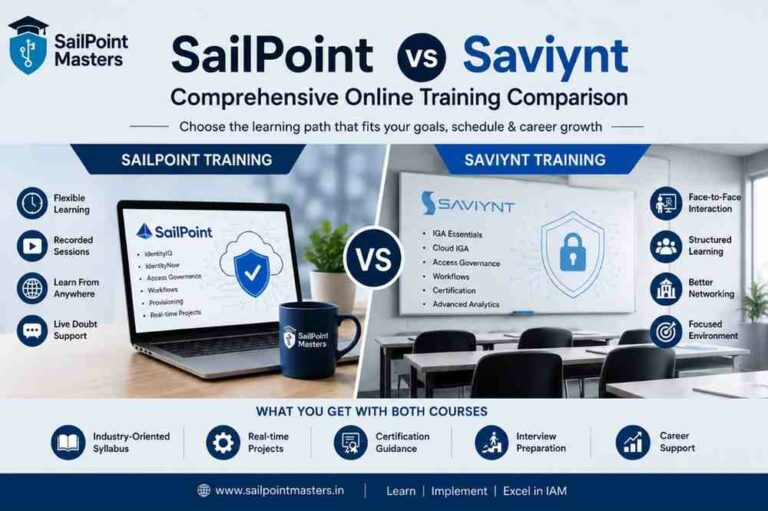
Choosing between two leading Identity Governance and Administration (IGA) platforms is one of the most important security decisions an enterprise makes today. The SailPoint vs Saviynt debate sits at the center of modern identity security strategy, and understanding the real differences matters whether you are an architect evaluating tools or a professional planning a career. If you want structured, hands-on skills in this space, SailPoint Certification Training in Hyderabad is a practical way to build the expertise that both projects and employers demand.
In this in-depth guide, we compare SailPoint and Saviynt across architecture, IGA capabilities, provisioning, workflow automation, AI analytics, deployment, pricing, scalability, and careers. We also explain the core identity technologies behind both platforms so beginners and experienced professionals can follow along and make an informed choice. To ground the fundamentals first, you may find our overview of what SailPoint is a helpful starting point.
SailPoint vs Saviynt
What Is SailPoint?
SailPoint is a market-leading identity security company known for pioneering enterprise Identity Governance and Administration. Its flagship products, SailPoint IdentityIQ (an on-premises and hybrid IGA solution) and SailPoint Identity Security Cloud (its SaaS platform, formerly IdentityNow), help organizations govern who has access to what, why, and whether that access is still appropriate.
SailPoint focuses on visibility, compliance, and automated governance across on-premises applications, cloud services, data, and infrastructure. Its strength lies in deep governance workflows, access certification, and a mature connector ecosystem. If you are comparing the two SailPoint offerings, our breakdown of the difference between IdentityIQ and IdentityNow workflows explains when to use each. You can also review SailPoint’s own Identity Security Cloud platform for its official product positioning.
What is Saviynt?
Saviynt is a cloud-native identity security vendor whose Enterprise Identity Cloud (EIC) converges Identity Governance, Privileged Access Management, application access governance, and third-party access into a single platform. Built API-first for cloud and hybrid environments, Saviynt positions itself as a unified, all-in-one identity solution.
Saviynt appeals to organizations that want to consolidate multiple identity functions under one roof, especially those heavily invested in cloud platforms and SaaS applications. Its intelligence layer emphasizes risk scoring, usage analytics, and automation. Because Saviynt is a competitor vendor, we reference it purely for comparison and keep the focus on helping you evaluate both objectively.
SailPoint vs Saviynt: Key Differences
The core distinction is maturity versus convergence. SailPoint has a longer enterprise track record, a very deep governance feature set, and two clear product lines for on-premises and cloud. Saviynt was built cloud-native from the start and bundles governance with privileged access and application controls in one converged platform.
SailPoint tends to win where governance depth, complex compliance, and large-scale on-premises estates matter most. Saviynt tends to win where cloud-first architecture, faster deployment, and a single converged platform are priorities. Both are recognized leaders in the IGA space, so the right choice depends on your environment, budget, and roadmap.
Feature Comparison: SailPoint vs Saviynt
The table below summarizes how the two IAM platforms compare across the dimensions enterprises weigh most when selecting an identity governance tool.
|
Dimension |
SailPoint |
Saviynt |
|
Deployment |
On-prem (IdentityIQ) + SaaS (Identity Security Cloud) |
Cloud-native SaaS (Enterprise Identity Cloud) |
|
User Interface |
Mature, governance-focused, highly configurable |
Modern, unified console across modules |
|
Workflow Automation |
Deep, flexible policy and workflow engine |
Strong low-code automation and rules |
|
AI Capabilities |
AI-driven recommendations and access insights |
Risk scoring and usage analytics |
|
Reporting |
Extensive compliance and audit reporting |
Real-time dashboards and analytics |
|
Compliance |
Very strong for regulated industries |
Strong, with converged controls |
|
Scalability |
Proven at very large enterprise scale |
Elastic cloud scalability |
|
Integrations |
Broad, mature connector catalog |
API-first, cloud and SaaS heavy |
|
Pricing |
Premium, module and identity based |
Subscription, often bundled |
|
Best Fit |
Large, regulated, hybrid enterprises |
Cloud-first, convergence seekers |
SailPoint vs Saviynt Architecture
SailPoint’s architecture centers on an identity warehouse (or identity cube model) that aggregates account data from connected systems, then applies governance policies, roles, and certifications on top. IdentityIQ is typically deployed on-premises or in a private cloud, while Identity Security Cloud delivers the same governance value as multi-tenant SaaS. For a deeper look at how the on-premises engine is structured, see our guide to SailPoint IdentityIQ architecture.
Saviynt’s architecture is microservices-based and cloud-native, designed to scale elastically and ingest identity signals through APIs. Its converged design means governance, privileged access, and application access controls share a common data model, which reduces integration overhead but ties functions more tightly together. Architecturally, SailPoint offers proven flexibility across hybrid estates, while Saviynt offers a lean, cloud-first footprint.
|
Architecture Aspect |
SailPoint |
Saviynt |
|
Core model |
Identity warehouse / identity cube |
Microservices, common data model |
|
Design origin |
Enterprise governance, later cloud SaaS |
Cloud-native from inception |
|
Deployment options |
On-prem, private cloud, and SaaS |
Multi-tenant SaaS |
|
Convergence |
Governance-focused; PAM via partners |
Governance + PAM + app access unified |
|
Integration style |
Mature connector catalog |
API-first, cloud/SaaS oriented |
|
Best suited for |
Complex hybrid, legacy-heavy estates |
Cloud-first, consolidation-focused |
Identity Governance Capabilities Comparison
Both platforms deliver the pillars of Identity Governance and Administration: visibility into access, policy enforcement, certifications, and audit readiness. SailPoint’s governance depth is widely regarded as best-in-class, with granular policy modeling and a long history of enterprise deployments. You can review SailPoint’s own official product documentation to see the breadth of governance features.
Saviynt matches many governance capabilities and adds converged privileged and application access governance in the same platform. For organizations that want governance plus PAM without stitching together separate tools, that convergence is a meaningful advantage. For pure, deep IGA in complex regulated environments, SailPoint often has the edge.
Access Certification and Compliance
Access certification is the periodic review where managers or system owners confirm that users still need their access. Both SailPoint and Saviynt automate certification campaigns, send reminders, and capture audit evidence. SailPoint offers highly configurable certification types and strong reporting for auditors, which is why it is favored in banking, healthcare, and government.
Saviynt provides intelligent certifications enriched with risk context, helping reviewers focus on high-risk access first. Both support compliance frameworks like SOX, HIPAA, GDPR, and PCI DSS. The difference is often in the depth of configuration (SailPoint) versus the risk-driven simplicity Saviynt aims for.
Role Management and Identity Lifecycle
Role management groups permissions into business roles so access can be granted consistently. SailPoint provides robust role modeling, role mining, and lifecycle automation aligned to joiner-mover-leaver events. To understand how roles are engineered inside the platform, read our detailed guide to role-based access control in SailPoint IdentityIQ.
Saviynt also supports role-based access control, role mining, and lifecycle automation, with strong emphasis on cloud application entitlements. Both platforms manage the full identity lifecycle, from onboarding a new hire to instantly revoking access when someone leaves, which is essential for reducing standing risk.
Provisioning and De-Provisioning Features
Provisioning creates and grants accounts and entitlements automatically; de-provisioning removes them when access is no longer needed. SailPoint’s provisioning engine is mature and connector-rich, handling complex approval chains and exception handling. Understanding how account data flows in first helps; our article on aggregation in SailPoint explains the data collection that provisioning builds upon.
Saviynt delivers cloud-forward provisioning with strong SaaS coverage and low-code workflows. Both platforms shine at automated de-provisioning, which closes one of the biggest security gaps in enterprises: orphaned and lingering accounts after employees change roles or exit.
Workflow and Automation Comparison
SailPoint’s workflow engine is deep and highly customizable, supporting complex business logic, escalations, and policy-driven automation. This flexibility is powerful but can require skilled configuration. Saviynt emphasizes low-code, rules-based automation that many teams find faster to stand up.
For enterprises with intricate, regulated processes, SailPoint’s configurability is a strength. For teams that value speed and simpler administration, Saviynt’s automation model is attractive. Both reduce manual identity tasks dramatically compared to legacy or manual access management.
AI and Analytics Capabilities
AI-driven identity security is now a differentiator. SailPoint applies machine learning to recommend access, detect anomalies, and surface risky entitlements, helping reviewers make smarter certification decisions. Saviynt uses risk scoring, peer analytics, and usage intelligence to prioritize the access that matters most.
Both vendors invest heavily in analytics to move identity from reactive to proactive. The practical takeaway: whichever platform you choose, AI-assisted insights are becoming central to reducing access risk at scale, and skills in interpreting these insights are increasingly valuable for identity professionals.
Cloud vs On-Premises Deployment
The deployment model is often the deciding factor. SailPoint uniquely offers both a strong on-premises option (IdentityIQ) and a SaaS option (Identity Security Cloud), which suits enterprises with hybrid estates or strict data residency needs. Saviynt is cloud-native and typically deployed as SaaS, ideal for cloud-first organizations.
If you have significant legacy, on-premises systems or regulatory constraints requiring on-prem control, SailPoint’s dual model is compelling. If your strategy is cloud-first and you want minimal infrastructure, Saviynt’s cloud-native approach reduces operational overhead.
|
Deployment Factor |
SailPoint |
Saviynt |
|
On-premises option |
Yes (IdentityIQ) |
Limited / cloud-focused |
|
SaaS option |
Yes (Identity Security Cloud) |
Yes (Enterprise Identity Cloud) |
|
Infrastructure overhead |
Higher for on-prem deployments |
Minimal (fully managed SaaS) |
|
Data residency control |
Strong (on-prem/private cloud) |
Cloud region based |
|
Time to deploy |
Longer for complex on-prem builds |
Faster SaaS onboarding |
|
Ideal environment |
Hybrid and regulated |
Cloud-first and SaaS-heavy |
Integration with Enterprise Applications
Integration breadth determines how quickly you can govern your whole estate. SailPoint offers a mature, extensive connector catalog spanning legacy systems, databases, directories, and modern SaaS. Its long history means edge-case enterprise systems are often already supported. For a practical example, see our guide to SailPoint Identity Security Cloud and how it connects modern applications.
Saviynt is API-first with strong coverage of cloud platforms and SaaS applications, reflecting its cloud-native design. For organizations dominated by cloud apps, Saviynt integrates smoothly; for those with heavy legacy footprints, SailPoint’s breadth is frequently the safer bet, supported through its connector catalog and setup options and integrations such as SailPoint integration with SAP. Developers extending either platform can explore SailPoint’s developer resources for APIs and SDKs.
Security and Compliance Features
Both platforms enforce Segregation of Duties (SoD), least-privilege access, and continuous compliance. SailPoint’s SoD policy engine and audit reporting are trusted in the most regulated industries. Saviynt bundles SoD with converged privileged access controls, giving a unified view of governance and privileged risk.
Security posture also depends on how each platform supports Zero Trust principles. Modern identity governance aligns with the guidance in the NIST Zero Trust Architecture publication, which emphasizes verifying every access request rather than trusting network location. Both SailPoint and Saviynt are strong enablers of a Zero Trust identity foundation.
Pricing Comparison
Neither vendor publishes simple public pricing, and both are premium enterprise investments. SailPoint pricing is typically module-based and scales with the number of identities and capabilities licensed. Saviynt often bundles governance, PAM, and application access into subscription tiers, which can be cost-effective when you need multiple functions.
The true cost includes implementation, integration, and ongoing administration. SailPoint’s depth can mean higher configuration effort; Saviynt’s convergence can reduce the number of separate tools you buy. Always evaluate total cost of ownership, not just license price, and factor in the availability of skilled talent for whichever platform you adopt.
Performance and Scalability
SailPoint has a long, proven record at a very large enterprise scale, governing millions of identities and entitlements across complex hybrid environments. Its architecture is battle-tested in demanding, regulated settings. Saviynt’s cloud-native, microservices design scales elastically and handles cloud-heavy workloads efficiently.
For massive on-premises and hybrid estates, SailPoint’s maturity is reassuring. For elastic cloud scale with minimal infrastructure management, Saviynt is well suited. Both can meet enterprise performance needs; the right fit depends on where your workloads and identities actually live.
Advantages of SailPoint
SailPoint’s advantages include deep, best-in-class governance; two deployment options covering on-prem and SaaS; a mature and broad connector ecosystem; strong compliance and audit capabilities; and a large talent pool and community. Its long enterprise track record makes it a low-risk choice for regulated organizations. The demand for SailPoint skills also translates into strong career prospects, as our guide on whether SailPoint is good for cybersecurity careers explains.
Advantages of Saviynt
Saviynt’s advantages include a converged platform that unifies IGA, PAM, and application access; a cloud-native, API-first design; faster SaaS deployment; strong risk analytics; and reduced tool sprawl for organizations wanting an all-in-one identity solution. For cloud-first enterprises consolidating identity functions, Saviynt’s convergence is a genuine differentiator that can simplify architecture and vendor management.
Limitations of SailPoint
SailPoint’s depth can mean a steeper configuration and administration effort, and IdentityIQ deployments may require more infrastructure and specialized skills. Premium pricing can be a barrier for smaller organizations. For teams seeking a single converged platform out of the box, SailPoint’s product separation between governance and privileged access can feel less unified than Saviynt’s approach.
Limitations of Saviynt
Saviynt’s cloud-native model may be less ideal for organizations with heavy on-premises or air-gapped requirements. As a converging platform, some deep governance edge cases and legacy integrations may be less battle-tested than SailPoint’s mature catalog. Its talent pool, while growing, is smaller than SailPoint’s, which can affect hiring and support for niche needs.
SailPoint vs Saviynt: Which Platform is Better?
There is no universal winner. SailPoint is generally better for large, regulated, hybrid enterprises that need the deepest governance and proven scale. Saviynt is generally better for cloud-first organizations that want a converged, all-in-one identity platform with fast SaaS deployment.
Ask three questions: Where do your identities and applications live (cloud, on-prem, hybrid)? How deep are your governance and compliance requirements? Do you want convergence with privileged access, or best-of-breed governance? Your answers point clearly to one platform. Many enterprises still choose SailPoint for its maturity, while cloud-native newcomers often prefer Saviynt.
Best Use Cases for SailPoint
SailPoint fits large banks, insurers, healthcare systems, government agencies, and any organization with complex hybrid environments and strict audit requirements. It excels where deep certification, granular policy modeling, and broad legacy integration are essential. Enterprises modernizing gradually benefit from SailPoint’s ability to govern both on-premises and cloud from one governance model.
Best Use Cases for Saviynt
Saviynt fits cloud-first enterprises, digital-native companies, and organizations consolidating identity, privileged access, and application governance into one platform. It works well for teams that prioritize fast deployment, elastic cloud scale, and reduced tool sprawl, especially where the application estate is dominated by SaaS and cloud infrastructure rather than legacy systems.
Career Opportunities in SailPoint and Saviynt
Both platforms power strong, well-paid careers in Identity and Access Management. Demand for IGA specialists continues to rise as enterprises invest in identity security. SailPoint skills are especially sought after in India and globally due to the platform’s large install base. To understand earning potential locally, see our breakdown of SailPoint course salary in Hyderabad and our overview of SailPoint careers.
Whether you build your foundation in SailPoint or Saviynt, roles like IAM Engineer, Identity Governance Consultant, and IGA Developer are in high demand, and you can prepare with common SailPoint interview questions and answers. If you are weighing where to start, learning a mature, widely adopted platform first gives you transferable identity concepts and strong hiring options. Practical, job-ready SailPoint training in Hyderabad can accelerate that journey.
Career Comparison Table
|
Role |
Required Skills |
Certifications |
Average Salary (India) |
Career Growth |
Demand in India |
|
SailPoint Developer |
IdentityIQ/ISC, Java basics, connectors, workflows |
SailPoint Certified Engineer |
₹8–18 LPA |
High |
Very High |
|
Saviynt Developer |
Saviynt EIC, REST APIs, cloud IAM |
Saviynt Certified Professional |
₹7–16 LPA |
High |
Growing |
|
IAM Engineer |
SSO, MFA, provisioning, directories |
Vendor + security certs |
₹6–15 LPA |
Strong |
Very High |
|
Identity Governance Consultant |
IGA strategy, compliance, RBAC, SoD |
Vendor + governance certs |
₹10–22 LPA |
Excellent |
High |
SailPoint vs Saviynt Certification Paths
SailPoint offers structured certifications through SailPoint University covering IdentityIQ and Identity Security Cloud for engineers and administrators. You can explore official learning tracks at SailPoint University. Saviynt provides its own certification program focused on the Enterprise Identity Cloud.
For most learners, a SailPoint certification opens the widest door because of the platform’s large market presence, and the credentials map to the topics covered in a full SailPoint IIQ curriculum. To plan your next steps after earning credentials, read our guide on what to do after SailPoint certification and our resource on SailPoint certification and free resources to get started.
Future of Identity Governance Platforms
The future of IGA is AI-driven, cloud-delivered, and converged. Expect deeper automation of certifications, autonomous risk remediation, and tighter integration with privileged access and Zero Trust architectures. Both SailPoint and Saviynt are investing in these directions, so skills learned today remain highly relevant as the market grows.
Identity is now the primary security perimeter. As enterprises adopt more cloud services and machine identities multiply, governance platforms will become even more central to security programs, keeping demand for skilled professionals strong for years to come.
Understanding the Core Identity Technologies
To fully evaluate SailPoint vs Saviynt, it helps to understand the technologies both platforms are built on
- Identity Governance and Administration (IGA): The discipline of managing and governing digital identities and their access, ensuring the right people have the right access for the right reasons, with full auditability.
- Identity Lifecycle Management: Automating access changes across the joiner-mover-leaver journey so accounts are granted, updated, and revoked at the right time.
- Role-Based Access Control (RBAC): Assigning access through business roles rather than individually, simplifying administration and enforcing consistency at scale.
- Access Certification: Periodic reviews confirming that each user’s access is still appropriate, producing audit evidence for compliance.
- Provisioning and De-Provisioning: Automatically creating and removing accounts and entitlements as roles and employment status change.
- Segregation of Duties (SoD): Preventing risky access combinations (for example, creating and approving the same payment) to reduce fraud and error.
- Single Sign-On (SSO): Letting users authenticate once to access multiple applications securely, improving both security and user experience.
- Multi-Factor Authentication (MFA): Requiring more than one factor to verify identity, sharply reducing the risk of compromised credentials.
- Privileged Access Management (PAM): Securing, monitoring, and controlling accounts with elevated permissions, a function Saviynt converges into its platform.
- Zero Trust Security: A model that verifies every access request continuously and never trusts based on network location alone.
- AI-Driven Identity Security: Using machine learning to detect anomalies, recommend access, and prioritize risk in governance decisions.
- Cloud Identity Management: Governing identities across cloud platforms and SaaS applications with the same rigor as on-premises systems.
Industry Insights: The Identity Security Market
Identity security is one of the fastest-growing areas of cybersecurity. According to market research from Grand View Research on the IGA market, the global identity governance and administration market was valued at USD 7.95 billion in 2024 and is projected to reach USD 27.11 billion by 2033, growing at a CAGR of roughly 14.9%. That growth reflects surging cloud adoption, tightening compliance, and rising identity-based attacks.
In India, digital transformation, cloud-first strategies, and expanding regulatory expectations are driving strong demand for IGA platforms and skilled professionals. Enterprises are accelerating Zero Trust implementation and AI-powered identity management, making both SailPoint and Saviynt expertise valuable in the local job market.
Why Identity Governance is One of the Fastest-Growing Cybersecurity Domains
Identity governance has moved from a compliance checkbox to a core security discipline. Several forces drive its rapid growth
- Rising cyber threats: Most breaches involve stolen or misused credentials, making identity the frontline of defense.
- Compliance requirements: Regulations like SOX, HIPAA, GDPR, and PCI DSS demand provable access controls and certifications.
- Cloud adoption: Sprawling cloud and SaaS estates multiply identities and entitlements that must be governed.
- Enterprise identity management: Consolidating fragmented access across systems requires dedicated governance platforms.
- Growing demand for IAM professionals: Enterprises struggle to hire skilled identity engineers, creating strong career opportunities.
- Long-term career opportunities: As identity becomes the security perimeter, IGA skills stay in demand for the long run.
Key Takeaways
- SailPoint offers best-in-class governance depth with both on-premises and SaaS deployment, ideal for large regulated enterprises.
- Saviynt is cloud-native and converges IGA, PAM, and application access into one platform, ideal for cloud-first organizations.
- Your choice depends on where your identities live, your compliance depth, and whether you want convergence or best-of-breed governance.
- Both platforms power strong IAM careers, but SailPoint’s large install base creates the widest hiring opportunities, especially in India.
- Identity governance is among the fastest-growing cybersecurity domains, making SailPoint or Saviynt skills a smart long-term investment.
Conclusion
The SailPoint vs Saviynt decision comes down to fit, not a single winner. If you need deep, proven governance across hybrid environments with strong compliance, SailPoint is the safer enterprise choice. If you want a cloud-native, converged, all-in-one identity platform with fast deployment, Saviynt is compelling. Evaluate your architecture, compliance needs, and roadmap before committing.
For professionals, learning a mature, in-demand platform is one of the smartest career moves in cybersecurity today. If you are ready to build job-ready identity skills, explore expert-led programs at SailPoint Masters and start your journey toward a high-growth career in Identity and Access Management.
FAQ
1. What is the main difference between SailPoint and Saviynt?
SailPoint is a mature IGA leader with both on-premises (IdentityIQ) and SaaS (Identity Security Cloud) options and best-in-class governance depth. Saviynt is cloud-native and converges governance, privileged access, and application access into a single platform. SailPoint suits large regulated enterprises; Saviynt suits cloud-first organizations wanting convergence.
2. Is SailPoint better than Saviynt?
Neither is universally better. SailPoint typically wins on governance depth, proven scale, and hybrid deployment. Saviynt wins on cloud-native convergence and faster SaaS setup. The right choice depends on your environment, compliance needs, and whether you want an all-in-one platform.
3. Which is easier to learn, SailPoint or Saviynt?
Both require identity fundamentals like RBAC, provisioning, and certifications. SailPoint has a larger community, more training resources, and abundant documentation, which often makes it easier to find learning support. Beginners commonly start with SailPoint because of its market presence and job opportunities.
4. Does SailPoint or Saviynt pay more in India?
Salaries are comparable and depend on experience and role. SailPoint professionals often see strong demand due to the platform’s large install base, with developers typically earning ₹8–18 LPA. Saviynt skills are growing in demand as cloud adoption rises, offering similarly attractive packages.
5. Can I learn SailPoint without a programming background?
Yes. Many SailPoint roles focus on configuration, governance, and administration rather than heavy coding, though basic Java helps for advanced customization. Structured training makes it accessible to beginners and career switchers moving into Identity and Access Management.
6. Do SailPoint and Saviynt support Zero Trust?
Yes. Both platforms are strong enablers of Zero Trust by enforcing least privilege, continuous verification, and tight governance of every access request. Identity governance is a foundational pillar of any Zero Trust architecture.
7. Which platform is better for cloud-first organizations?
Saviynt’s cloud-native, API-first design is a natural fit for cloud-first organizations. However, SailPoint Identity Security Cloud also delivers full SaaS governance, so SailPoint remains a strong cloud option, especially for enterprises with hybrid needs.
8. What certifications should I pursue for a career in IGA?
For SailPoint, pursue SailPoint Certified Engineer credentials via SailPoint University. For Saviynt, pursue its Enterprise Identity Cloud certifications. SailPoint certifications currently open the widest range of roles due to the platform’s market share.
9. Is SailPoint a good career choice in 2026?
Yes. With identity security among the fastest-growing cybersecurity domains and IGA demand rising sharply, SailPoint skills offer excellent, future-proof career prospects. Strong salaries and a large hiring market make it a smart long-term choice.
10. Which is more widely adopted, SailPoint or Saviynt?
SailPoint has a longer history and a larger global install base, particularly across regulated industries and large enterprises. Saviynt adoption is growing quickly among cloud-first organizations, but SailPoint remains the more widely deployed platform overall.
SailPoint Trainer
SailPoint Masters Editorial Team | 15+ Articles Published
We specialize in SailPoint Certification Training in Hyderabad, helping aspiring professionals and IT experts develop in-demand Identity and Access Management (IAM) skills. Our training covers SailPoint IdentityIQ, Identity Security Cloud, certification preparation, real-world projects, and career guidance to support success in cybersecurity and identity governance careers.
Share