
SailPoint vs Microsoft Entra ID Governance: A Complete Comparison
SailPoint is a dedicated identity governance and administration (IGA) platform built for complex, heterogeneous enterprise environments, while Microsoft Entra ID Governance is a governance layer within the Microsoft Entra ecosystem, optimized for organizations already invested in Microsoft 365 and Azure. The right choice depends on application landscape, deployment model, and integration needs rather than one platform being universally superior.
★★★★★
4.9/5 rated by 1329+ students · Google Verified
Table of Contents
Introduction
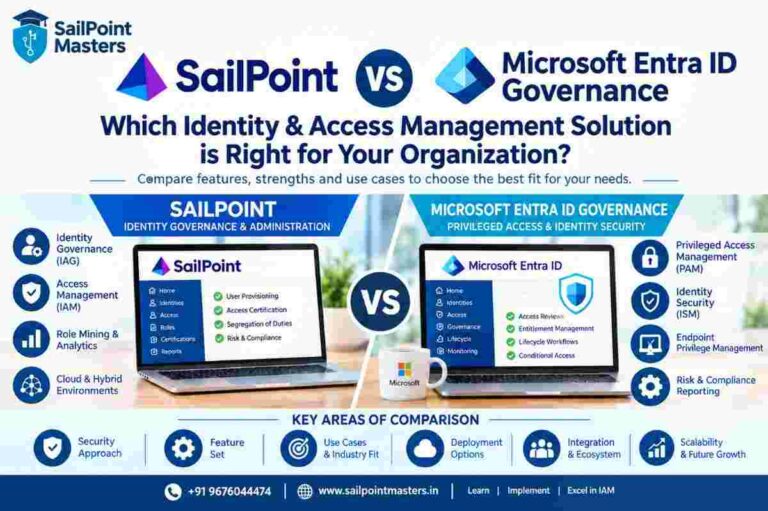
Identity governance is the discipline of controlling who has access to what, for how long, and why. As organizations add more cloud applications, remote employees, contractors, and third-party partners, tracking and governing this access manually becomes unmanageable. This is where Identity Governance and Administration (IGA) platforms come in — they automate identity lifecycle management, enforce least-privilege access, and provide the audit trails regulators expect.
Two names dominate conversations about enterprise IGA today: SailPoint and Microsoft Entra ID Governance. Both aim to solve similar problems — managing identity lifecycles, certifying access, and reducing risk — but they approach the problem from different starting points. SailPoint was built from the ground up as a specialized identity security platform, while Microsoft Entra ID Governance extends the broader Microsoft Entra identity platform with governance capabilities.
Organizations comparing these two platforms are usually trying to answer a practical question: does our environment need a dedicated, deeply customizable IGA platform, or does a governance layer built into our existing Microsoft ecosystem cover our needs? There’s no single right answer — it depends on the number and diversity of applications in use, compliance obligations, existing infrastructure, and long-term identity strategy.
Beyond the technology decision, this comparison matters for another reason: career growth. IAM and IGA skills are in increasing demand in India and globally, as more companies invest in identity security following high-profile breaches and growing regulatory pressure. Professionals who understand both SailPoint and Microsoft Entra ID Governance are well positioned for roles ranging from IAM analyst to identity security architect.
This guide breaks down both platforms in detail — what they are, how they compare, where each tends to fit, and what it means for your career if you’re considering IAM as a specialization.
SailPoint vs Microsoft Entra ID Governance
What is SailPoint?
SailPoint is an identity security and identity governance platform designed to help organizations manage, secure, and govern access across their entire digital ecosystem. It is built specifically around IGA use cases rather than being a general-purpose identity provider with governance features added on. For a broader introduction, see our detailed guide on what SailPoint is, covering its features and career relevance.
At its core, SailPoint helps organizations answer questions like: Who has access to what? Should they still have it? How did they get it? And is that access appropriate given their role? SailPoint addresses this through several core capabilities
- Identity lifecycle management — automatically provisioning, updating, and removing access as employees join, change roles, or leave the organization.
- Access governance — defining policies that determine who can request, approve, or hold specific entitlements.
- Access certification — periodic reviews where managers or application owners confirm that existing access is still appropriate.
- Provisioning and deprovisioning — automatically granting or revoking access to systems and applications based on identity attributes and lifecycle events.
- Role management — grouping entitlements into business-friendly roles so access can be assigned and reviewed more efficiently.
- Compliance — supporting audit and regulatory requirements through documented access reviews, policy enforcement, and reporting.
- Identity analytics — using data and, increasingly, AI-driven insights to flag risky access patterns or outlier entitlements.
- Enterprise integrations — connecting to a wide range of applications, directories, databases, and cloud platforms, including many niche or legacy systems.
SailPoint offers two primary product lines relevant to this comparison
SailPoint IdentityIQ is the traditional, highly customizable IGA platform, often deployed on-premises or in a customer-managed cloud environment. It’s known for deep customization capabilities through workflows, rules, and connectors, making it popular in large enterprises with complex, unique governance requirements.
SailPoint Identity Security Cloud (ISC) is SailPoint’s modern SaaS-based identity security platform. It delivers similar governance capabilities as IdentityIQ but as a fully managed cloud service, with faster deployment, built-in AI-driven identity analytics, and continuous updates without the operational overhead of managing infrastructure.
What is Microsoft Entra ID Governance?
Microsoft Entra ID Governance is a set of identity governance capabilities built into the Microsoft Entra platform (formerly Azure Active Directory). It’s important to distinguish it clearly from Microsoft Entra ID itself, which is Microsoft’s core identity and access management service used for authentication, single sign-on, and directory services.
Microsoft Entra ID handles the “who are you and can you sign in” part of identity. Microsoft Entra ID Governance adds the “should you have this access, and for how long” layer on top — including lifecycle workflows, access reviews, and entitlement management.
Key capabilities of Microsoft Entra ID Governance include
- Identity lifecycle management — automating identity changes tied to HR events like new hires, transfers, and terminations, particularly when integrated with systems like Workday or SAP SuccessFactors.
- Access requests — allowing users to request access to applications, groups, or resources through a self-service catalog.
- Access reviews — recurring reviews where designated reviewers confirm whether users should retain access to groups, applications, or roles.
- Entitlement management — bundling related resources (apps, groups, sites) into “access packages” that can be requested, approved, and reviewed as a unit.
- Privileged identity considerations — working alongside Microsoft Entra Privileged Identity Management (PIM) to manage just-in-time access to privileged roles.
- Guest and external-user governance — managing the lifecycle of external collaborators and partners who need limited, time-bound access.
- Microsoft ecosystem integration — native, deep integration with Microsoft 365, Azure resources, Teams, SharePoint, and other Microsoft services.
- Compliance and access control — supporting audit requirements through built-in reporting and review workflows.
Because Microsoft Entra ID Governance is layered on the same platform organizations already use for authentication and directory services, it tends to be easier to adopt for organizations that are already heavily invested in Microsoft 365 and Azure.
SailPoint vs Microsoft Entra ID Governance
At a high level, both platforms address the same governance goals, but with different strengths depending on the environment they operate in.
Identity governance: Both platforms provide policy-based governance, but SailPoint’s governance model was purpose-built for complex, multi-application environments, while Microsoft’s model is tightly woven into the Entra identity fabric.
Access certification: SailPoint offers deeply configurable certification campaigns, including support for a wide range of certification types and scheduling logic. Microsoft Entra ID Governance provides access reviews that cover groups, applications, and roles, with strong integration into Microsoft’s own resource types.
Access requests: SailPoint supports request workflows across a broad connector ecosystem. Microsoft Entra ID Governance’s entitlement management is particularly efficient for bundling and requesting Microsoft-centric resources.
Provisioning and deprovisioning: SailPoint has an extensive connector library covering legacy, on-premises, and cloud systems, useful in heterogeneous IT landscapes. Microsoft’s provisioning capabilities are strongest for Microsoft Entra ID-connected applications, though it also supports many SaaS applications via its app gallery.
Role management: SailPoint offers advanced role modeling and role mining features. Microsoft Entra ID Governance handles role-like structures largely through groups and access packages.
Lifecycle workflows: Both support automated joiner-mover-leaver workflows, with SailPoint offering more granular workflow customization and Microsoft offering simpler configuration for organizations using standard Microsoft-aligned processes.
SaaS capabilities: SailPoint Identity Security Cloud and Microsoft Entra ID Governance are both SaaS-delivered. SailPoint IdentityIQ can be deployed on-premises or in customer-managed cloud environments.
Hybrid environments: Both platforms can operate in hybrid environments, though the specifics of directory synchronization, connector availability, and legacy system support differ.
Microsoft ecosystem integration: Microsoft Entra ID Governance has a natural advantage here, since it’s part of the same platform as Microsoft Entra ID and Microsoft 365.
Third-party integrations: SailPoint generally has a broader out-of-the-box connector catalog for non-Microsoft, legacy, and industry-specific applications.
Compliance, reporting, and automation: Both platforms support compliance reporting and automation, with the depth of customization and reporting flexibility varying by product tier and licensing.
Scalability and deployment: Both are designed to scale for large enterprises, but deployment complexity, licensing structure, and required expertise differ significantly between the two.
No platform is universally “better” — organizations with complex, multi-vendor application ecosystems often lean toward SailPoint’s breadth of governance customization, while organizations built around Microsoft 365 and Azure often find Microsoft Entra ID Governance more efficient to adopt and operate. In short: SailPoint’s edge is depth and breadth across heterogeneous systems, while Microsoft’s edge is native fit within its own ecosystem.
SailPoint IdentityIQ vs Microsoft Entra ID Governance
Beyond the general comparison above, IdentityIQ specifically differs from Microsoft Entra ID Governance in deployment flexibility and customization depth. For a deeper technical breakdown of how IdentityIQ is structured internally, see our SailPoint IdentityIQ architecture guide.
Deployment: IdentityIQ can run on-premises, in a private cloud, or as a customer-managed instance, giving organizations control over infrastructure that Microsoft’s cloud-only Entra ID Governance doesn’t offer.
Customization model: IdentityIQ workflows are built on a code-extensible framework (rules, BeanShell, custom connectors), which allows for deep, bespoke governance logic — at the cost of requiring dedicated SailPoint developers and administrators. Microsoft’s lifecycle workflows use a more templated, low-code configuration approach that’s faster to stand up but less flexible for unusual requirements.
Typical fit: IdentityIQ implementations are common in large enterprises with long-standing, highly customized governance programs, while Microsoft Entra ID Governance is typically administered by identity teams already managing Entra ID day to day.
SailPoint Identity Security Cloud vs Microsoft Entra ID Governance
SailPoint Identity Security Cloud (ISC) is the more direct SaaS-to-SaaS comparison, since both ISC and Microsoft Entra ID Governance are cloud-native, multi-tenant services with no infrastructure for the customer to manage.
Where they differ: ISC carries forward SailPoint’s certification depth and role-modeling capabilities into a SaaS delivery model, plus AI-driven identity analytics for flagging risky access. Microsoft’s distinctive strength here is entitlement management (access packages) for bundling and requesting Microsoft and connected resources in one step.
Ecosystem reach: Microsoft Entra ID Governance naturally has the deepest integration with Microsoft 365 and Azure resources, since it’s part of the same platform. ISC integrates with Microsoft Entra ID as one connector among many in a broader, multi-platform connector catalog — a better fit for organizations governing a mix of Microsoft and non-Microsoft applications.
SailPoint vs Microsoft Entra ID Governance Comparison Table
|
Feature |
SailPoint |
Microsoft Entra ID Governance |
|
Identity Governance |
Dedicated, deeply configurable IGA platform |
Governance layer within the Entra identity platform |
|
Identity Lifecycle Management |
Highly customizable workflows and rules |
Templated lifecycle workflows tied to HR attributes |
|
Access Reviews/Certifications |
Granular, configurable certification campaigns |
Access reviews scoped to groups, apps, and roles |
|
Access Requests |
Workflow-driven requests across many connectors |
Self-service requests via access packages |
|
Entitlement Management |
Role and access profile modeling |
Native entitlement management (access packages) |
|
Provisioning |
Broad connector library, including legacy systems |
Provisioning via app gallery and Microsoft Graph |
|
Deprovisioning |
Rule-based, customizable deprovisioning |
Automated deprovisioning tied to lifecycle workflows |
|
Role Management |
Advanced role modeling and role mining |
Group-based structures, limited native role mining |
|
Workflow Automation |
Code-extensible workflow engine |
Low-code lifecycle workflow templates |
|
Microsoft Integration |
Available via connector, not native |
Native, deeply integrated |
|
Third-Party Integration |
Extensive out-of-the-box connector catalog |
Growing but narrower app gallery |
|
Hybrid Environment Support |
Strong support, including legacy on-prem systems |
Supported via Entra Connect and hybrid identity |
|
Compliance |
Configurable compliance reporting and policies |
Built-in compliance tools tied to Microsoft Purview |
|
Reporting |
Highly customizable reporting |
Reporting integrated with Microsoft compliance suite |
|
SaaS Deployment |
Available via Identity Security Cloud |
Delivered as part of Microsoft Entra (cloud-native) |
|
Customization |
High, especially in IdentityIQ |
Moderate, primarily configuration-based |
|
Enterprise Use Cases |
Large, complex, multi-application enterprises |
Microsoft-centric or hybrid enterprises |
Note: Capabilities and licensing tiers evolve over time; organizations should verify current feature sets directly with SailPoint and Microsoft before making deployment decisions.
SailPoint vs Microsoft Entra ID Governance – Which Organizations Use Them?
The choice between these platforms often comes down to the shape of an organization’s IT environment rather than a fixed preference for one vendor.
- Large enterprises with complex governance programs often evaluate SailPoint for its depth of customization and certification capabilities.
- Microsoft-centric organizations that run primarily on Microsoft 365 and Azure frequently find Microsoft Entra ID Governance sufficient without adding a separate IGA vendor.
- Hybrid IT environments with a mix of on-premises and cloud systems may lean on SailPoint’s connector maturity for legacy applications.
- Multi-cloud environments using AWS, Google Cloud, and Azure together may require SailPoint’s broader integration flexibility.
- Organizations with complex application ecosystems, including custom-built or industry-specific software, often need SailPoint’s extensibility.
- Highly regulated industries such as banking, healthcare, and insurance frequently prioritize the depth of certification and audit trail capabilities either platform can provide, depending on their existing infrastructure.
- Organizations with extensive identity governance requirements, including large contractor populations or many third-party integrations, tend to weigh connector breadth heavily in their decision.
SailPoint vs Microsoft Entra ID Governance – Integration Capabilities
Integration breadth is often the deciding factor in platform selection, since governance is only as effective as the systems it can actually manage.
Both platforms integrate with
- Active Directory — for on-premises identity synchronization
- Microsoft Entra ID — SailPoint connects to it as a source/target; it’s native for Microsoft Entra ID Governance
- LDAP — supported by both, though implementation specifics vary
- Databases — SailPoint offers broader native database connector support
- HR systems — both integrate with systems like Workday and SAP SuccessFactors for lifecycle triggers
- SaaS applications — both support popular SaaS apps, though catalog size and connector depth differ
- Enterprise applications — SailPoint has a longer track record with legacy ERP and custom applications
- APIs — SailPoint offers REST APIs; Microsoft relies on Microsoft Graph
- Cloud platforms — both support major cloud providers, with varying depth of native governance
- SIEM/security ecosystems — both can feed identity risk data into broader security monitoring tools
For a closer look at how one of these enterprise integrations works in practice, see our guide on SailPoint integration with SAP, covering connectors, provisioning, and compliance for SAP-based environments.
SailPoint vs Microsoft Entra ID Governance – Access Governance
Beyond the request and certification mechanics already covered above, access governance also depends on policy enforcement that runs quietly in the background
- Separation of duties — policies preventing users from holding conflicting access combinations (e.g., someone who can both create and approve a purchase order)
- Least privilege — ensuring users only have the access necessary for their current role, not accumulated access from past roles
- Joiner-Mover-Leaver enforcement — these policies apply automatically as identities move through their lifecycle, not just at initial provisioning
SailPoint’s policy engine tends to offer more granular separation-of-duties modeling for complex, multi-system environments, while Microsoft Entra ID Governance enforces these policies most naturally within groups and access packages native to the Entra ecosystem.
SailPoint vs Microsoft Entra ID Governance – Identity Lifecycle Management
Identity lifecycle management becomes clearer with practical, everyday examples.
- Joiner: A new employee is hired and needs accounts provisioned across email, HR systems, and business applications.
- Mover: An employee changes departments and needs new access granted while old access is revoked.
- Leaver: An employee resigns, and all access must be deprovisioned promptly to reduce risk.
- Employee onboarding: Automated workflows create accounts and assign baseline access based on role and department.
- Department changes: Access adjusts automatically as attributes like department or manager change in the HR system.
- Role changes: A promotion or lateral move triggers a review of existing entitlements against new role requirements.
- Employee termination: Immediate deprovisioning reduces the window of risk from orphaned accounts.
- Contractor lifecycle: Time-bound access ensures contractors lose access automatically when their contract ends.
- Guest identity lifecycle: External collaborators are granted limited, often time-bound access, with periodic reviews to confirm continued need.
Both SailPoint and Microsoft Entra ID Governance automate these scenarios, though the configuration approach, connector maturity, and integration depth with the source HR system will shape how smoothly they function in practice.
SailPoint vs Microsoft Entra ID Governance – Compliance and Security
Identity governance plays a central role in compliance and security posture, but it’s important to understand what it does and doesn’t guarantee.
Both platforms contribute to
- Audit readiness — maintaining records of who approved what access and when
- Regulatory compliance — supporting frameworks that require documented access controls
- Access control — enforcing who can access which systems and data
- Least privilege — reducing excess access accumulated over time
- Separation of duties — preventing conflicting access combinations that increase fraud risk
- Access reviews — periodic validation that access remains appropriate
- Identity risk reduction — flagging unusual or risky access patterns
- Governance reporting — providing evidence for auditors and regulators
Neither SailPoint nor Microsoft Entra ID Governance automatically guarantees compliance. Compliance outcomes depend on how well the platform is configured, how consistently reviews are performed, and how the organization responds to findings.
SailPoint vs Microsoft Entra ID Governance – Career Opportunities
Identity governance expertise opens a range of career paths across enterprises, consulting firms, and managed service providers.
Common roles include
- SailPoint Developer — builds and customizes workflows, rules, and connectors within IdentityIQ or ISC
- SailPoint Administrator — manages day-to-day platform operations and configuration
- SailPoint Consultant — implements SailPoint solutions for clients across industries
- Identity Governance Engineer — designs and maintains governance processes across platforms
- IAM Engineer — builds and maintains broader identity and access infrastructure
- IAM Analyst — monitors access reviews, certifications, and compliance reporting
- Microsoft Entra Administrator — manages Entra ID and Entra ID Governance configurations
- Identity and Access Management Consultant — advises organizations on IAM strategy and platform selection
- Cloud Identity Engineer — focuses on identity architecture across cloud platforms
For a detailed look at what one of these roles involves day to day, see our guide on SailPoint Developer roles and responsibilities.
Opportunities exist for
- Freshers — entry-level roles focusing on access administration and support
- Experienced professionals — moving into architecture, consulting, or specialized engineering roles
- Career-gap candidates — re-entering the workforce through IAM training and certification programs
- IT professionals transitioning into IAM — from system administration, helpdesk, or software development backgrounds
SailPoint Jobs and Career Opportunities in India
India has a growing IAM job market, driven by global enterprises setting up security operations centers and IT service providers offering SailPoint implementation services to clients worldwide.
Common opportunities include
- SailPoint Developer Jobs — focused on workflow, rule, and connector development
- SailPoint Consultant Jobs — often client-facing roles within IT services and consulting firms
- IAM Engineer Jobs — broader identity infrastructure roles that may include SailPoint alongside other tools
- Identity Governance Jobs — roles focused on governance processes, certifications, and compliance
- SailPoint IdentityIQ opportunities — common in large enterprises with legacy, customized deployments
- SailPoint Identity Security Cloud opportunities — growing as more organizations migrate to SaaS-based IGA
Job availability, salary, and specific requirements vary significantly based on location, experience level, employer, certifications held, and technical skill depth. If you’re preparing for interviews, our SailPoint interview questions and answers guide covers commonly asked technical and scenario-based questions.
Microsoft Entra ID Governance Career Opportunities in India
As more Indian and global enterprises adopt Microsoft 365 and Azure, demand for professionals skilled in Microsoft Entra and Entra ID Governance continues to grow.
Relevant career paths include roles focused on
- Microsoft Entra ID administration and configuration
- Microsoft Entra ID Governance implementation, including access reviews and entitlement management
- Azure identity architecture and security
- Cloud IAM roles spanning multiple platforms
- Identity security roles focused on risk detection and remediation
- Microsoft security technologies, including integration with Microsoft Defender and Microsoft Purview
Employers typically look for hands-on experience with Microsoft Entra ID, familiarity with Microsoft Graph, and an understanding of governance concepts like lifecycle workflows and access packages.
SailPoint vs Microsoft Entra ID Governance – Skills Required
Building expertise in either platform requires a mix of foundational IAM knowledge and platform-specific technical skills.
SailPoint Skills
- IdentityIQ
- Identity Security Cloud
- Java
- BeanShell
- XML
- SQL
- REST APIs
- Identity lifecycle management
- Workflows
- Connectors
- Access certification
Microsoft Entra Skills
- Microsoft Entra ID
- Entra ID Governance
- Azure
- Microsoft Graph
- PowerShell
- REST APIs
- Access Reviews
- Entitlement Management
- Conditional Access concepts
- Identity lifecycle management
Professionals aiming for broader IAM careers often benefit from learning foundational concepts common to both — authentication, authorization, directory services, and governance principles — before specializing in a specific platform.
Certifications for SailPoint and Microsoft Entra Careers
Certifications can help validate platform-specific knowledge, though they work best when paired with hands-on project experience.
- SailPoint certification options — vendor-offered certifications covering IdentityIQ and Identity Security Cloud administration and development, through SailPoint’s Professional Certification and Credentialing Program
- Microsoft identity/security certifications — Microsoft offers certifications covering identity and access administration within the broader Azure and security certification tracks
- Microsoft Azure certifications — foundational cloud certifications that support broader Azure and identity career paths
- Practical project experience — building lab environments or contributing to real implementations strengthens practical understanding
- IAM fundamentals — general identity and access management training that applies across vendors and platforms
Certification alone does not guarantee employment. Employers typically also evaluate hands-on experience, problem-solving ability, and understanding of real-world governance scenarios. For a breakdown of specific SailPoint certification paths and free resources to get started, see our SailPoint certification guide.
SailPoint vs Microsoft Entra ID Governance – Learning Roadmap
|
Level |
What to Learn |
Practical Skills |
|
Beginner |
IAM Fundamentals |
Identity, authentication, authorization |
|
Intermediate |
Platform Fundamentals |
SailPoint or Entra Governance |
|
Advanced |
Integrations & Automation |
APIs, workflows, provisioning |
|
Expert |
Architecture & Governance |
Enterprise IAM, compliance, solution design |
For a more detailed, step-by-step version of this path, see our full SailPoint Roadmap, which breaks down each stage from IAM fundamentals to enterprise architecture.
SailPoint vs Microsoft Entra ID Governance – Salary in India
|
Experience |
Typical Role |
Salary Range |
|
0–2 Years |
IAM/SailPoint/Entra Associate |
₹4–₹7 LPA |
|
3–5 Years |
IAM Engineer/Developer |
₹8–₹15 LPA |
|
6–10 Years |
Senior IAM Engineer/Consultant |
₹15–₹28 LPA |
|
10+ Years |
IAM Lead/Architect |
₹28 LPA+ |
These salary figures are indicative estimates and can vary based on experience, location, employer, technical specialization, certifications, and interview performance. Readers should verify current figures through recent job market data and salary surveys specific to their region and role. For a closer look at pay bands specific to one IAM hub, see our SailPoint course salary in Hyderabad breakdown.
SailPoint vs Microsoft Entra ID Governance – Pros and Considerations
SailPoint
- Strong enterprise IGA capabilities with deep configurability
- Broad application ecosystem, including legacy and niche systems
- Specialized focus purely on identity governance
- Complex implementation requirements, especially for IdentityIQ
- Customization and administration often require dedicated technical resources
Microsoft Entra ID Governance
- Deep, native Microsoft ecosystem integration
- Cloud-oriented governance that’s easier to adopt for existing Entra ID customers
- Tight integration with Entra ID, Microsoft 365, and Azure resources
- Licensing considerations tied to Microsoft’s broader subscription tiers
- May require supplementation for organizations with significant non-Microsoft applications or complex heterogeneous environments
Why Identity Governance is Becoming Important in Modern IT
Several trends are pushing identity governance from a “nice to have” to a business necessity
- Cloud applications — organizations now manage identities across dozens or hundreds of SaaS tools
- Hybrid environments — a mix of on-premises and cloud systems complicates unified governance
- Remote work — distributed workforces increase the number and diversity of access points
- SaaS adoption — each new application adds another system requiring lifecycle management
- Growing numbers of identities — including human, service, and machine identities
- Third-party users — contractors, vendors, and partners require carefully scoped access
- Regulatory requirements — data protection and industry regulations increasingly mandate documented access controls
- Excessive permissions — access tends to accumulate over time without regular review
- Identity-based security risks — compromised credentials remain one of the most common attack vectors
Future of Identity Governance and IAM in India
Identity governance continues to evolve alongside broader security and cloud trends
- Cloud IAM — identity platforms increasingly move to SaaS delivery models
- Identity Security — governance is converging with broader identity threat detection
- Zero Trust — governance plays a foundational role in verifying every access request
- Automated provisioning — reducing manual intervention in lifecycle events
- AI-assisted identity operations — using analytics to flag anomalies and streamline reviews
- Identity analytics — data-driven insights into access patterns and risk
- Machine identities — governance is expanding to cover service accounts, APIs, and bots
- SaaS-based IGA — continued shift away from on-premises deployments
- API-driven integrations — deeper, more flexible connections between platforms
- Microsoft Entra ecosystem growth — expanding governance features as Microsoft invests further in identity security
- Enterprise adoption of identity security platforms — growing investment as organizations prioritize identity as a security perimeter
Established capabilities like access reviews and certifications are mature and widely deployed today, while AI-assisted identity analytics and machine identity governance are still emerging areas that continue to develop.
How to Start a Career in SailPoint or Microsoft Entra ID Governance
- Learn IAM fundamentals.
- Understand authentication and authorization.
- Learn Active Directory and directory concepts.
- Learn SQL.
- Learn REST APIs.
- Choose SailPoint or Microsoft Entra as a specialization.
- Build hands-on projects.
- Learn provisioning and lifecycle workflows.
- Study access governance and compliance.
- Prepare for interviews and certifications.
- Build a practical IAM portfolio.
- Apply for entry-level IAM roles.
If you’re just getting started, our SailPoint Course for Beginners walks through this path in more depth, with a structured curriculum built around these same steps.
Key Takeaways
- SailPoint is a dedicated IGA platform offering deep customization, especially useful in complex, heterogeneous enterprise environments.
- Microsoft Entra ID Governance is a governance layer within the Entra platform, offering strong native integration for Microsoft-centric organizations.
- Neither platform is universally better — the right choice depends on application landscape, deployment model, and integration requirements.
- Both platforms support core IGA functions like lifecycle management, access reviews, certifications, and compliance reporting, with differing depth and configuration approaches.
- IAM and IGA skills, in both SailPoint and Microsoft Entra ID Governance, represent growing career opportunities in India across engineering, consulting, and administration roles.
Conclusion
Choosing between SailPoint vs Microsoft Entra ID Governance isn’t about picking a universally superior product — it’s about matching platform capabilities to your organization’s architecture, application landscape, and governance requirements.
SailPoint’s strength lies in its depth of customization and broad connector ecosystem, making it well suited to complex, heterogeneous enterprises with extensive third-party and legacy application needs. Microsoft Entra ID Governance’s strength lies in its native integration with the Microsoft ecosystem, making it a natural extension for organizations already built around Microsoft 365 and Azure.
The right decision depends on factors like your organization’s existing infrastructure, Microsoft ecosystem usage, application diversity, compliance obligations, deployment preferences, and long-term IAM strategy.
For professionals exploring a career in identity and access management, both platforms offer meaningful opportunities. Start by building a strong foundation in IAM fundamentals, then gain hands-on experience with identity lifecycle management, access governance, APIs, and workflow automation — whether your path leads through SailPoint, Microsoft Entra ID Governance, or both.
FAQ
- What is the difference between SailPoint and Microsoft Entra ID Governance?
SailPoint is a dedicated identity governance platform built for complex, multi-system enterprise environments. Microsoft Entra ID Governance is a governance layer within the Microsoft Entra identity platform, optimized for organizations already using Microsoft 365 and Azure.
- Is SailPoint an IGA platform?
Yes. SailPoint is purpose-built as an identity governance and administration (IGA) platform, offering identity lifecycle management, access certification, provisioning, and compliance reporting through IdentityIQ and Identity Security Cloud.
- What does Microsoft Entra ID Governance do?
It provides identity lifecycle management, access requests, access reviews, and entitlement management within the Microsoft Entra ecosystem, helping organizations govern who has access to Microsoft and connected resources.
- Is Microsoft Entra ID Governance the same as Microsoft Entra ID?
No. Microsoft Entra ID handles core identity functions like authentication and single sign-on, while Microsoft Entra ID Governance adds governance capabilities such as access reviews, lifecycle workflows, and entitlement management on top of it.
- Which skills are required for a SailPoint career?
Key skills include IdentityIQ or Identity Security Cloud, Java, BeanShell, XML, SQL, REST APIs, and a solid understanding of identity lifecycle management, workflows, and access certification processes.
- Is Microsoft Entra ID Governance useful for IAM careers?
Yes. As more organizations adopt Microsoft 365 and Azure, skills in Microsoft Entra ID Governance — including access reviews and entitlement management — are increasingly valuable for IAM professionals.
- What is the difference between SailPoint IdentityIQ and Entra ID Governance?
IdentityIQ is a highly customizable, often on-premises-capable IGA platform with deep workflow and connector flexibility. Microsoft Entra ID Governance is a cloud-native governance layer tightly integrated into the Microsoft Entra platform.
- Is SailPoint used with Microsoft Entra ID?
Yes. SailPoint can integrate with Microsoft Entra ID as a source or target system, allowing organizations to govern Microsoft-based identities and resources alongside other applications in their environment.
- What are SailPoint jobs in India?
Common roles include SailPoint Developer, SailPoint Consultant, IAM Engineer, and Identity Governance Engineer, often found in IT services firms, consulting companies, and enterprises implementing identity security programs.
- Which certification is useful for an IAM career?
Vendor-specific certifications from SailPoint and Microsoft, along with general IAM fundamentals training, can support an IAM career, though practical hands-on experience remains equally important to employers.
SailPoint Trainer
SailPoint Masters Editorial Team | 15+ Articles Published
We specialize in SailPoint Certification Training in Hyderabad, helping aspiring professionals and IT experts develop in-demand Identity and Access Management (IAM) skills. Our training covers SailPoint IdentityIQ, Identity Security Cloud, certification preparation, real-world projects, and career guidance to support success in cybersecurity and identity governance careers.
Share