
IAM vs PAM
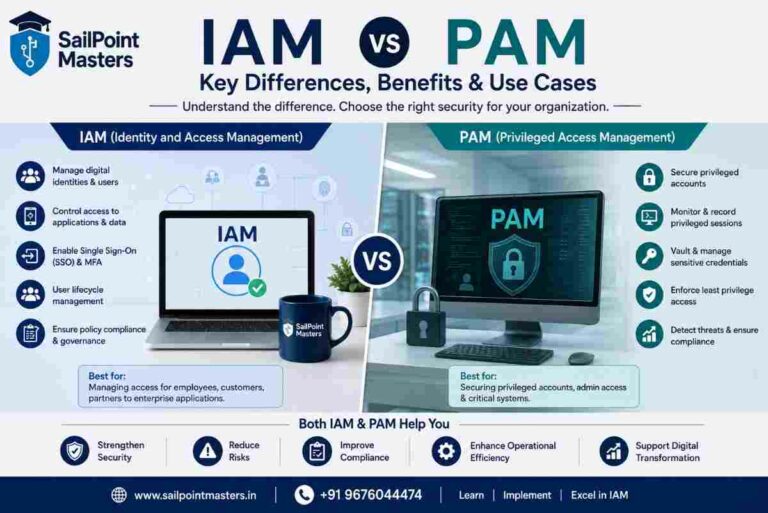
IAM (Identity and Access Management) manages digital identities and controls access for all users — employees, contractors, and systems — across an organization. PAM (Privileged Access Management) is a specialized subset that secures, vaults, and monitors high-risk privileged accounts like admins and root users. IAM governs the broad identity population; PAM adds tighter controls specifically around accounts that could cause the most damage if compromised. Most enterprises run both together as part of a Zero Trust strategy.
★★★★★
4.9/5 rated by 1329+ students · Google Verified
Table of Contents
Introduction
Every organization running more than a handful of applications eventually asks the same question: who has access to what, and is that access actually appropriate? Answering that question well is the job of Identity and Access Management (IAM). A narrower, higher-stakes version of the same question — who can log in as an administrator, a root user, or a service account, and what are they doing with that access — is the job of Privileged Access Management (PAM).
IAM vs PAM is one of the most common points of confusion for people entering cybersecurity, and for good reason: the two disciplines overlap, they’re frequently deployed together, and vendors sometimes blur the line between them. IAM is the broad identity foundation — authentication, authorization, provisioning, and governance for every user in an organization. PAM is a focused layer on top of that foundation, built specifically to protect the small number of accounts that carry the highest risk.
Identity has become one of the most common attack paths into enterprise systems, and stolen or misused privileged credentials are behind a disproportionate share of major breaches. That has pushed identity security to the top of enterprise security budgets and turned IAM and PAM into two of the fastest-growing, best-paying specializations in Indian cybersecurity. Whether you’re a CISO deciding what to implement first or a professional deciding what to learn first, understanding exactly where IAM ends and PAM begins is the starting point. This guide is part of the blog for SailPoint Certification Training in Hyderabad at https://sailpointmasters.in/, so alongside the concepts, we’ve also covered what each path means for your career and earning potential in India.
IAM vs PAM
What is IAM?
Identity and Access Management (IAM) is the discipline of managing digital identities and controlling what each identity is allowed to do across an organization’s applications, systems, and data. IAM covers every identity in the organization — employees, contractors, partners, and increasingly, machine and service accounts — not just a privileged few.
A mature IAM program typically includes
- Identity lifecycle management — creating, updating, and removing identities as people join, change roles, or leave
- Authentication — verifying that a user is who they claim to be, often via Multi-Factor Authentication (MFA)
- Authorization — determining what an authenticated user is allowed to access
- Single Sign-On (SSO) — letting users authenticate once to reach multiple applications
- Role-Based Access Control (RBAC) — grouping entitlements into business-friendly roles rather than managing permissions one by one (see our https://sailpointmasters.in/role-based-access-control-in-sailpoint-identityiq/ deep dive for how this works inside SailPoint IdentityIQ)
- Provisioning and deprovisioning — automatically granting or revoking access as roles change (our https://sailpointmasters.in/sailpoint-provisioning-vs-deprovisioning/ guide covers this lifecycle step in detail)
- Identity governance and access reviews — periodically certifying that existing access is still justified
In short, IAM exists to make sure the right user has the right access to the right resource at the right time — and can prove it during an audit.
What is PAM?
Privileged Access Management (PAM) is a specialized security discipline focused on securing, controlling, and monitoring accounts that hold elevated or “privileged” access — the accounts that could cause the most damage if compromised.
Privileged accounts include
- Administrative accounts used to configure servers, networks, and applications
- Root accounts with unrestricted control over a system
- Service accounts that let applications talk to each other without human login — a category that’s growing fast enough that we cover it separately in our https://sailpointmasters.in/sailpoint-machine-identity-security/ guide to machine identity security
- Break-glass or emergency accounts used only in exceptional situations
Core PAM capabilities include
- Credential vaulting — storing privileged passwords and keys in a hardened, access-controlled vault
- Password rotation — automatically changing privileged credentials on a schedule or after use
- Just-in-time (JIT) access — granting elevated privileges only for the duration of a specific task instead of leaving them standing
- Privileged session monitoring — recording and, when needed, terminating privileged sessions in real time
- Least privilege enforcement — limiting every account to only the access it strictly needs
- Privileged account discovery — finding unmanaged or “shadow” privileged accounts across the environment
Privileged accounts need this extra layer of control because a single compromised admin credential can expose an entire environment, whereas a compromised standard user account is typically contained by normal IAM controls.
IAM vs PAM: What is the Difference?
The main distinction lies in their scope and level of access control. IAM governs every identity in the organization at a policy level — who should have access, and to what. PAM narrows in on the smaller set of privileged identities and adds real-time controls — vaulting, session recording, and time-limited access — around how that access is actually used.
|
Feature |
IAM |
PAM |
|
Main purpose |
Manage identities and access broadly |
Secure and monitor privileged accounts |
|
Primary users |
All employees, contractors, and machine identities |
Admins, root accounts, service accounts |
|
Access type |
Standard and role-based access |
Elevated, high-risk access |
|
Authentication |
SSO, MFA for all users |
Vaulted credentials, session-based authentication |
|
Authorization |
RBAC/ABAC across applications |
Time-limited, just-in-time privilege elevation |
|
Credential vaulting |
Not a core feature |
Core feature |
|
Session monitoring |
Not a core feature |
Core feature, often with recording |
|
Least privilege |
Applied at the role level |
Applied at the individual privileged-session level |
|
Typical use cases |
Onboarding, SSO, access certification |
Admin credential protection, session control |
|
Security focus |
Breadth — governing the whole identity population |
Depth — locking down the highest-risk accounts |
IAM vs PAM: Which One is More Important?
This isn’t really a competition. IAM provides the broader identity foundation — without it, an organization has no reliable way to know who its users even are, let alone what they’re allowed to do. PAM adds a deeper, more intensive layer of protection specifically for the accounts that pose outsized risk.
Most security teams implement IAM first, since it establishes basic identity governance across the organization. PAM is then layered in, often prioritized for environments with a large number of privileged accounts — data centers, cloud administration, and DevOps pipelines. For a mid-size or large enterprise with real compliance obligations, the realistic answer is that both are necessary: IAM governs the policy layer, and PAM enforces it at the credential level for the riskiest accounts.
How IAM and PAM Work Together
A typical enterprise workflow shows how the two disciplines connect in practice
- An employee joins the organization.
- IAM creates the identity and assigns baseline, role-based access.
- The employee later needs elevated access — for example, to administer a production server.
- A request for privileged access is raised and routed for approval.
- PAM grants just-in-time access to the privileged account, rather than standing access.
- The privileged credential is checked out from the vault and automatically rotated after use.
- The privileged session is monitored and recorded.
- Access is automatically revoked once the task or approved window ends.
- The full activity trail — request, approval, session, and revocation — is logged for audit.
This is also where IAM and PAM technically integrate: IAM governs who should be allowed to request privileged access and for how long, while PAM enforces and records how that access is actually used. If you’re mapping this against a specific vendor stack, our https://sailpointmasters.in/sailpoint-vs-cyberark-for-identity-governance/ comparison breaks down exactly how SailPoint (governance) and CyberArk, now rebranded Idira under Palo Alto Networks (privileged access), divide this workflow between them.
IAM and PAM Tools and Platforms
Rather than one platform doing both jobs well, most enterprises run dedicated tools for each discipline and integrate them.
IAM/IGA platforms include SailPoint (our https://sailpointmasters.in/what-is-sailpoint/ guide covers what it is and how it works if you’re new to the platform), Microsoft Entra ID, Okta, and Ping Identity — each focused on identity lifecycle, SSO, and governance at scale. If you’re weighing SailPoint against the other IAM platforms specifically, our https://sailpointmasters.in/sailpoint-vs-okta/, https://sailpointmasters.in/sailpoint-vs-saviynt/, and https://sailpointmasters.in/ping-identity-vs-sailpoint/ comparisons cover that ground in detail.
PAM platforms include CyberArk (now operating under the Idira brand at Palo Alto Networks), BeyondTrust, Delinea, and Microsoft Entra Privileged Identity Management (PIM) for cloud-native privilege elevation. CyberArk’s own architecture documentation, available at https://docs.cyberark.com/pam-self-hosted/latest/en/content/pasimp/privileged-account-security-solution-architecture.htm, is a useful reference for how vaulting and session isolation are implemented under the hood.
Each category addresses a different problem: IAM platforms answer “does this identity have the access it needs,” while PAM platforms answer “is this specific high-risk credential being used safely, right now.” For a full side-by-side of a leading IAM platform against a leading PAM platform — including architecture, pricing, and India salary data — see the comparison linked above.
IAM and PAM Use Cases
IAM use cases: employee onboarding and offboarding, application access via SSO, MFA enforcement, periodic access reviews, role management, and cloud identity governance.
PAM use cases: protecting domain administrator and root accounts, securing database and server admin access, vaulting privileged credentials, granting temporary elevated access for a specific task, monitoring privileged sessions, and protecting service-account credentials used by applications and CI/CD pipelines.
IAM and PAM Security Benefits
Together, IAM and PAM reduce unauthorized access, improve visibility into who holds what access, enforce least privilege at both the role and session level, and reduce the risk of credential theft. They also improve compliance and auditability — IAM through access certifications and lifecycle logs, PAM through session recordings and rotation logs — and together they reduce insider-risk exposure while strengthening an organization’s Zero Trust posture in both on-premises and cloud environments.
IAM vs PAM: Career Opportunities in India
Both fields offer strong, growing career paths in India, spanning IAM Analyst, IAM Engineer, IAM Developer, and Identity Governance Engineer roles on one side, and PAM Engineer, PAM Administrator, and Privileged Access Consultant roles on the other. Both tracks are open to freshers, IT administrators, and professionals transitioning into cybersecurity, and both are commonly grouped under the broader umbrella of IAM jobs in India.
On the IAM side, platforms like SailPoint expose REST and SCIM APIs — documented on https://developer.sailpoint.com/docs/api/getting-started/ — that let engineers automate provisioning and governance workflows programmatically, which is a common area of hands-on skill-building for IAM Engineer and IAM Developer roles.
Rather than repeat the full career and hiring breakdown here, our dedicated guides go deeper on each side: https://sailpointmasters.in/sailpoint-careers/ for the IAM/governance track and https://sailpointmasters.in/cyberark-jobs/ for the PAM track. If you’re evaluating a structured training path with placement support, our https://sailpointmasters.in/iam-course-with-job-guarantee/ page covers what that looks like.
IAM Salary vs PAM Salary in India
The figures below are approximate market ranges based on current India hiring trends, not guaranteed compensation — actual offers vary by city, employer, and specialization.
|
Experience Level |
IAM Salary (INR/year) |
PAM Salary (INR/year) |
|
Fresher (0–2 Years) |
4–7 LPA |
4–8 LPA |
|
Mid-Level (3–5 Years) |
8–15 LPA |
9–16 LPA |
|
Senior (6–10 Years) |
16–25 LPA |
17–27 LPA |
|
Lead/Architect (10+ Years) |
25–35+ LPA |
27–38+ LPA |
PAM specialists often command a modest premium at the senior end, since fewer professionals are trained on privileged-access platforms relative to the number of open roles. IAM/governance roles remain more numerous overall, since nearly every enterprise running an identity program needs them. For a full breakdown specific to one platform, see our https://sailpointmasters.in/cyberark-salary/ guide for PAM compensation trends.
Compensation in both fields depends heavily on experience, product specialization, certifications, cloud skills, location, and whether the role involves architecture-level responsibility.
Skills Required for IAM and PAM Careers
IAM skills: identity lifecycle management, Active Directory and LDAP, SQL, REST APIs, SAML, OAuth, OpenID Connect, RBAC, provisioning workflows, basic scripting, cloud IAM, and identity governance concepts.
PAM skills: Windows and Linux administration, Active Directory, networking fundamentals, privileged account management concepts, credential vaulting, password rotation, session management, scripting, API integration, cloud security, SIEM integration, and hands-on knowledge of a PAM platform such as CyberArk/Idira.
Both fields also reward strong fundamentals in general cybersecurity and troubleshooting, since IAM and PAM engineers routinely work alongside SOC, network, and cloud security teams.
IAM vs PAM Career Path
Most professionals progress the same way in both fields: start with core identity and access fundamentals, move into hands-on platform administration (SailPoint or a PAM tool like CyberArk/Idira), then specialize into engineering, integration, or governance roles, and eventually move toward consulting or architecture. For a detailed, stage-by-stage roadmap on the IAM/governance side, see our https://sailpointmasters.in/sailpoint-roadmap/ guide.
IAM vs PAM Certifications
On the IAM side, SailPoint’s IdentityIQ and https://sailpointmasters.in/sailpoint-identity-security-cloud/ certifications, along with Microsoft and Okta identity certifications, are widely recognized. On the PAM side, CyberArk/Idira certifications remain the most requested in Indian job postings, alongside broader security credentials like ISC2 and CompTIA certifications. Certification value in both fields depends heavily on hands-on experience alongside the credential — not the certificate alone. Our https://sailpointmasters.in/cyberark-course-syllabus/ page outlines what a structured PAM certification track covers.
IAM vs PAM in Zero Trust Security
Zero Trust security assumes no user or device is trusted by default, inside or outside the network — every access request must be explicitly verified. IAM contributes the identity-centric foundation of Zero Trust: strong authentication, continuous verification, and role-based authorization for every user. PAM adds a deeper layer specifically for privileged access: enforcing least privilege at the session level, eliminating standing access through just-in-time elevation, and continuously monitoring the accounts that pose the greatest risk. The https://csrc.nist.gov/pubs/sp/800/207/final Zero Trust Architecture standard and the https://www.cisa.gov/zero-trust-maturity-model both treat identity governance and privileged access as complementary, not interchangeable, pillars of a Zero Trust strategy.
IAM vs PAM in Cloud Security
Cloud environments multiply the number of identities that need managing — human users, workload identities, service accounts, and cloud administrators, often across multiple providers. Cloud IAM handles day-to-day access for these identities, typically through native controls like AWS IAM or Microsoft Entra ID. Cloud PAM narrows in on privileged cloud roles specifically, using tools like https://learn.microsoft.com/en-us/entra/id-governance/privileged-identity-management/pim-configure to grant temporary, just-in-time elevation instead of permanent administrative rights. As organizations move more infrastructure to the cloud, the volume of privileged cloud roles — and the importance of controlling them tightly — continues to grow.
Industries Hiring IAM and PAM Professionals
Banking and financial services, IT services, healthcare, telecommunications, e-commerce, government, and insurance are the heaviest adopters of both IAM and PAM, largely because of regulatory compliance requirements and the scale and sensitivity of the identities they manage. Regulated and large organizations in particular need both a governance layer to prove access is appropriate, and a privileged-access layer to control the accounts that could do the most damage.
IAM vs PAM vs IGA
Identity Governance and Administration (IGA) is often confused with IAM, but it’s really the governance-heavy subset of IAM: certifications, Segregation of Duties (SoD) enforcement, and lifecycle automation across the full identity population. IAM is the broader umbrella that includes authentication, SSO, and access management, while IGA focuses specifically on proving and governing that access over time. PAM sits alongside both, focused narrowly on privileged accounts. Our https://sailpointmasters.in/sailpoint-iga/ guide covers IGA capabilities in depth if you want to go further on that side.
IAM vs PAM vs CIEM
Cloud Infrastructure Entitlement Management (CIEM) is a newer discipline focused specifically on cloud permissions — identifying excessive or unused entitlements across cloud infrastructure like AWS, Azure, and GCP. IAM manages identities and access broadly; PAM secures privileged accounts specifically; CIEM analyzes and right-sizes cloud entitlements at scale, often flagging over-permissioned roles that neither traditional IAM nor PAM tools were built to catch. The three increasingly work together as organizations shift more workloads to the cloud.
How to Start a Career in IAM or PAM
- Learn core cybersecurity and networking fundamentals.
- Understand IAM and PAM concepts — authentication, authorization, privileged accounts, and least privilege.
- Get comfortable with Active Directory and basic Linux administration.
- Learn authentication and authorization protocols: SAML, OAuth, and OpenID Connect (the https://developer.okta.com/docs/concepts/oauth-openid/ reference is a good starting point).
- Practice identity lifecycle management concepts hands-on.
- Pick a platform to specialize in — an IAM/IGA tool like SailPoint, or a PAM tool like CyberArk/Idira.
- Build small hands-on projects or lab environments.
- Prepare for a relevant certification.
- Build a resume specific to IAM or PAM roles.
- Apply for entry-level IAM/PAM roles and prepare for technical interviews.
- Continue learning cloud identity, Zero Trust, and (increasingly) machine-identity security as you progress.
If you’re preparing specifically for PAM interviews, our https://sailpointmasters.in/cyberark-interview-questions/ guide is a useful next stop; for hands-on platform training in Hyderabad, see our https://sailpointmasters.in/cyberark-training-in-hyderabad/ and https://sailpointmasters.in/sailpoint-identity-access-management/ programs.
Key Takeaways
- IAM manages identities and access for every user in an organization; PAM is a specialized subset securing high-risk privileged accounts.
- IAM focuses on breadth — governing the whole identity population — while PAM focuses on depth for the accounts that pose the greatest risk.
- Most enterprises deploy IAM and PAM together, with IAM governing policy and PAM enforcing it at the credential level.
- Both fields are converging around Zero Trust and cloud security as machine and AI-agent identities multiply.
- IAM and PAM both offer strong, growing career paths in India, with distinct but complementary skill sets and salary ranges.
Conclusion
IAM vs PAM isn’t a competition between two rival technologies — it’s a question of scope. IAM gives an organization the identity foundation it needs to know who its users are and what they’re allowed to do. PAM adds a tighter, more intensive layer of control around the specific accounts that could cause the most damage if compromised. Understanding where one ends and the other begins is essential both for building a secure identity architecture and for choosing the right specialization if you’re building a career in identity security.
If you’re ready to build hands-on skills on either side of this stack — governance-focused IAM with SailPoint, or privileged access with CyberArk/Idira — explore the programs at SailPoint Certification Training in Hyderabad: https://sailpointmasters.in/. Call or WhatsApp +91 9676044474 to book a free demo class and figure out which path fits your background.
FAQ
- What is the difference between IAM and PAM?
IAM manages identities and access for every user in an organization, while PAM is a focused subset that secures, vaults, and monitors accounts with elevated or privileged access.
- Is PAM part of IAM?
PAM is generally considered a specialized subdomain within the broader IAM discipline, though it’s implemented with dedicated tools and controls distinct from general IAM platforms.
- Which is better, IAM or PAM?
Neither is “better” — they solve different problems. IAM provides the identity foundation every organization needs; PAM adds deeper protection specifically for high-risk privileged accounts. Most enterprises need both.
- What is the difference between IAM, PAM, and IGA?
IAM is the broad umbrella covering authentication, authorization, and access management. IGA is the governance-heavy subset of IAM focused on certifications and lifecycle automation. PAM is a separate, narrower discipline focused specifically on privileged accounts.
- Is CyberArk an IAM or PAM tool?
CyberArk, now rebranded Idira under Palo Alto Networks, is primarily a PAM tool, focused on vaulting, rotating, and monitoring privileged credentials.
- Is SailPoint IAM or PAM?
SailPoint is an IAM/IGA platform focused on identity governance and lifecycle management, not privileged access management specifically.
- Is IAM a good career in India?
Yes. Demand for IAM professionals has grown steadily as banks, insurers, and IT services firms expand identity governance programs across Hyderabad, Bengaluru, and other major hubs.
- Is PAM a good career in India?
Yes. Privileged access remains one of the highest-risk areas in enterprise security, and demand for skilled PAM professionals continues to outpace the available talent pool.
- Which has better career opportunities, IAM or PAM?
IAM roles are more numerous overall since nearly every enterprise identity program needs them. PAM roles are more specialized and can command a premium at senior levels due to scarcer trained talent.
- What should I learn first, IAM or PAM?
Most professionals benefit from learning core IAM concepts first, since they establish the identity fundamentals that PAM builds on. From there, you can specialize into a PAM platform if privileged-access work interests you.
SailPoint Trainer
SailPoint Masters Editorial Team | 15+ Articles Published
We specialize in SailPoint Certification Training in Hyderabad, helping aspiring professionals and IT experts develop in-demand Identity and Access Management (IAM) skills. Our training covers SailPoint IdentityIQ, Identity Security Cloud, certification preparation, real-world projects, and career guidance to support success in cybersecurity and identity governance careers.
Share