
SailPoint vs Oracle Identity Governance: The Complete Comparison for Enterprises and IAM Careers
SailPoint and Oracle Identity Governance are two leading Identity Governance and Administration (IGA) platforms. SailPoint offers a cloud-native SaaS model (Identity Security Cloud) alongside its mature on-premises IdentityIQ product, while Oracle Identity Governance is a highly customizable, Java-based platform built for complex on-premises and hybrid Oracle-centric environments. The right choice depends on cloud strategy, existing infrastructure, and compliance needs.
★★★★★
4.9/5 rated by 1329+ students · Google Verified
Table of Contents
Introduction
Every enterprise, regardless of size or industry, eventually runs into the same problem: too many people have access to too many systems, and nobody can say with confidence who has access to what, why they have it, or whether they still need it. This is the problem that Identity Governance and Administration (IGA) exists to solve. IGA platforms centralize how organizations create, manage, review, and revoke digital identities and their access to applications, data, and infrastructure — while producing the audit trail that regulators and security teams demand.
Organizations adopt identity governance platforms for a mix of reasons: regulatory pressure (SOX, GDPR, HIPAA, and industry-specific mandates), the sheer complexity of managing access across hundreds of cloud and on-premises applications, and the basic security principle of least privilege. Manual, spreadsheet-driven access reviews simply don’t scale once an organization crosses a few thousand identities.
Two names dominate conversations about enterprise IGA: SailPoint and Oracle Identity Governance (OIG). SailPoint built its reputation as a governance-first, identity-centric vendor and has pushed hard into cloud-native SaaS delivery with Identity Security Cloud. Oracle Identity Governance, meanwhile, grew out of Oracle’s broader identity and middleware stack and remains deeply embedded in large, Oracle-centric enterprises running complex, hybrid environments.
Comparing SailPoint vs Oracle Identity Governance matters for two very different audiences. For IT and security leaders, it’s a platform decision that will shape provisioning, compliance, and audit readiness for years. For IAM professionals — especially in India, which has become one of the largest global hubs for IAM implementation and support work — it’s a career decision, since specializing in one platform (or both) shapes the job market you’re competing in, the projects you’ll work on, and your earning potential. This guide from SailPoint Certification Training in Hyderabad walks through both angles in detail, with a particular focus on what the comparison means for your SailPoint learning path and career in India.
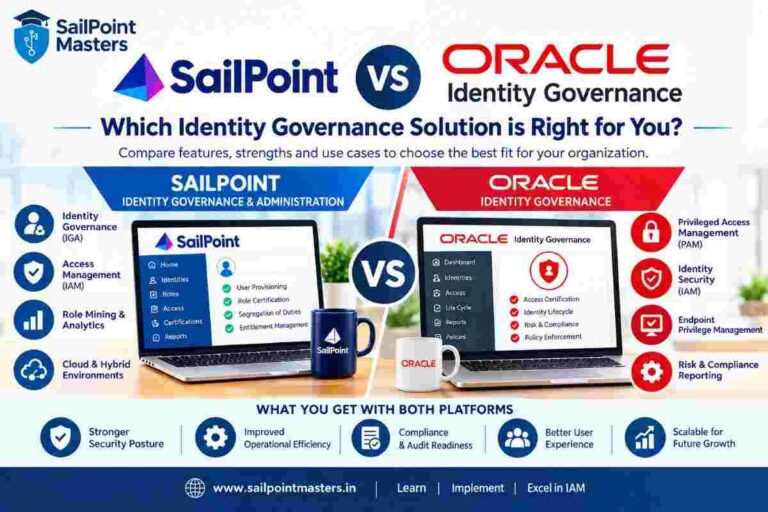
SailPoint vs Oracle Identity Governance
What is SailPoint?
SailPoint is an identity security company whose core product line addresses Identity Governance and Administration. SailPoint’s platform manages the full identity lifecycle — from the moment an employee, contractor, or service account is created, through every access change during their tenure, to final deactivation when they leave. For a deeper walkthrough of the company, its history, and its full feature set, see this complete guide to what SailPoint is.
SailPoint’s IGA capabilities include
- Identity lifecycle management — automating account creation, updates, and deactivation as people join, move within, or leave an organization (commonly called Joiner-Mover-Leaver, or JML).
- Access governance — certifying that existing access is appropriate through periodic and event-triggered access reviews.
- Compliance — supporting Segregation of Duties (SoD) policies and generating audit-ready reports for regulatory frameworks.
- Provisioning and deprovisioning — automatically granting or removing access to target systems through connectors.
- Role management — modeling and maintaining roles so that access can be granted in logical, business-aligned bundles rather than one entitlement at a time.
SailPoint offers two flagship products. SailPoint IdentityIQ (IIQ) is the long-established, highly customizable platform, traditionally deployed on-premises or in a customer-managed cloud environment, built on Java with an XML-based configuration model that lets engineers tailor workflows, rules, and connectors to complex business needs. SailPoint Identity Security Cloud (ISC), formerly known as IdentityNow, is SailPoint’s cloud-native, multi-tenant SaaS platform — see SailPoint’s own Identity Security Cloud product overview for the vendor’s current positioning and roadmap. IdentityIQ suits organizations that need heavy customization, while Identity Security Cloud suits cloud-first organizations that want lower operational overhead and automatic updates. ISC increasingly leans on AI-driven capabilities such as access recommendations and anomaly detection to reduce the burden of manual access reviews. If you’re deciding which SailPoint module to specialize in first, this comparison of SailPoint IIQ and IdentityNow breaks down features, salaries, and career paths for each.
What is Oracle Identity Governance?
Oracle Identity Governance is Oracle’s enterprise identity governance platform, part of its broader Oracle Identity and Access Management suite — see Oracle’s own Identity Governance product page for the vendor’s official description and feature list. Oracle Identity Governance is a J2EE web application whose architecture is distributed across logical tiers — a user-interface tier, an application tier, a database tier, and a connector tier. This architecture reflects its roots as a highly configurable, developer-extensible platform designed for large, often legacy-heavy enterprise environments.
OIG’s core capabilities cover the same ground as any mature IGA platform
automating provisioning, managing the lifecycle of identities, and conducting certification and compliance activities, so that access to systems and data stays appropriately controlled and auditable. Provisioning in OIG can be automated or manual, and it uses a robust set of connectors to push access changes out to managed applications and target systems, whether that access needs to be granted or later revoked following a monitoring event.
Where OIG particularly stands out is its integration with Oracle’s broader enterprise ecosystem. Organizations already running Oracle E-Business Suite, PeopleSoft, or Oracle ERP often choose OIG because of its native connectors and its ability to use Oracle ERP as the authoritative source of business context for access decisions in lifecycle workflows. Oracle has also layered newer capabilities on top of the traditional OIG core, including Oracle Access Governance, a more modern SaaS governance layer that can run in hybrid mode alongside Oracle Identity Governance 12c, letting managers renew or revoke access entitlements with a direct connection back to OIG. Oracle has also introduced Oracle Identity Role Intelligence, which uses data mining, AI, and ML to help identify common access patterns across peer groups and continuously optimize role-based access control.
SailPoint vs Oracle Identity Governance: Key Differences
Quick answer: SailPoint (especially Identity Security Cloud) leans toward a modern, cloud-native, AI-assisted governance model with faster deployment, while Oracle Identity Governance is a deeply customizable, Java-based platform best suited to complex, Oracle-centric, on-premises or hybrid environments.
|
Area |
SailPoint |
Oracle Identity Governance |
|
Platform architecture |
IdentityIQ: on-prem, Java/XML-based. ISC: cloud-native SaaS |
J2EE, multi-tier (UI, application, database, connector tiers) |
|
Identity lifecycle management |
Strong, JML-focused, AI-assisted in ISC |
Strong, especially where HR/ERP is the source of truth |
|
Access governance |
Certification campaigns, AI-driven recommendations (ISC) |
Certification campaigns, customizable via workflows |
|
Provisioning |
Connector-based, automated and manual |
Connector-based, automated and manual, deep Oracle app support |
|
Role management |
Role modeling and mining capabilities |
Role modeling, enhanced by Oracle Identity Role Intelligence |
|
Access certifications |
Periodic and event-based, AI-assisted prioritization in ISC |
Configurable certification campaigns by user, role, application, or entitlement |
|
Compliance |
Strong SoD and audit reporting |
Strong SoD and audit reporting, ERP-aligned compliance context |
|
Analytics |
Growing AI/ML-driven identity analytics in ISC |
Data-mining-based role intelligence via OIRI |
|
Workflow capabilities |
Configurable workflows and rules (deep in IIQ) |
Configurable workflows via Java-based customization |
|
Application integrations |
Broad connector marketplace, strong SaaS app coverage |
Strong for Oracle ecosystem (EBS, PeopleSoft, ERP) plus general connectors |
|
Cloud capabilities |
Native (ISC); IdentityIQ can integrate with cloud apps |
Available via Oracle Access Governance hybrid mode |
|
On-premises deployment |
Available (IdentityIQ) |
Core deployment model historically |
|
User experience |
Modern, simplified UI in ISC |
Functional but often described as complex, especially in older versions |
|
Scalability |
Strong, particularly for large SaaS-app portfolios |
Strong for large, complex enterprise estates |
|
Administration |
Lower overhead in ISC; more effort in IIQ |
Generally higher administrative and maintenance overhead |
|
Reporting |
Built-in dashboards and compliance reports |
Strong reporting, especially for regulatory/ERP-aligned audits |
|
Automation |
High, with AI-assisted decisions in ISC |
High, but often requires custom Java development |
|
Enterprise integration |
Broad, cloud-and-SaaS-first |
Deep for Oracle-centric enterprise stacks |
SailPoint Architecture and Components
SailPoint IdentityIQ is built around a Java application server with an XML-based object model that defines identities, applications, roles, policies, and workflows. Its core components include the identity warehouse (a normalized store of identity and access data pulled from connected systems), connectors (which link IdentityIQ to target applications for provisioning and data aggregation), workflows and rules (which encode business logic for approvals, provisioning, and certifications), and the certification engine (which drives access review campaigns).
SailPoint Identity Security Cloud, being SaaS, abstracts away most of this infrastructure. Organizations configure sources (connected applications), identity profiles, access profiles, roles, and workflows through a web-based admin console rather than managing servers directly. ISC layers AI-driven features on top of this foundation, including access recommendations that help reviewers make faster, more accurate certification decisions, and continuous monitoring for risky access combinations. For a layer-by-layer technical breakdown, see this SailPoint IdentityIQ architecture guide.
Oracle Identity Governance Architecture and Components
Oracle Identity Governance’s system architecture is distributed across four logical tiers: a user-interface tier where administrators and end users interact with the system, an application tier, a database tier, and a connector tier. The application tier hosts the core governance engine — provisioning logic, workflow processing, and policy enforcement — while the connector tier manages communication with target systems such as Active Directory, databases, ERP applications, and custom systems. For the full technical breakdown, see Oracle’s official documentation on Identity Governance product architecture.
Because OIG is a J2EE application, it typically runs on Oracle WebLogic Server and depends on an Oracle Database backend, which ties its deployment closely to the broader Oracle middleware stack. This is a double-edged sword: organizations already standardized on Oracle infrastructure gain tight integration, while organizations without that Oracle footprint take on additional infrastructure complexity just to run OIG. More recently, Oracle has introduced Oracle Access Governance as a cloud-based governance layer that can operate alongside on-premises OIG, giving organizations a path toward modernizing certification and access-review workflows without a full platform migration — Oracle’s reference architecture for an identity governance solution walks through how this hybrid model fits together.
SailPoint vs Oracle Identity Governance: Which is Better?
There’s no universal winner here — the right platform depends heavily on context.
- Organization size: Very large, complex enterprises with deep legacy estates have historically gravitated toward both IdentityIQ and OIG; smaller and mid-sized organizations, or those prioritizing speed of deployment, often favor SailPoint’s ISC.
- Existing technology ecosystem: Organizations heavily invested in Oracle applications (E-Business Suite, PeopleSoft, Oracle ERP) often find OIG’s native integration compelling. Organizations with a diverse, cloud-heavy SaaS portfolio often find SailPoint’s connector ecosystem a better fit.
- Cloud strategy: Cloud-first organizations tend to prefer SailPoint ISC for its SaaS delivery model; organizations with strict data-residency or on-premises requirements may lean toward IdentityIQ or OIG.
- Compliance requirements: Both platforms support certification campaigns and SoD enforcement adequate for most regulatory frameworks; the deciding factor is usually how well each integrates with the systems that hold the compliance-relevant data.
- Integration requirements: Deep Oracle ERP integration favors OIG; broad SaaS application coverage favors SailPoint.
- IAM maturity: Organizations early in their IAM journey often find ISC’s guided configuration easier to stand up; organizations with mature, in-house IAM engineering teams can extract more value from IdentityIQ’s or OIG’s deep customization.
- Budget: Licensing, implementation, and ongoing maintenance costs vary by vendor negotiation and deployment complexity, and should be evaluated through a direct vendor conversation rather than assumed.
- Deployment preferences: On-premises requirements point toward IdentityIQ or classic OIG; SaaS preference points toward ISC or Oracle Access Governance.
- Customization requirements: Both IdentityIQ and OIG support deep customization at the cost of higher implementation and maintenance effort.
- Long-term identity strategy: Organizations moving toward Zero Trust and continuous, AI-assisted governance may find SailPoint’s current product direction more aligned; organizations consolidating around Oracle’s enterprise stack may find OIG’s roadmap more relevant.
SailPoint vs Oracle Identity Governance for Career Opportunities
Both platforms support long, stable IAM careers, but the day-to-day work differs.
- SailPoint Developer — builds and maintains connectors, workflows, and rules (heavily Java-based in IdentityIQ).
- SailPoint Administrator — manages sources, identity profiles, access profiles, and certification campaigns.
- SailPoint IAM Engineer — designs and implements identity lifecycle and provisioning solutions across IdentityIQ or ISC.
- SailPoint Consultant — leads implementation and advisory engagements for client organizations adopting SailPoint.
- Identity Governance Consultant — a platform-agnostic role advising on IGA strategy, often working across multiple vendors including SailPoint and Oracle.
- Oracle Identity Governance Developer — builds custom connectors, workflows, and adapters using Java/J2EE.
- Oracle IAM Consultant — implements and configures OIG (and related Oracle IAM products) for enterprise clients.
- IAM Architect — designs the overall identity architecture, often spanning multiple platforms including SailPoint, Oracle, and others.
- Identity Security Engineer — focuses on the security posture of identity systems, increasingly overlapping with Zero Trust and threat detection work.
IAM skills are valuable in India’s IT market because the country hosts a large share of global enterprise IT services delivery, and identity governance implementations for multinational clients are frequently staffed from India-based teams. As more global enterprises modernize compliance and access-governance programs, demand for professionals fluent in either platform — or both — has grown accordingly.
SailPoint Jobs in India
SailPoint professionals in India are hired by a broad mix of organizations: global IT services and consulting firms delivering SailPoint implementations for international clients, banking and financial services companies driven by regulatory compliance needs, large enterprises running in-house IAM teams, and specialized identity security boutiques. Demand is especially concentrated in GCC (Global Capability Center) hubs, where multinational banks and consultancies run enterprise IAM programs locally. For a fuller look at the role landscape, hiring trends, and growth paths, see this breakdown of SailPoint careers in 2026.
Oracle Identity Governance Jobs in India
Oracle Identity Governance professionals in India are typically hired by large enterprises and IT services firms supporting clients with established Oracle infrastructure — banking, insurance, manufacturing, and government-adjacent sectors are common employers, given how often these industries run on Oracle ERP and middleware. Roles range from OIG developers building custom connectors and workflows, to IAM consultants configuring certification campaigns and provisioning policies, to architects designing governance solutions across hybrid Oracle environments.
SailPoint Salary in India
Salary ranges below are general indicators based on publicly available job market information and vary significantly by company, location, certifications, project complexity, and negotiated compensation. They should not be treated as guaranteed figures.
- Fresher / Entry Level: Typically an early-career IT salary range, often boosted somewhat by SailPoint-specific training or certification.
- Mid-Level (roughly 3–6 years): A meaningful step up, reflecting hands-on implementation experience with IdentityIQ or ISC.
- Senior (roughly 6–10 years): Higher compensation for professionals who can lead implementations, mentor teams, and handle complex connector and workflow design.
- Lead / Architect: The highest tier, reserved for professionals who design enterprise-wide identity governance strategy and lead large-scale SailPoint programs.
For current, precise figures, cross-check recent listings on job platforms and salary-aggregation sites, since compensation data shifts over time and by city. If you want a city-specific breakdown, this SailPoint course salary guide for Hyderabad covers benchmarks by platform (IIQ vs. ISC), experience, and employer type.
Oracle Identity Governance Salary in India
Similarly, Oracle Identity Governance salaries in India scale with experience and specialization
- Fresher / Entry Level: Entry-level compensation, often for professionals moving into OIG from broader Java or middleware backgrounds.
- Mid-Level: Increases with hands-on OIG implementation and connector-development experience.
- Senior: Reflects the ability to independently design and deliver complex OIG solutions, often within Oracle-heavy enterprise environments.
- Lead / Architect: The top tier, for professionals architecting enterprise IAM strategy across Oracle’s identity stack.
As with SailPoint, treat these as general directional ranges rather than guarantees — actual compensation depends on employer, location (Hyderabad, Bengaluru, Pune, and other hubs often differ), certifications, and demand at the time of hiring.
Skills Required for SailPoint Professionals
- IdentityIQ (rules, workflows, connectors, XML configuration)
- Identity Security Cloud (sources, access profiles, identity profiles)
- Identity lifecycle management concepts (JML)
- Provisioning and deprovisioning
- Workflow and rule design
- Role modeling and RBAC
- Access certifications
- Segregation of Duties (SoD)
- Connector development and configuration
- REST APIs
- Java (especially for IdentityIQ customization)
- SQL
- LDAP and Active Directory
- Cloud IAM concepts
- Troubleshooting and log analysis
Hands-on practice with SailPoint’s official developer documentation is one of the fastest ways to build real API, connector, and extensibility skills beyond what any course alone can teach. For a structured, layer-by-layer study plan covering these skills, see this SailPoint IIQ curriculum guide.
Skills Required for Oracle Identity Governance Professionals
- Oracle Identity Governance configuration and administration
- Identity lifecycle management
- Provisioning and reconciliation
- Access policies and certification campaigns
- Workflow customization (Java/J2EE-based)
- Connector development
- Java and J2EE fundamentals
- SQL and Oracle Database basics
- LDAP and Active Directory
- Integration with the broader Oracle ecosystem (WebLogic, ERP, E-Business Suite)
- Core IAM concepts (RBAC, SoD, least privilege)
- Compliance and governance reporting
SailPoint vs Oracle Identity Governance: Certifications
Quick answer: SailPoint offers role-based certifications (such as Identity Security Cloud and IdentityIQ engineer-level credentials), while Oracle’s IAM certifications sit within its broader Oracle Cloud and middleware certification tracks. Certifications help validate skills but work best paired with hands-on project experience.
SailPoint offers certifications tied to its products, including credentials focused on Identity Security Cloud and IdentityIQ implementation and engineering skills — see the official SailPoint Certifications and Credentials program for current exam tracks and prerequisites. Oracle offers certifications within its Oracle Cloud Infrastructure and identity management certification tracks that cover Oracle’s IAM and governance products. Beyond vendor-specific credentials, foundational IAM certifications (covering general identity and access management concepts) can help build a base understanding before specializing.
Certification alone does not guarantee employment — most employers weight hands-on project experience, problem-solving ability, and familiarity with real enterprise scenarios (connectors, workflows, troubleshooting) heavily alongside any certificate. For a role-by-role look at which SailPoint certifications lead to which salary bands, see this guide to SailPoint certification and free resources to get started.
SailPoint vs Oracle Identity Governance: Use Cases
Both platforms are commonly deployed for
- Employee onboarding and offboarding
- Joiner-Mover-Leaver (JML) process automation
- Self-service access requests
- Automated provisioning and deprovisioning across target systems
- Periodic and event-triggered access reviews/certifications
- Role-based access control (RBAC) design and maintenance
- Segregation of Duties (SoD) policy enforcement
- Regulatory compliance audits (SOX, GDPR, industry-specific mandates)
- Privileged access governance (often integrated with dedicated PAM tools)
- Application access governance across cloud and on-premises systems
- Broader identity lifecycle automation tied to HR systems
Role-based access control is one of the use cases that varies most in implementation depth between platforms — see this deep dive on role-based access control in SailPoint IdentityIQ for how role mining, business/IT role structures, and certifications work together in practice.
SailPoint vs Oracle Identity Governance: Pros and Cons
SailPoint — Pros:
- Strong cloud-native SaaS option (ISC) with lower operational overhead
- AI-assisted access recommendations and certification support
- Broad connector ecosystem covering many modern SaaS applications
- Active community and growing certification ecosystem
SailPoint — Cons:
- IdentityIQ customization can require significant Java development effort
- Migrating from IdentityIQ to ISC is a meaningful project in itself
- Can carry a premium cost for large-scale enterprise deployments
Oracle Identity Governance — Pros:
- Deep integration with Oracle ERP, E-Business Suite, and PeopleSoft
- Highly customizable for complex, non-standard governance requirements
- Comprehensive and powerful identity lifecycle automation with strong control, governance, and compliance capabilities for complex environments
Oracle Identity Governance — Cons:
- Complex architecture and high maintenance overhead make upgrades and daily operations more time-consuming than some modern IGA platforms
- Custom Java-based connectors and workflows are expensive to maintain, since every connector and workflow is hand-built in Java EE
- User interface and deployment agility can trail newer cloud-native platforms, adding operational overhead relative to SaaS alternatives
SailPoint vs Oracle Identity Governance for Beginners
Quick answer: SailPoint’s Identity Security Cloud generally has a gentler learning curve for beginners due to its guided, SaaS-based configuration model, while Oracle Identity Governance’s Java/J2EE foundation demands more upfront technical grounding.
Before diving into either platform, beginners benefit from learning
- Core IAM fundamentals (authentication vs. authorization, identity lifecycle)
- Active Directory and LDAP basics
- SQL fundamentals
- Java basics (more critical for OIG and IdentityIQ customization)
- RBAC and role-modeling concepts
- Provisioning and deprovisioning concepts
- Access governance and certification concepts
Learners without a strong Java background may find SailPoint’s ISC administration console more approachable initially, while those coming from a Java or middleware development background may find OIG’s architecture more familiar. If you’re starting from zero, this SailPoint course for beginners in 2026 lays out a low-barrier entry path, including which adjacent IT skills transfer directly.
SailPoint vs Oracle Identity Governance: Future Scope
The IAM industry is steadily shifting toward cloud identity, Zero Trust architectures, and AI-assisted governance. Both platforms are evolving in that direction: SailPoint has invested heavily in ISC’s AI-driven recommendations and continuous access insights, while Oracle has introduced AI/ML-based role intelligence and a cloud-based Access Governance layer that complements its traditional on-premises OIG core.
Emerging themes shaping both platforms’ roadmaps include machine and non-human identity governance (service accounts, API keys, bots), SaaS application governance as organizations adopt more cloud tools, automated access decisioning to reduce reviewer fatigue, identity threat detection tied more closely into broader security operations, and continuous (rather than periodic) access governance. Professionals who build skills in these emerging areas — alongside core platform expertise — are well positioned as both SailPoint and Oracle continue investing in AI-assisted governance.
Why Identity Governance is a Strong IT Career in India
Identity governance has become one of the steadier specializations within India’s broader cybersecurity and IT services landscape, driven by several converging trends:
- Growing cybersecurity requirements across regulated industries
- Rapid enterprise cloud adoption, which multiplies the number of applications needing governance
- Regulatory and compliance requirements pushing companies toward auditable, automated access controls
- Ongoing digital transformation initiatives at large enterprises
- Increasingly sprawling application environments that are hard to govern manually
- Rising demand for identity lifecycle automation to reduce operational overhead
- A persistent shortage of experienced IAM specialists relative to enterprise demand
- Concentrated opportunities in major IT hubs such as Hyderabad, Bengaluru, Pune, Chennai, and Mumbai, where global enterprises and IT services firms run large identity implementation and support teams
Ready to build these skills hands-on? SailPoint Certification Training in Hyderabad offers instructor-led and 1-on-1 mentorship batches with real-time labs, covering both IdentityIQ and Identity Security Cloud, with career support for placements across Hyderabad and PAN India. Explore the training program.
SailPoint vs Oracle Identity Governance Career Roadmap
|
Level |
Skills to Learn |
Recommended Focus |
|
Beginner |
IAM fundamentals, LDAP, Active Directory, SQL |
Understand identity and access concepts |
|
Intermediate |
SailPoint or Oracle IGA, provisioning, workflows, connectors |
Build practical IAM skills |
|
Advanced |
RBAC, certifications, SoD, APIs, integrations |
Work on enterprise IAM implementations |
|
Expert |
Architecture, cloud IAM, identity security, governance strategy |
Lead complex IAM programs |
For a more detailed, stage-by-stage version of this roadmap — including what to study first and how long each stage typically takes — see the full SailPoint Roadmap 2026.
SailPoint vs Oracle Identity Governance: Which Should You Learn?
- Fresh graduates: Either platform is a reasonable entry point; SailPoint’s ISC may offer a gentler on-ramp if you don’t yet have strong Java skills.
- Experienced IT professionals: Consider which ecosystem your target employers use — Oracle-heavy enterprises will value OIG experience, while cloud-forward organizations will value SailPoint.
- Java developers: Your existing skills translate well to both IdentityIQ customization and OIG connector/workflow development.
- Cybersecurity professionals: SailPoint’s growing AI-driven governance and identity security focus may align well with a broader security career path.
- System administrators: Both platforms value strong Active Directory, LDAP, and provisioning knowledge as a starting point.
- IAM professionals already in the field: Building cross-platform familiarity (SailPoint and Oracle, plus adjacent tools) tends to widen job opportunities more than deep specialization in just one.
- Professionals moving into cybersecurity: Either platform provides a practical, in-demand entry point into enterprise security work.
- Professionals targeting cloud identity careers: SailPoint’s Identity Security Cloud is the more directly cloud-native option to prioritize.
There isn’t a single “better” technology to learn — the right choice depends on the industries and employers you’re targeting, and your existing technical background.
Key Takeaways
- SailPoint and Oracle Identity Governance both deliver strong identity lifecycle management, provisioning, access certification, and compliance capabilities, but they take different architectural paths — SailPoint through cloud-native SaaS (ISC) plus on-prem IdentityIQ, and Oracle through a Java/J2EE-based platform deeply tied to its enterprise application ecosystem.
- The better platform depends on organizational context: cloud strategy, existing Oracle footprint, customization needs, and IAM maturity all matter more than any generic “best” ranking.
- Both platforms support solid, long-term IAM careers in India, with opportunities concentrated in major IT hubs and driven by growing cybersecurity, compliance, and cloud adoption trends.
- Core technical foundations — Active Directory, LDAP, SQL, Java, and IAM/RBAC concepts — are valuable across both SailPoint and Oracle Identity Governance career paths.
- Certifications help validate skills, but hands-on implementation experience remains the strongest differentiator in the job market for either platform.
Suggested SEO Keywords
SailPoint vs Oracle Identity Governance, SailPoint vs Oracle IAM, SailPoint Identity Governance, Oracle Identity Governance, SailPoint IGA, Oracle IGA, SailPoint IdentityIQ, SailPoint Identity Security Cloud, Identity Governance and Administration, IAM Jobs in India, SailPoint Jobs in India, Oracle IAM Jobs in India, SailPoint Salary in India, Oracle Identity Governance Salary, SailPoint Certification, Oracle IAM Certification, Identity Governance Career, IAM Career in India, SailPoint Developer, SailPoint Consultant, Oracle IAM Consultant, Identity Governance Consultant, IAM Architect, Identity Security, Cloud IAM, Access Governance, Identity Lifecycle Management, Role-Based Access Control, Segregation of Duties, Access Certification
Suggested FAQ Schema Questions
- What is the difference between SailPoint and Oracle Identity Governance?
- Is SailPoint better than Oracle Identity Governance?
- Which is easier to learn, SailPoint or Oracle Identity Governance?
- Is SailPoint a good career in India?
- Is Oracle Identity Governance a good career?
- Which has better job opportunities, SailPoint or Oracle IAM?
- What is the salary of a SailPoint professional in India?
- What skills are required to become a SailPoint developer?
- Does Oracle Identity Governance require Java knowledge?
- Which IAM technology should I learn in 2026?
FAQ
- What is the difference between SailPoint and Oracle Identity Governance?
SailPoint offers a cloud-native SaaS platform (Identity Security Cloud) alongside its on-premises IdentityIQ product, while Oracle Identity Governance is a Java/J2EE-based platform traditionally deployed on-premises, with deep integration into Oracle’s enterprise application ecosystem.
- Is SailPoint better than Oracle Identity Governance?
Neither is universally better. SailPoint tends to fit cloud-first organizations and broad SaaS application portfolios well, while Oracle Identity Governance tends to fit large, Oracle-centric enterprises with complex, customized governance needs.
- Which is easier to learn, SailPoint or Oracle Identity Governance?
SailPoint’s Identity Security Cloud generally has a gentler learning curve thanks to its guided, SaaS-based configuration approach, while Oracle Identity Governance’s Java/J2EE foundation typically requires more upfront technical grounding.
- Is SailPoint a good career in India?
Yes — SailPoint skills are in steady demand across IT services firms, financial institutions, and enterprises modernizing their identity governance programs in India’s major IT hubs.
- Is Oracle Identity Governance a good career?
Yes, particularly for professionals targeting large enterprises and IT services firms that support Oracle-centric clients in banking, insurance, manufacturing, and similar sectors.
- Which has better job opportunities, SailPoint or Oracle IAM?
Both have solid opportunities; SailPoint roles skew toward cloud-forward organizations, while Oracle IAM roles skew toward enterprises with an established Oracle technology footprint. Many IAM professionals benefit from familiarity with both.
- What is the salary of a SailPoint professional in India?
Salaries vary significantly by experience level, company, location, and certifications — ranging from entry-level compensation for freshers up to senior architect-level pay for experienced professionals leading large SailPoint programs. Check current job listings for precise, up-to-date figures.
- What skills are required to become a SailPoint developer?
Core skills include IdentityIQ or Identity Security Cloud configuration, connector and workflow development, Java (especially for IdentityIQ), SQL, LDAP/Active Directory, and general IAM concepts like RBAC and SoD. For a full breakdown of day-to-day responsibilities and a learning path, see this SailPoint Developer roles and responsibilities guide.
- Does Oracle Identity Governance require Java knowledge?
Yes, in most implementation and development roles — OIG’s connectors and workflows are commonly built and customized using Java/J2EE, so Java skills are valuable for anyone working beyond basic administration.
- Which IAM technology should I learn in 2026?
It depends on your target employers and existing skills. If you’re aiming for cloud-forward organizations, prioritize SailPoint’s Identity Security Cloud. If you’re targeting large, Oracle-centric enterprises, prioritize Oracle Identity Governance. Many experienced IAM professionals eventually build familiarity with both.
SailPoint Trainer
SailPoint Masters Editorial Team | 15+ Articles Published
We specialize in SailPoint Certification Training in Hyderabad, helping aspiring professionals and IT experts develop in-demand Identity and Access Management (IAM) skills. Our training covers SailPoint IdentityIQ, Identity Security Cloud, certification preparation, real-world projects, and career guidance to support success in cybersecurity and identity governance careers.
Share