
SailPoint vs CyberArk for Identity Governance: The Complete 2026 Comparison
SailPoint vs CyberArk for identity governance is really a comparison between two different disciplines. SailPoint is a purpose-built Identity Governance and Administration (IGA) platform that manages the full identity lifecycle and access certification. CyberArk, now rebranded as Idira under Palo Alto Networks, is the market leader in Privileged Access Management (PAM), securing and monitoring high-risk credentials. Most enterprises run both together rather than choosing one over the other.
★★★★★
4.9/5 rated by 1329+ students · Google Verified
Table of Contents
Introduction
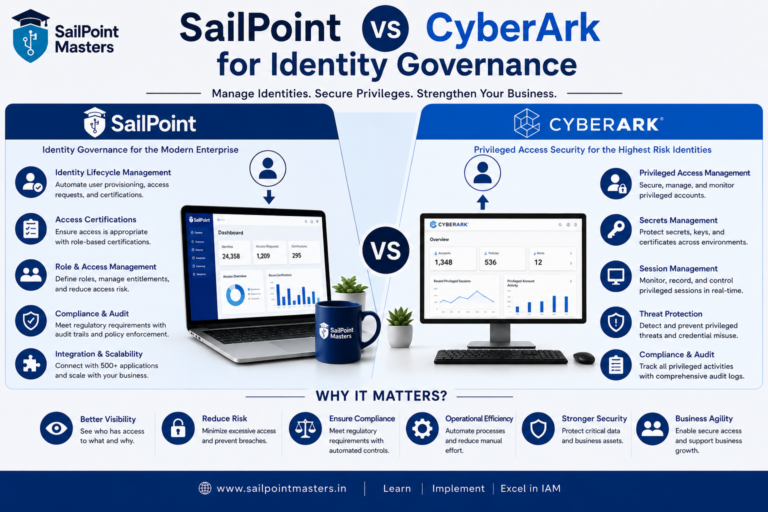
Every large organisation eventually asks the same uncomfortable question: can we prove, to an auditor’s satisfaction, that every employee, contractor, and system account has exactly the access it needs and nothing more? That question sits at the heart of Identity Governance and Administration (IGA), and it’s why SailPoint vs CyberArk for identity governance is one of the most searched comparisons in enterprise security today.
Identity has quietly become the primary attack surface in modern IT. Stolen credentials, over-provisioned accounts, and forgotten access rights are behind a large share of breaches reported every year. Regulators have responded with tighter compliance mandates — SOX, HIPAA, GDPR, and RBI/SEBI guidelines in India — that require organisations to demonstrate continuous control over who can access what. That pressure has fuelled explosive demand for identity security platforms, and for the professionals who can implement them.
In India specifically, the IAM and PAM job market has grown sharply as global banks, insurers, and IT services firms in Hyderabad, Bengaluru, and Pune build out governance and privileged-access teams for international clients. This is exactly why so many professionals evaluating a cybersecurity career — and so many CISOs evaluating a security stack — end up comparing SailPoint and CyberArk side by side. They are frequently mentioned together, but as you’ll see below, they solve different halves of the same problem. This guide is part of the blog for our https://sailpointmasters.in/ program, so we’ve also broken down what each platform means for your career and earning potential in India.
SailPoint vs CyberArk for Identity Governance
What is Identity Governance and Administration (IGA)?
Identity Governance and Administration (IGA) is the discipline of managing digital identities and their access rights across an organisation’s applications, systems, and data. IGA answers four core questions: who has access, why they have it, whether that access is still appropriate, and how you prove it to auditors.
A mature IGA program covers
- Identity Lifecycle Management — automatically provisioning access when someone joins, adjusting it when they change roles, and revoking it the moment they leave.
- Access Certification — periodic reviews where managers or application owners confirm that existing access is still justified.
- Role-Based Access Control (RBAC) — grouping entitlements into business-friendly roles instead of managing thousands of individual permissions.
- Access Requests and Approvals — a self-service catalogue where employees request access, routed through appropriate approval workflows.
- Segregation of Duties (SoD) — policies that prevent one person from holding two conflicting permissions, such as creating and approving the same payment.
- Compliance and Auditing — evidence trails that satisfy SOX, HIPAA, GDPR, and similar regulations.
SailPoint is generally considered the market leader in this specific discipline, and we’ll come back to exactly how its governance engine works a little further down.
What is SailPoint?
SailPoint is an enterprise identity security company that specialises in IGA, giving organisations centralised visibility into every human and machine identity and automating governance controls to keep access accurate and least-privilege by design. It ships two flagship products — SailPoint IdentityIQ (IIQ), the on-premises and hybrid governance engine, and SailPoint Identity Security Cloud (ISC), the SaaS platform built on Atlas.
If you’re new to the platform, our complete walkthrough of https://sailpointmasters.in/what-is-sailpoint/ covers its history, architecture, and use cases in depth, and our https://sailpointmasters.in/identityiq-vs-identity-security-cloud/ comparison explains which product to learn first.
What is CyberArk?
CyberArk was founded in 1999 and built its reputation as the pioneer of Privileged Access Management (PAM) — vaulting, rotating, and monitoring the credentials used by administrators, service accounts, and other high-risk identities. In February 2026, Palo Alto Networks completed a roughly $25 billion acquisition of CyberArk, and in May 2026 it folded the CyberArk portfolio into a new unified brand called Idira. The underlying technology, component names (Vault, CPM, PVWA, PSM), and the skills required to run it are unchanged during the transition — only the vendor branding and platform packaging have shifted. Because “CyberArk” remains the term most professionals and job listings still use, this guide uses it throughout, with the Idira rebrand noted where it matters.
CyberArk’s core capabilities include
- Credential Vaulting — a hardened digital vault that stores and rotates privileged passwords, keys, and secrets.
- Session Isolation and Monitoring — routing privileged sessions through a proxy that records and can terminate suspicious activity in real time.
- Just-in-Time and Zero Standing Privilege Access — granting elevated access only for the duration of a task instead of leaving it permanently active.
- Secrets Management — securing credentials used by applications, scripts, and CI/CD pipelines (formerly Conjur).
- Endpoint Privilege Management — removing unnecessary local admin rights on workstations and servers.
You can review CyberArk’s own architecture documentation on its https://docs.cyberark.com/pam-self-hosted/latest/en/content/pasimp/privileged-account-security-solution-architecture.htm page, and its current product positioning on the https://www.cyberark.com/products/privileged-access-manager/ page.
SailPoint vs CyberArk for Identity Governance
This is the question most people are really asking: if you need identity governance specifically, is CyberArk a substitute for SailPoint? The short answer is no. SailPoint vs CyberArk for identity governance isn’t really a contest, because CyberArk was not built to run access certifications, manage joiner-mover-leaver workflows, or enforce SoD policies across thousands of business applications — that is SailPoint’s core competency. CyberArk’s governance-adjacent features exist mainly to control access to privileged accounts themselves, not to govern the broader identity population.
In practice, the two platforms are frequently deployed together: SailPoint governs standard and privileged identities at the policy level, while CyberArk (Idira) enforces and monitors the moment-to-moment use of high-risk credentials. Enterprises rarely have to choose one over the other — they choose SailPoint for governance and CyberArk for privileged session control, then integrate the two.
Key Differences Between SailPoint and CyberArk
|
Aspect |
SailPoint |
CyberArk (Idira) |
|
Core discipline |
Identity Governance and Administration (IGA) |
Privileged Access Management (PAM) |
|
Primary question answered |
Who has access, and should they? |
Who is using privileged credentials, and how? |
|
Scope |
All identities — employees, contractors, machine identities |
Primarily privileged/admin accounts and secrets |
|
Governance depth |
Deep — certifications, SoD, lifecycle, RBAC |
Shallow outside privileged accounts |
|
Session control |
Not a core feature |
Core feature — vaulting, recording, isolation |
SailPoint vs CyberArk Features Comparison
|
Feature |
SailPoint |
CyberArk (Idira) |
|
Primary Focus |
Identity Governance |
Privileged Access Management |
|
Identity Governance |
Extensive (certifications, RBAC, SoD) |
Limited to privileged identities |
|
Privileged Access Management |
Via integration with PAM tools |
Native and market-leading |
|
Compliance |
Strong audit trails for SOX, HIPAA, GDPR |
Strong for privileged-access controls specifically |
|
Access Certifications |
Native, scheduled and event-based |
Not a core capability |
|
Role Management |
Native RBAC engine |
Not applicable |
|
Password Vaulting |
Not native |
Core capability |
|
Session Monitoring |
Not native |
Core capability, with recording |
|
Cloud Support |
Identity Security Cloud (SaaS) |
Privilege Cloud / Idira SaaS |
|
AI Features |
AI-driven access recommendations, anomaly detection |
AI-assisted threat detection, zero standing privilege |
|
Best Use Cases |
Access certification, compliance audits, lifecycle automation |
Securing admin credentials, session recording, secrets management |
Identity Governance Capabilities in SailPoint
SailPoint’s governance engine is built around continuous visibility and policy enforcement: certification campaigns that let managers review access on a schedule or trigger automatically on role change, an SoD policy engine that flags toxic access combinations before they become audit findings, and role-mining that converts entitlement sprawl into manageable, business-aligned roles. Identity Security Cloud layers AI on top of this — recommending access based on peer-group analysis and highlighting risky or rarely used entitlements. Our https://sailpointmasters.in/sailpoint-iga/ covers each of these capabilities in full depth.
Privileged Access Management Capabilities in CyberArk
CyberArk’s strength is depth on a narrower slice of the identity population: the accounts that can do the most damage if compromised. Its Vault stores privileged credentials with strict access controls and automatic rotation, so a stolen password becomes worthless within a short window. Privileged Session Manager (PSM) proxies every privileged connection, records it, and can terminate it mid-session if behaviour looks anomalous. Its move toward Zero Standing Privilege — granting elevated rights only for the duration of a specific task — reflects where the whole PAM market, and now the broader Idira platform, is heading as machine and AI-agent identities multiply inside enterprise environments.
SailPoint vs CyberArk Architecture Comparison
SailPoint IdentityIQ follows a classic three-tier Java architecture: a presentation layer, a business logic layer running the governance engine, and a persistence layer backed by a relational database — connectors then pull identity data from HR systems, directories, and target applications for aggregation and provisioning. (Our full breakdown of the https://sailpointmasters.in/sailpoint-identityiq-architecture/ covers this layer by layer.) Identity Security Cloud replaces this with a multi-tenant SaaS architecture on the Atlas platform.
CyberArk’s architecture centres on a hardened Digital Vault as the system of record for credentials, with the Central Policy Manager (CPM) handling automatic rotation, the Password Vault Web Access (PVWA) providing the web console, and PSM brokering and recording sessions. Both platforms support hybrid deployment models, but SailPoint’s architecture is oriented around governing broad identity data; CyberArk’s is oriented around protecting a small number of extremely sensitive credentials.
SailPoint vs CyberArk Deployment Options
Both vendors offer on-premises and SaaS deployment models. SailPoint IdentityIQ is typically self-hosted or hybrid for large regulated enterprises that need deep customisation via BeanShell and XML, while Identity Security Cloud is fully SaaS. CyberArk similarly offers PAM Self-Hosted for organisations with strict data-residency requirements, alongside Privilege Cloud and the newer Idira SaaS offering for faster deployment. Enterprises with heavy compliance obligations — banking, insurance, healthcare — often lean toward self-hosted or hybrid deployments for both platforms; cloud-first organisations increasingly default to the SaaS versions of each. If you’re planning which deployment track to train on first, our https://sailpointmasters.in/sailpoint-identity-access-management/ guide walks through what a course covers for both IdentityIQ and Identity Security Cloud.
SailPoint vs CyberArk Security and Compliance Features
SailPoint’s compliance value comes from its audit trail of access decisions: every certification, approval, and policy violation is logged and reportable, which is exactly what auditors want to see for SOX Section 404 or HIPAA access reviews. CyberArk’s compliance value comes from session-level evidence: recorded privileged sessions, credential rotation logs, and proof that no standing access existed outside an approved task window. Frameworks like https://www.nist.gov/news-events/news/2020/08/zero-trust-architecture-nist-publishes-sp-800-207 and the https://www.cisa.gov/zero-trust-maturity-model both treat identity governance and privileged access controls as complementary pillars — not substitutes — which is a useful way to think about how the two platforms fit together in a compliance program.
SailPoint vs CyberArk Integration Capabilities
SailPoint connects to HR systems, directories, cloud platforms, and thousands of target applications through its connector framework, and its REST and SCIM APIs — documented on the https://developer.sailpoint.com/docs/api/getting-started/ — let engineers extend and automate governance workflows. Its full product documentation, covering connectors, provisioning, and workflows in depth, is maintained on the official https://documentation.sailpoint.com/identityiq/help/index.html site. Enterprise integrations like https://sailpointmasters.in/best-sailpoint-integration-with-sap/ show how deep this connector model goes for large ERP environments. Importantly, SailPoint is designed to integrate with PAM tools like CyberArk: SailPoint governs the policy layer (who should have privileged access and for how long), while CyberArk enforces and vaults that access. CyberArk, for its part, integrates with SIEM platforms, ticketing systems, and cloud IAM providers, and exposes its own REST APIs for provisioning and session management.
SailPoint vs CyberArk User Experience and Administration
SailPoint IdentityIQ administration involves configuring connectors, certification campaigns, and workflows — powerful but technical, often requiring BeanShell scripting for advanced customisation. Our https://sailpointmasters.in/sailpoint-iiq-curriculum/ breaks down exactly what this scripting and configuration layer involves for learners. Identity Security Cloud simplifies this with a cleaner, more modern admin console and AI-assisted defaults. CyberArk administration centres around Vault policies, safe structures, and platform configurations in the PVWA console; it’s a different skill set entirely, closer to systems administration and security operations than to governance policy design. Professionals rarely need to be experts in both consoles — most specialise in one track.
SailPoint vs CyberArk Pricing Considerations
Neither vendor publishes flat public pricing; both are quoted per organisation based on identity volume, number of connected applications, deployment model, and modules licensed. As a general pattern, SailPoint pricing scales with the number of identities and applications under governance, while CyberArk (Idira) pricing scales with the number of privileged accounts, secrets, and session volume being protected. Enterprises evaluating both should request tailored quotes rather than relying on public estimates, and should budget separately for implementation and training alongside licensing.
SailPoint vs CyberArk Career Opportunities in India
The figures below are estimated market ranges based on current India hiring trends for IAM and PAM roles; actual offers vary by city, employer, and project scope. For a deeper, city-specific breakdown of the SailPoint side, see our dedicated guide to https://sailpointmasters.in/sailpoint-course-salary-in-hyderabad/.
|
Experience Level |
SailPoint Salary (INR/year) |
CyberArk (Idira) Salary (INR/year) |
|
Fresher (0–2 Years) |
4–7 LPA |
4–8 LPA |
|
Mid-Level (3–5 Years) |
8–15 LPA |
9–16 LPA |
|
Senior (6–10 Years) |
16–25 LPA |
17–27 LPA |
|
Architect/Lead (10+ Years) |
25–35+ LPA |
27–38+ LPA |
PAM specialists often command a modest premium over general IGA roles at the senior end, since trained CyberArk/Idira engineers are scarcer relative to open enterprise roles — but SailPoint roles are more numerous overall, since nearly every large enterprise running an IGA program needs SailPoint skills. Our breakdown of https://sailpointmasters.in/sailpoint-certification-and-free-resources-to-get-started/ goes deeper into which specific job titles pay the most.
Which Industries Use SailPoint and CyberArk?
Both platforms are heavily used across BFSI (banking, financial services, insurance), healthcare, government, IT services, and pharmaceuticals — industries with strict regulatory obligations and large, complex identity populations. SailPoint tends to see the deepest adoption anywhere access certification and SoD enforcement are mandated by regulation, such as banking and insurance. CyberArk sees the deepest adoption anywhere privileged infrastructure access is a primary risk — data centres, critical infrastructure, cloud platform teams, and DevOps environments managing secrets at scale. Hyderabad alone hosts SailPoint delivery work for several of these sectors through global captive centres; our guide on https://sailpointmasters.in/is-sailpoint-good-for-cyber-security-careers/ covers which employers are hiring right now.
Future of Identity Governance and Privileged Access Management
Both disciplines are converging around the same pressures: exploding numbers of machine and AI-agent identities, a shift toward Zero Trust architectures, and growing regulatory scrutiny of access controls. SailPoint has extended governance to machine identities through capabilities like https://sailpointmasters.in/sailpoint-machine-identity-security/, while CyberArk’s transition into the Idira platform under Palo Alto Networks explicitly widens its scope to machine and AI-agent identity security alongside traditional PAM. Expect both governance and privileged-access tooling to lean further into AI-driven risk scoring, continuous (rather than periodic) access reviews, and unified identity security platforms that blur the historical line between IGA and PAM.
Which Platform Should You Choose?
- Choose SailPoint if your priority is governing the full identity lifecycle, running access certifications, enforcing SoD, and proving broad compliance across your workforce and applications.
- Choose CyberArk (Idira) if your priority is locking down, vaulting, and monitoring the small number of high-risk privileged and machine accounts that could cause the most damage if compromised.
- Choose both if you’re a mid-size-to-large enterprise with real compliance obligations — which describes most organisations that are seriously comparing the two. SailPoint governs the policy layer; CyberArk enforces it at the credential level.
If you’re weighing SailPoint against other governance platforms rather than a PAM tool, our comparisons of https://sailpointmasters.in/sailpoint-vs-saviynt/ and https://sailpointmasters.in/sailpoint-vs-okta/ cover the rest of the identity security landscape.
Why Identity Governance and Privileged Access Management Are Critical for Modern Enterprises
Regulatory compliance now assumes continuous, demonstrable control over access — not a once-a-year spreadsheet exercise. Insider threats and credential theft remain leading causes of breaches, and unmanaged privileged accounts are consistently among the highest-risk assets in any environment. Cloud transformation has multiplied the number of systems, services, and machine identities that need governing, while digital identity management has become a board-level concern rather than a back-office IT function. Together, IGA and PAM form the backbone of a defensible Zero Trust strategy: one governs who should have access, the other controls how the riskiest access is actually used.
Key Takeaways
- SailPoint and CyberArk solve different problems — IGA versus PAM — and are not direct competitors for identity governance specifically.
- CyberArk was rebranded to Idira under Palo Alto Networks in 2026, but the underlying skills and technology carry over directly.
- Most enterprises deploy both platforms together rather than choosing one, with SailPoint governing policy and CyberArk enforcing privileged access.
- Career paths in both platforms are strong in India, with SailPoint offering broader demand and CyberArk/Idira offering specialised, often higher-paying niche roles.
- The two disciplines are converging as machine and AI-agent identities multiply, pointing toward more unified identity security platforms in the coming years.
Conclusion
SailPoint vs CyberArk for identity governance isn’t really a fight to the death — it’s a question of matching the right tool to the right layer of your identity security stack. SailPoint remains the clearer choice when your priority is governing the full identity lifecycle, running access certifications, and proving compliance across a broad workforce. CyberArk, now operating under the Idira brand at Palo Alto Networks, remains the standard for vaulting, monitoring, and tightly controlling the smaller set of privileged accounts that pose the greatest risk. For professionals building a career in identity security, understanding both — and how they connect — is one of the most valuable skill combinations in Indian IT today.
If you’re ready to build hands-on SailPoint skills with placement support, explore the https://sailpointmasters.in/ program at SailPoint Masters.  Call or WhatsApp +91 9676044474 to book a free demo class and get started.
FAQ
- Is SailPoint better than CyberArk for identity governance?
For pure identity governance — certifications, lifecycle management, SoD — yes, SailPoint is purpose-built for this and CyberArk is not a substitute. CyberArk excels at privileged access management instead.
- What is the difference between SailPoint and CyberArk?
SailPoint governs the full identity lifecycle and access certifications across an organisation; CyberArk (now Idira) secures, vaults, and monitors privileged credentials and sessions.
- Can SailPoint and CyberArk be used together?
Yes, and this is the most common enterprise pattern. SailPoint typically governs policy around who should hold privileged access, while CyberArk enforces and monitors that access at the credential level.
- Which has better career opportunities, SailPoint or CyberArk?
Both offer strong careers in India. SailPoint roles are more numerous because nearly every enterprise with an IGA program needs them; CyberArk/PAM roles are more specialised and can command a premium due to scarcer talent.
- Is CyberArk only for privileged access management?
CyberArk’s core strength is PAM, but under the Idira rebrand it has expanded into secrets management, machine identity security, and early AI-agent identity controls.
- What industries use SailPoint?
Banking, insurance, healthcare, government, and IT services are the heaviest adopters, largely driven by access certification and SoD compliance requirements.
- What industries use CyberArk?
Financial services, critical infrastructure, government, and any organisation with large DevOps/cloud environments where privileged credentials and secrets are a primary risk.
- Which certification is better for IAM professionals?
It depends on the career path: SailPoint certifications (IdentityIQ or Identity Security Cloud) suit governance-focused roles, while CyberArk/Idira certifications suit privileged-access and security-operations roles. Many senior professionals pursue both over time. If you’re preparing for SailPoint interviews specifically, our https://sailpointmasters.in/sailpoint-interview-questions-and-answers/ guide is a good next stop.
- Is SailPoint in demand in India?
Yes. Demand has grown steadily as global banks, insurers, and IT services firms expand identity governance teams out of Hyderabad, Bengaluru, and Pune.
- Is CyberArk (Idira) a good career option in 2026?
Yes. Privileged access remains one of the highest-risk areas in enterprise security, and the Idira rebrand under Palo Alto Networks has, if anything, increased visibility and investment in the platform rather than reducing it.
SailPoint Trainer
SailPoint Masters Editorial Team | 15+ Articles Published
We specialize in SailPoint Certification Training in Hyderabad, helping aspiring professionals and IT experts develop in-demand Identity and Access Management (IAM) skills. Our training covers SailPoint IdentityIQ, Identity Security Cloud, certification preparation, real-world projects, and career guidance to support success in cybersecurity and identity governance careers.
Share