
SailPoint UI Development Kit: The Complete 2026 Guide
The SailPoint UI Development Kit is an official, open-source Angular-and-Electron-based framework from SailPoint that lets developers build custom desktop and web interfaces on top of Identity Security Cloud (ISC). It gives IAM teams a reusable component library, built-in authentication, and a structured project template so they can extend SailPoint’s identity governance platform without building a UI from scratch.
★★★★★
4.9/5 rated by 1329+ students · Google Verified
Table of Contents
Introduction
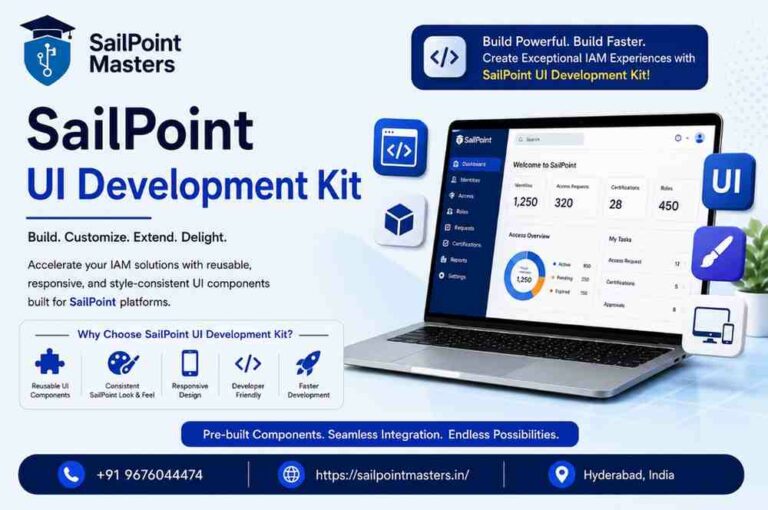
Every identity security team eventually hits the same wall: SailPoint’s out-of-the-box interfaces cover the common cases well, but the moment a business asks for a workflow that doesn’t fit the standard screens — a custom access-request dashboard, a branded self-service portal, a specialized admin console — teams are left stitching together API calls and hand-rolled front ends. The SailPoint UI Development Kit exists to close that gap.
Rather than treating UI customization as a one-off engineering project, the SailPoint UI Development Kit gives developers a maintained, opinionated starting point: an Angular and Electron template pre-wired to authenticate against Identity Security Cloud, call its REST APIs, and reuse a shared library of identity-aware components. For organizations running SailPoint at scale, that means less time spent on boilerplate authentication and layout work, and more time spent on the specific screens the business actually needs.
This matters more each year because identity governance itself is becoming more visible to end users. Employees request access through self-service portals, managers approve certifications from dashboards, and auditors review evidence through custom reporting views. As identity security moves from a back-office control to a front-and-center part of how organizations operate, the ability to shape that interface — rather than accept it as fixed — has real value for developers, administrators, and the enterprises that employ them.
SailPoint UI Development Kit
What Is the SailPoint UI Development Kit?
The SailPoint UI Development Kit is an official, open-source project maintained by SailPoint’s Developer Relations team and published on GitHub under the sailpoint-oss organization. At its core, it is a template application — built on Angular 19 and Electron — that developers clone, configure with their own Identity Security Cloud (ISC) tenant credentials, and extend to build custom user interfaces that talk directly to ISC’s APIs.
Instead of starting a new front-end project from an empty folder, a developer starts from a working application that already knows how to authenticate, route between pages, and render a set of pre-built identity components. The goal is to make it practical for in-house teams and implementation partners to create purpose-built UIs — such as custom account list views, approval dashboards, or administrative utilities — without duplicating the plumbing every project otherwise requires.
Key Features of the SailPoint UI Development Kit
According to the official SailPoint developer documentation, the kit ships with the following core capabilities:
- Pre-built authentication flow using OAuth against an ISC tenant, so developers don’t have to implement token handling themselves.
- A shared component library (sailpoint-components) containing reusable UI elements built by SailPoint and community contributors.
- A component generator (npm run generate:component) that scaffolds new components with matching HTML, TypeScript, and CSS files.
- Cross-platform desktop packaging via Electron, so the same codebase can run as a desktop utility as well as a web app.
- Direct integration with ISC REST APIs, including endpoints for accounts, identities, and other governance objects.
- Built-in error-handling patterns for common API failure cases, such as invalid filters or sorters on list endpoints.
- A component selector in the sidebar that lets developers toggle which shared components are active in a given build, part of what SailPoint calls the Admin’s Toolbox.
Why the SailPoint UI Development Kit Matters for Identity Security
Identity governance platforms live or die by adoption, and adoption depends heavily on whether the people using the system — end users, managers, and administrators — find the interface intuitive for their specific workflows. A generic, one-size-fits-all UI can slow down access reviews, confuse approvers, or fail to surface the right context at the right moment.
By giving developers a structured way to build custom interfaces on top of Identity Security Cloud, the SailPoint UI Development Kit lets organizations tailor the experience to their own processes rather than forcing their processes to match a vendor’s default screens. That customization capability directly supports better governance outcomes: faster certifications, clearer audit trails, and self-service experiences that reduce the burden on IT and security teams.
Components of the SailPoint UI Development Kit
A typical UI Development Kit project is organized around a few key folders:
- projects/sailpoint-components/ — houses shared, reusable components that any page in the app can consume.
- src/app/ — contains the core Angular application: components, modules, and route definitions (app.component.ts, app.module.ts, app.routes.ts).
- package.json and angular.json — standard Angular tooling configuration.
- electron-builder.json — configuration for packaging the app as a cross-platform desktop application.
This structure keeps shared, identity-aware UI pieces separate from page-specific logic, which makes it easier for teams to maintain a consistent look and feel as the number of custom screens grows. If you’re coming from the on-premises world, it’s a useful contrast to SailPoint IdentityIQ architecture, which is organized very differently.
How the SailPoint UI Development Kit Works
The workflow generally follows these steps
- Clone the project from the official sailpoint-oss/ui-development-kit GitHub repository.
- Install prerequisites — Node.js, Angular, and TypeScript (installed globally via npm so the tsc command is available anywhere in the terminal).
- Connect to an ISC tenant by supplying the tenant name and OAuth client credentials, either through the SailPoint CLI’s existing environment configuration or by creating a new environment inside the app, as laid out in the official Getting Started guide.
- Enable or build components using the component selector, or scaffold new ones with the generator command.
- Call ISC REST APIs from custom pages — for example, retrieving a list of accounts, applying filters and sorters, and rendering the results in a table.
- Handle errors gracefully, following the kit’s documented error-handling guide for common API failure cases.
- Package and deploy the finished application, either as a web build or as a desktop installer via Electron, per the official deployment guide.
Benefits of Using the SailPoint UI Development Kit
- Faster time to a working UI, since authentication, routing, and component scaffolding are already solved problems.
- Consistency across custom applications, because shared components enforce a common look, feel, and behavior.
- Lower maintenance overhead, since updates to the shared component library benefit every project built on the kit.
- Flexibility in deployment, supporting both browser-based and Electron desktop packaging from a single codebase.
- Direct, well-documented access to ISC APIs, reducing guesswork around authentication and error handling.
- Community support, through the SailPoint Developer Community forum, where ISC users and SailPoint’s own developer advocates answer implementation questions.
SailPoint UI Development Kit Architecture
Architecturally, the kit sits between two layers: Identity Security Cloud’s REST API layer, which exposes identity, account, and governance data, and the Angular/Electron front end, which consumes that data and renders it for end users. Angular provides the component-based structure and TypeScript support that make the codebase maintainable as it grows, while Electron wraps the same web technologies in a shell that can run as a standalone desktop application on Windows, macOS, or Linux.
Configuration is tenant-aware: the kit stores connection details (tenant name, client ID, client secret) per environment, so a single codebase can be pointed at different ISC tenants — for example, separate development, staging, and production environments — without code changes.
SailPoint UI Development Kit for IdentityIQ
It’s worth being precise here: the UI Development Kit, as published by SailPoint, is built specifically for Identity Security Cloud (ISC), SailPoint’s SaaS identity governance platform — not for the on-premises IdentityIQ (IIQ) product line. IdentityIQ is customized from inside the application using rules and workflows, whereas the UI Development Kit is a separate Angular application that talks to Identity Security Cloud over REST APIs. The two follow different development models, which is explained in our guide on the difference between IdentityIQ and IdentityNow workflows.
Teams working primarily in IdentityIQ can still benefit from understanding the UI Development Kit’s patterns — particularly its approach to component reuse and API-driven design — but should not expect to drop the kit directly into an IIQ environment. Organizations migrating from IdentityIQ to Identity Security Cloud will find the UI Development Kit directly relevant to that new environment. If you’re weighing which platform your team should be building for, see our breakdown of IdentityIQ vs Identity Security Cloud.
SailPoint UI Development Kit Best Practices
- Keep shared components generic. Anything specific to one page belongs in that page’s own component, not in sailpoint-components.
- Separate environments cleanly. Use distinct client credentials for development, staging, and production ISC tenants to avoid accidentally testing against live data.
- Follow the kit’s error-handling patterns consistently, so failures are surfaced to users in a predictable way rather than failing silently.
- Version-control configuration carefully. Client secrets should never be committed to source control; use environment-specific configuration instead.
- Contribute back where possible. Since the shared component library is community-maintained, well-built components can be proposed back to the project for others to reuse.
- Test against realistic data volumes. List and filter endpoints behave differently at scale than in a small sandbox tenant.
Skills Required to Work with the SailPoint UI Development Kit
- Working knowledge of Angular and TypeScript
- Familiarity with JavaScript, HTML, and CSS fundamentals
- Understanding of REST APIs and how to consume JSON responses
- Basic knowledge of OAuth-based authentication
- Comfort with Git for version control and collaboration
- Awareness of core identity governance concepts — accounts, identities, entitlements, certifications
- For desktop builds, familiarity with Electron’s packaging model
Front-end developers new to the SailPoint ecosystem often assume they need heavy Java experience first — that’s not the case for the UI Development Kit specifically. See can you learn SailPoint without Java knowledge for a fuller breakdown of what’s actually required.
Tools and Technologies Used with the SailPoint UI Development Kit
|
Technology |
Role in the UI Development Kit |
|
Angular |
Core front-end framework for building components and routes |
|
TypeScript |
Primary language for application logic |
|
Electron |
Packages the app as a cross-platform desktop application |
|
Node.js / npm |
Runtime and package management for the project |
|
REST APIs (ISC) |
Data source for identities, accounts, and governance objects |
|
JSON |
Data format exchanged with ISC APIs |
|
Git |
Version control for cloning and contributing to the project |
|
Docker |
Optional containerized deployment path for the built application |
Day to day, working with the kit means using npm to install dependencies, the component generator to scaffold new pages, and the SailPoint CLI environment configuration to point the app at the right ISC tenant. Because the account and identity views in your custom screens are only as good as the data behind them, it also helps to understand how sources are connected to ISC, which is covered in our SailPoint connectors list and setup guide.
Career Opportunities for SailPoint UI Developers
Roles that use the UI Development Kit sit at the intersection of Angular front-end development and identity governance, with titles such as SailPoint UI Developer, ISC Front-End Engineer, Identity Security Developer, and IAM Full-Stack Developer. Unlike general SailPoint developer work built around rules and connectors, these roles focus on the user-facing screens, and you can see how the wider developer track compares in SailPoint developer roles and responsibilities. To move into this niche from your current role, follow the steps in how to become a SailPoint developer.
SailPoint UI Developer Salary in India
UI Development Kit work follows the general SailPoint developer pay scale rather than a separate salary band, and the premium comes from combining Angular and TypeScript skills with ISC API knowledge. For the experience-wise salary breakdown, see our SailPoint course salary in Hyderabad guide.
Want to build these skills with expert guidance? WhatsApp SailPoint Masters to talk to our team about our SailPoint certification training in Hyderabad.
Future Scope of the SailPoint UI Development Kit
Identity Security Cloud continues to be SailPoint’s primary investment area, and as more organizations migrate from on-premises IdentityIQ deployments to the SaaS platform, tools that extend and customize ISC — including the UI Development Kit — are likely to see growing use. The project’s open, community-contributed component model also means its capabilities tend to expand over time as more developers add and refine shared components, rather than relying solely on SailPoint’s internal roadmap.
How to Learn the SailPoint UI Development Kit
|
Stage |
Focus |
Key Skills / Resources |
|
Beginner |
Front-end fundamentals |
HTML, CSS, JavaScript, basic Git usage |
|
Intermediate |
Angular and TypeScript |
Component architecture, routing, npm tooling, the official UI Development Kit “Getting Started” guide |
|
Advanced |
ISC API integration |
OAuth authentication, REST API calls (accounts, identities), error handling, building custom pages such as account list views |
|
Expert |
Architecture and deployment |
Contributing shared components, Electron packaging, Docker-based deployment, multi-tenant environment management |
The SailPoint Developer Community is the primary hub for structured learning: it hosts the official documentation for the UI Development Kit, video walkthroughs from SailPoint’s developer advocates, and an active discussion forum where developers troubleshoot real implementation issues. If you’d rather follow a guided, instructor-led path instead of self-teaching from documentation, our structured SailPoint learning roadmap lays out the same progression stage by stage.
Comparison: SailPoint UI Development Kit vs. Other SailPoint Development Paths
|
Aspect |
UI Development Kit |
IdentityIQ Development |
SailPoint API Development |
SailPoint Workflow Development |
|
Primary goal |
Build custom front-end interfaces |
Customize on-prem IIQ via Java/BeanShell/XML |
Integrate systems via REST APIs directly |
Automate governance processes |
|
Platform |
Identity Security Cloud |
IdentityIQ (on-prem) |
ISC or IIQ |
Primarily ISC |
|
Core language |
TypeScript / Angular |
Java, BeanShell, XML |
Any language calling REST endpoints |
Low-code / JSON-based workflow definitions |
|
Typical output |
Custom UI screens and dashboards |
Custom rules, workflows, connectors |
Automated integrations, scripts |
Automated business processes and notifications |
|
Best fit for |
Front-end developers building tailored user experiences |
Java developers deep in IIQ configuration |
Integration engineers connecting external systems |
Admins/analysts automating governance steps |
Industry Trends Shaping Demand
Three shifts make the UI Development Kit more relevant. First, organizations moving from IdentityIQ to Identity Security Cloud need custom screens built for the new platform. Second, self-service and approval experiences are moving from back-office admin tools to portals used by employees and managers. Third, the kit’s component library is community-contributed, so its capabilities keep growing without waiting on a vendor roadmap. For the wider investment picture, see why enterprises are investing in SailPoint IGA.
Why SailPoint UI Development Kit Skills Are Valuable for IT Professionals
Skills centered on the SailPoint UI Development Kit sit in a genuinely narrow niche: general Angular developers are common, and generalist IAM consultants are common, but professionals who can do both — build production-quality front ends and understand identity governance data models — are comparatively rare. That scarcity tends to translate into stronger negotiating position and faster career progression for developers who invest in it early.
For SailPoint administrators and consultants, adding UI Development Kit skills is a practical way to move toward developer-track roles without leaving their existing domain. For front-end developers, pairing Angular and TypeScript with the SailPoint ecosystem opens a route into identity security, and our guide on whether SailPoint is good for cybersecurity careers covers the wider outlook.
Key Takeaways
- The SailPoint UI Development Kit is an official, open-source Angular/Electron template for building custom UIs on Identity Security Cloud — it is not a tool for on-premises IdentityIQ.
- It provides pre-built authentication, a shared component library, and API integration patterns that significantly cut down the boilerplate work of building a custom identity-facing UI.
- Core skills needed include Angular, TypeScript, REST API integration, and a working understanding of identity governance concepts.
- Salary and career prospects for SailPoint UI developers in India scale meaningfully with the depth of both front-end and identity governance expertise, not either skill alone.
- Demand for these hybrid skills is likely to keep growing as more organizations migrate to Identity Security Cloud and invest further in Zero Trust and IGA initiatives.
FAQ
- What is the SailPoint UI Development Kit used for?
It’s used to build custom user interfaces — web or desktop — that connect to SailPoint Identity Security Cloud, letting developers create tailored dashboards, portals, and admin tools beyond the platform’s default screens.
- Is the SailPoint UI Development Kit free to use?
Yes, it’s an open-source project published on GitHub, though using it still requires an active Identity Security Cloud tenant to connect to.
- Does the UI Development Kit work with IdentityIQ?
No — it’s built specifically for Identity Security Cloud (ISC). IdentityIQ customization uses a different model based on Java, BeanShell, and XML.
- What programming language does the SailPoint UI Development Kit use?
Primarily TypeScript, built on the Angular framework, with Electron used for optional desktop packaging.
- Do I need to know Angular before starting with the UI Development Kit?
Basic Angular knowledge helps significantly, since the entire template is built on Angular’s component and routing model.
- Can the SailPoint UI Development Kit be deployed as a desktop application?
Yes — it’s built with Electron specifically to support packaging as a cross-platform desktop app in addition to running as a web application.
- What’s the difference between the UI Development Kit and direct API development?
Direct API development means writing your own integration from scratch; the UI Development Kit provides a ready-made front-end structure, authentication, and shared components on top of the same underlying ISC APIs.
- How do I connect the UI Development Kit to my SailPoint tenant?
You configure it with your ISC tenant name and OAuth client credentials, either reusing an existing SailPoint CLI environment or setting up a new one inside the app.
- What career paths use SailPoint UI Development Kit skills?
Roles such as SailPoint UI Developer, ISC front-end engineer, and IAM full-stack developer, typically within consulting firms, systems integrators, or enterprise security engineering teams.
- Where can I learn the SailPoint UI Development Kit?
The SailPoint Developer Community hosts the official documentation, getting-started guides, and video walkthroughs, along with an active forum for troubleshooting real implementation questions.
Preparing for interviews on the back of this? Check our full SailPoint interview questions and answers guide once you’ve got the fundamentals down here.
Conclusion
The SailPoint UI Development Kit fills a specific, practical gap: it gives developers a maintained, well-documented foundation for building custom interfaces on Identity Security Cloud instead of reinventing authentication, routing, and component structure from scratch for every project. For organizations, that translates into faster delivery of tailored identity experiences. For developers, it represents a genuinely differentiated skill set — one that combines front-end engineering with identity governance domain knowledge, a combination that remains in short supply relative to demand.
If you’re a front-end developer looking to move into cybersecurity, or a SailPoint professional looking to add development skills to your configuration background, the UI Development Kit is a practical, low-barrier place to start: clone the repository, connect it to a sandbox ISC tenant, and begin building. The identity security field isn’t slowing down, and developers who can shape how that security is actually experienced by end users are positioned to grow with it.
If you’d rather build these skills through structured, mentor-led training instead of self-teaching, explore SailPoint certification training in Hyderabad to see how a guided program can get you there faster.
SailPoint Trainer
SailPoint Masters Editorial Team | 15+ Articles Published
We specialize in SailPoint Certification Training in Hyderabad, helping aspiring professionals and IT experts develop in-demand Identity and Access Management (IAM) skills. Our training covers SailPoint IdentityIQ, Identity Security Cloud, certification preparation, real-world projects, and career guidance to support success in cybersecurity and identity governance careers.
Share