
IAM Course with Job Guarantee: The Complete 2026 Career Guide for India
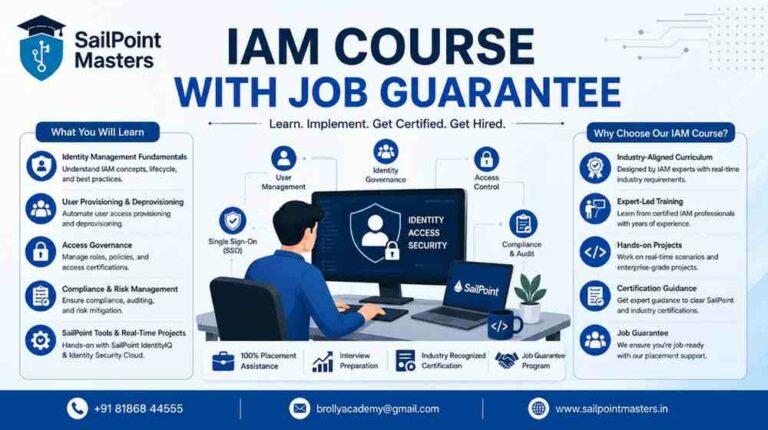
An IAM course with job guarantee typically refers to identity and access management training paired with structured placement assistance — resume support, mock interviews, and job referrals — rather than an unconditional job promise. IAM is one of India’s fastest-growing cybersecurity fields, with strong demand for SailPoint, Okta, and CyberArk skills across banking, IT services, and healthcare.
★★★★★
4.9/5 rated by 1329+ students · Google Verified
Table of Contents
Introduction
If you’ve searched for an IAM course with job guarantee, you’re probably weighing two things at once: is Identity and Access Management (IAM) actually a good career bet, and can any training program realistically promise you a job at the end of it?
Both questions deserve honest answers.
Identity and Access Management (IAM) is the branch of cybersecurity that controls who gets access to what — which employee can open which application, which vendor account gets deprovisioned the day a contract ends, which system logs prove to an auditor that access was appropriate all along. Every regulated company on earth needs people who can run this, and very few IT professionals in India are actually trained to do it well. That gap is exactly why IAM has become one of the most talked-about entry points into cybersecurity.
As for the “job guarantee” part — reputable institutes rarely offer an unconditional guarantee, because no training provider controls a company’s hiring decision. What the better ones offer instead is structured placement assistance: real project work, mock interviews, resume rebuilding, and direct referrals into their hiring network, backed by a track record you can actually verify. That’s a meaningfully different (and more honest) promise than “guaranteed job,” and in this guide we’ll show you how to tell the two apart.
We specialize in SailPoint Certification Training in Hyderabad, helping aspiring professionals and IT experts develop in-demand Identity and Access Management (IAM) skills.
In the sections below, we’ll cover what IAM actually is, why it’s in high demand in India right now, the tools you need to learn, realistic salary ranges by experience level, a career roadmap, and how to evaluate an IAM training program before you enrol — including what a placement-assistance-backed SailPoint Certification Training in Hyderabad program looks like in practice.
IAM Course with Job Guarantee
What is Identity and Access Management (IAM)?
Identity and Access Management (IAM) is the security discipline that governs digital identities and controls what each identity — human or machine — is allowed to access across an organisation’s systems.
In practice, IAM answers four questions for every single user, every single day:
- Who is this person or system? (Identity/authentication)
- What are they allowed to access? (Authorization)
- Why do they have that access? (Governance and justification)
- Is that access still appropriate? (Certification and review)
IAM platforms automate this across the entire employee lifecycle — from the day someone joins (provisioning), through role changes (recertification), to the day they leave (deprovisioning). Without IAM, companies rely on manual spreadsheets and email approvals, which is exactly how orphaned accounts, compliance failures, and insider-risk incidents happen.
This is a distinct discipline from IT support or general cybersecurity — it sits at the intersection of security, compliance, and enterprise software configuration, which is part of why trained IAM professionals are so hard to find.
Why IAM is a High-Demand Career in India
Three forces are converging on India’s IT industry right now, and all three point toward IAM.
- Regulatory pressure is rising. Frameworks like SOX, HIPAA, PCI-DSS, ISO 27001, GDPR, and India’s own DPDP Act require organisations to prove — not just claim — that access is appropriate and regularly reviewed. Identity governance is how that proof gets generated.
- India is a global IAM delivery hub. Hyderabad, Bengaluru, Pune, Chennai, and the NCR host delivery centres for global system integrators running IAM programmes for clients worldwide. That concentrates demand for trained IAM talent in Indian cities specifically.
- Zero Trust has become a board-level mandate. Zero Trust architecture assumes no user or device is trusted by default — every access decision must be verified. Identity is the foundation this entire model is built on, which means IAM skills are becoming a prerequisite for broader cybersecurity roles, not a side specialty.
The result: identity governance is now one of the fastest-growing segments in enterprise security, and supply of trained professionals has not caught up with demand — which is good news if you’re the one getting trained.
IAM Course with Job Guarantee: What Does It Mean?
Let’s be precise about this term, because it gets thrown around loosely in the ed-tech space.
A genuine, unconditional “job guarantee” — where a company promises you employment or a full refund no matter what — is rare and usually comes with heavy fine print: minimum attendance requirements, mandatory assessment scores, relocation clauses, and salary caps on the roles offered.
What most credible IAM institutes actually deliver, and what you should actually be evaluating, is a placement assistance program. That typically includes
- Hands-on, project-based training on real IAM tools (not just theory slides)
- Resume building tailored to IAM/SailPoint job descriptions
- Mock technical and HR interview rounds
- Direct referrals into the institute’s hiring network (consulting firms, GCCs, IT services companies)
- A transparent, verifiable placement rate
For example, SailPoint Masters’ SailPoint Certification Training in Hyderabad is built around this model — 100% placement assistance backed by a published 91.32% placement rate across 1,000+ students trained, rather than a blanket promise. When you’re comparing programs, ask for the actual placement rate and recent hiring partners, not just the words “job guarantee” on a landing page.
Career Opportunities After Completing an IAM Course
IAM training opens roles across the full spectrum of technical depth
- IAM/IGA Analyst — day-to-day access reviews, certification campaigns, and ticket resolution
- SailPoint/IAM Developer — configuring connectors, workflows, and custom rules inside platforms like IdentityIQ
- Identity Governance Consultant — implementation projects for banking, healthcare, and insurance clients
- IAM Engineer (Cloud) — managing Okta, Entra ID, or Identity Security Cloud tenants
- PAM Engineer — administering privileged access tools like CyberArk
- IAM Architect — designing enterprise-wide identity strategy and governance frameworks
- GRC/Compliance Analyst (Identity focus) — mapping identity controls to audit and regulatory requirements
Freshers typically start as analysts or junior developers; the architect and consulting tracks open up with 6+ years of hands-on experience. If you’re weighing IAM against other cybersecurity specialisations, our breakdown of whether SailPoint is good for cyber security careers goes deeper into the demand and salary case.
Industries Hiring IAM Professionals
IAM isn’t a niche-industry skill — it’s needed anywhere regulated data or sensitive systems exist
- Banking, Financial Services & Insurance (BFSI) — heaviest IAM hiring in India due to RBI and SOX-style compliance needs
- Healthcare — HIPAA-driven access governance for patient data systems
- IT Services & Global Capability Centres (GCCs) — running IAM programmes for international clients
- Government & Public Sector — identity infrastructure for citizen and employee systems
- Retail & E-commerce — customer identity and access management (CIAM) at scale
- Telecom — large-scale privileged and machine identity management
Top Companies Hiring IAM Experts in India
Hyderabad alone carries a heavy concentration of active IAM hiring, with global consulting and IT services firms — Deloitte, Accenture, TCS, HCL, Wipro, Capgemini, and IBM among them — running dedicated identity governance practices from their local delivery centres. For the full list of active hirers and where their SailPoint practices are based, see our SailPoint Course Salary in Hyderabad guide, which breaks down hiring companies alongside role-wise compensation.
IAM Roles and Responsibilities
|
Role |
Core Responsibilities |
|
IAM Analyst |
Access reviews, certification campaigns, user provisioning tickets |
|
IAM/SailPoint Developer |
Connector configuration, workflow and rule development, custom integrations |
|
IAM Consultant |
Client-facing implementation, requirements gathering, solution design |
|
PAM Engineer |
Privileged account vaulting, session monitoring, credential rotation |
|
IAM Architect |
Enterprise identity strategy, platform selection, governance framework design |
|
GRC Analyst (Identity) |
Mapping access controls to audit requirements, policy documentation |
IAM Salary in India
Salaries scale sharply with hands-on platform experience (SailPoint, Okta, CyberArk, Entra ID) rather than years alone. The figures below are indicative industry ranges, not a guarantee for any individual outcome.
|
Experience Level |
Salary Range (INR per annum) |
|
Fresher (0–2 Years) |
₹3.5 – 6 LPA |
|
Mid-Level (3–5 Years) |
₹6 – 14 LPA |
|
Senior (6–10 Years) |
₹14 – 26 LPA |
|
Lead/Architect (10+ Years) |
₹26 – 45+ LPA |
For a deeper, role-wise breakdown specific to SailPoint careers, see the SailPoint Course Salary in Hyderabad guide.
Skills Required to Become an IAM Professional
- Core identity concepts: authentication vs. authorization, provisioning/deprovisioning, SoD (Segregation of Duties)
- Working knowledge of at least one IGA/IAM platform (SailPoint is the most in-demand in India)
- Java and SQL fundamentals — SailPoint rules and BeanShell scripting are Java-based
- XML and REST API familiarity for connector and workflow configuration
- Understanding of directory services (Active Directory, LDAP)
- Basic cloud security concepts (AWS/Azure IAM constructs)
- Analytical thinking for access certification and audit reporting
- Communication skills — IAM roles are compliance-facing and require explaining access decisions to non-technical stakeholders
IAM Tools Every Professional Should Learn
|
Tool |
Purpose & Career Relevance |
|
SailPoint IdentityIQ |
On-premises identity governance engine used by large, complex enterprises for provisioning, certification, and policy enforcement. The most in-demand IGA skill in Indian delivery centres — see the IdentityIQ Architecture guide for how it’s built under the hood, or SailPoint’s own developer documentation for the technical reference. |
|
SailPoint Identity Security Cloud |
SaaS-based identity governance platform (formerly IdentityNow); growing fast as enterprises move governance to the cloud, including newer capabilities like Machine Identity Security for non-human accounts. |
|
Microsoft Entra ID (Azure AD) |
Cloud identity and access platform for authentication, conditional access, and SSO across Microsoft ecosystems. See Microsoft’s official Entra ID documentation for the full product overview. |
|
Okta |
Cloud-native identity provider widely used for workforce and customer SSO/MFA implementations. Okta’s own developer concepts guide covers the platform’s architecture in depth. |
|
CyberArk |
Market-leading Privileged Access Management (PAM) platform for securing admin and service accounts. See CyberArk’s official PAM documentation for implementation detail. |
|
Active Directory |
On-premises directory service that underpins authentication for most enterprise environments. |
Wondering how the two SailPoint platforms actually differ day-to-day? Our comparison of IdentityIQ vs. Identity Security Cloud workflows breaks down the on-prem vs. cloud automation model in detail.
Related Concepts You’ll Work With Daily
- Single Sign-On (SSO): Lets users authenticate once to access multiple applications, reducing password fatigue and attack surface.
- Multi-Factor Authentication (MFA): Adds a second verification layer (OTP, biometric, hardware token) beyond a password — see CISA’s official MFA guidance for why this matters at the national security level.
- Role-Based Access Control (RBAC): Assigns access based on job function/role rather than individually per user, simplifying governance at scale. The model traces back to the NIST RBAC standard, adopted as an ANSI/INCITS standard in 2004.
- Identity Governance and Administration (IGA): The umbrella discipline covering the full identity lifecycle — provisioning, certification, policy, and audit reporting. Read the full SailPoint IGA guide for a deeper technical breakdown, or start with What is SailPoint? if you’re new to the platform itself.
- Privileged Access Management (PAM): Secures and monitors high-risk accounts (admins, service accounts) with elevated system access.
- Access Certifications: Periodic reviews where managers or system owners confirm that existing access is still required.
- Provisioning and Deprovisioning: Automated granting and revoking of system access tied to onboarding, role changes, and offboarding events — closely tied to how platforms run aggregation in SailPoint to keep identity data current in the first place.
IAM Career Path
|
Stage |
Skills & Tools |
Certifications |
Typical Progression |
|
Beginner |
IAM fundamentals, Active Directory basics, SQL, RBAC concepts |
SailPoint Certified IdentityIQ Associate |
IAM Trainee → Junior Analyst |
|
Intermediate |
SailPoint IdentityIQ configuration, Java/BeanShell, connectors |
SailPoint Certified IdentityIQ Engineer (SCIIQE) |
IAM Analyst → SailPoint Developer |
|
Advanced |
Workflow development, Identity Security Cloud, REST integrations, PAM basics |
SailPoint IdentityNow Engineer/Architect track |
Senior Developer → IAM Consultant |
|
Expert |
Enterprise identity strategy, multi-platform architecture, Zero Trust design |
SailPoint Architect-level, CISSP (paired credential) |
IAM Architect / Practice Lead |
For a fuller walkthrough of this progression, see the SailPoint Roadmap and the SailPoint IIQ Curriculum.
Certifications That Boost IAM Careers
At a glance, the credentials that matter most run from the entry-level SailPoint Certified IdentityIQ Associate through the hands-on SCIIQE Engineer track, up to Identity Security Cloud and Architect-level certifications — often paired with CISSP for consulting and architecture roles. Certified professionals typically command a meaningful salary premium over non-certified peers, since certification validates real implementation competence to hiring managers.
For the full certification roadmap, exam paths, and free preparation resources, see SailPoint Certification and Free Resources to Get Started.
Future Scope of IAM in India
The identity governance market is growing fast globally, and Asia is among the fastest-rising regions for adoption — driven by cloud migration, rising cybersecurity workforce demand, and the shift toward identity-first, Zero Trust security architectures. Demand for SailPoint, Okta, and CyberArk specialists specifically continues to rise as more Indian delivery centres win global IAM implementation contracts.
For the underlying market data and hiring trends behind this growth, see SailPoint Careers in 2026.
Why IAM is One of the Best Cybersecurity Careers in India
- Specialised, not commoditised: IAM requires configuration and business-judgement skills that are genuinely hard to automate, unlike more repetitive IT support roles.
- High demand, limited supply: Trained IAM engineers remain scarce relative to open roles, which keeps compensation strong.
- Compliance makes it non-optional: Regulated industries cannot skip identity governance — this isn’t a discretionary IT spend that gets cut in a downturn.
- Global mobility: IAM and SailPoint skills transfer directly to onshore and international roles, since the same platforms are used worldwide.
- Clear seniority ladder: The path from analyst to architect is well-defined, with certifications marking each step.
How to Start a Career with an IAM Course with Job Guarantee
If you’re evaluating training programs, use this checklist before you enrol
- Verify the actual placement rate — ask for a real number, not just the phrase “job guarantee.”
- Check for hands-on lab access, not just recorded lectures — IAM hiring managers test for configuration skills, not theory recall.
- Confirm which platform you’ll train on — SailPoint remains the highest-demand IGA platform in Indian delivery centres, and decide early whether online or classroom training fits your schedule better.
- Ask about mock interviews and resume support as concrete, scheduled parts of the program — our own SailPoint interview questions and answers guide is a good gauge of what real interviews cover.
- Look for real project work you can describe in interviews and reference on your resume.
Structured, mentor-led training that pairs SailPoint fundamentals with real project scenarios is generally the fastest route from “IT background” to “IAM job-ready.” Programs like SailPoint Certification Training in Hyderabad — with 100% placement assistance and a published 91.32% placement rate — are built specifically around that model. You can review the curriculum, ask about the current batch, or book a free demo class directly via WhatsApp or by calling +91 9676044474.
Why IAM is One of the Best IT Careers in India
Beyond the cybersecurity-specific case above, IAM holds up well against IT careers more broadly on two counts that matter most to freshers and career-switchers: job stability, because identity governance is a compliance requirement rather than a discretionary project that gets cut in a downturn, and salary growth, since compensation scales steeply with platform expertise rather than tenure alone. If you’re moving into IAM from a general IT background, our guide on How to Become a SailPoint Developer maps that exact transition step by step.
Key Takeaways
- IAM (Identity and Access Management) controls who can access what across an organisation, and is one of the fastest-growing segments in enterprise cybersecurity.
- “Job guarantee” claims should be evaluated against a real, verifiable placement rate and structured placement assistance — not the phrase alone.
- SailPoint remains the most in-demand IGA platform in Indian delivery centres, alongside Okta, CyberArk, and Microsoft Entra ID.
- Salaries scale sharply with hands-on platform expertise and certifications, from roughly ₹3.5–6 LPA for job-ready freshers to ₹26–45+ LPA at the architect level.
- BFSI, IT services/GCCs, and healthcare are the heaviest hirers of IAM talent in India, with Hyderabad a major delivery hub.
Conclusion
Identity and Access Management has moved from a niche IT function to one of the most strategically important — and best-paying — corners of cybersecurity in India. The demand is real, the skill gap is real, and the career ladder from analyst to architect is well-defined for anyone willing to put in structured, hands-on training.
What separates a smart enrolment decision from a risky one isn’t the phrase “job guarantee” on a landing page — it’s whether the program gives you real project experience, a platform employers are actually hiring for, and placement support you can verify with actual numbers.
If you’re ready to start, the SailPoint Certification Training in Hyderabad program combines hands-on IdentityIQ and Identity Security Cloud training with 100% placement assistance and a published 91.32% placement rate across 1,000+ students trained. Chat with us on WhatsApp or call +91 9676044474 to book a free demo class and take the first real step into an IAM career.
FAQ
1. Is an IAM course with job guarantee worth it?
An IAM course is worth it when it’s evaluated on real outcomes — hands-on platform training, a verifiable placement rate, and structured interview support — rather than the marketing phrase “job guarantee” alone. Look for institutes that publish actual placement statistics.
2. Can freshers get IAM jobs?
Yes. Freshers typically need six to nine months of structured training covering Java, SQL, XML, IAM concepts, and hands-on configuration work before they’re interview-ready. BFSI and IT services companies do hire trained freshers into junior IAM analyst or engineer roles.
3. What is the salary after IAM training?
Freshers with strong hands-on SailPoint or IAM platform skills typically start around ₹3.5–6 LPA in India, with salaries rising sharply as experience and certifications accumulate.
4. Is SailPoint good for beginners?
Yes, with structured training. SailPoint IdentityIQ has a learning curve involving Java-based scripting (BeanShell), but mentor-led, lab-driven programs can take a motivated beginner to job-ready within a few months.
5. Which IAM certification is best?
For India’s job market specifically, SailPoint certifications (IdentityIQ Associate, then SCIIQE) carry the strongest weight, since SailPoint is the most widely deployed IGA platform among Indian delivery centres. CISSP pairs well for architecture-track roles.
6. How long does it take to learn IAM?
A foundational, job-ready level typically takes three to six months of structured training; deeper platform expertise (developer or architect level) builds over one to two years of hands-on project work.
7. Is coding required for IAM?
Some coding is required for developer-track roles — Java and SQL fundamentals, plus BeanShell scripting for SailPoint IdentityIQ. Analyst and governance-focused roles require less coding and more process/compliance skill.
8. What industries hire IAM professionals?
Banking and financial services, healthcare, IT services and GCCs, government, retail/e-commerce, and telecom are the heaviest employers of IAM talent in India.
9. What are the best IAM tools to learn?
SailPoint IdentityIQ and Identity Security Cloud lead demand in India, followed by Okta and Microsoft Entra ID for cloud SSO, and CyberArk for privileged access management.
10. Does IAM have a future in India?
Yes. The identity governance market is growing at a strong double-digit rate globally, India is a major delivery hub for international IAM programmers, and Zero Trust adoption is increasing the strategic importance of identity governance rather than reducing it.
SailPoint Trainer
SailPoint Masters Editorial Team | 15+ Articles Published
We specialize in SailPoint Certification Training in Hyderabad, helping aspiring professionals and IT experts develop in-demand Identity and Access Management (IAM) skills. Our training covers SailPoint IdentityIQ, Identity Security Cloud, certification preparation, real-world projects, and career guidance to support success in cybersecurity and identity governance careers.
Share