
SailPoint vs One Identity: The Complete IAM Comparison and Career Guide (2026)
SailPoint and One Identity are two leading Identity and Access Management (IAM) platforms. SailPoint focuses heavily on identity governance and cloud-first access management, while One Identity offers a broader portfolio spanning governance, privileged access, and directory management. The right choice depends on an organization’s size, infrastructure, and compliance needs. Both platforms also open strong IAM career paths in India.
★★★★★
4.9/5 rated by 1329+ students · Google Verified
Table of Contents
Introduction
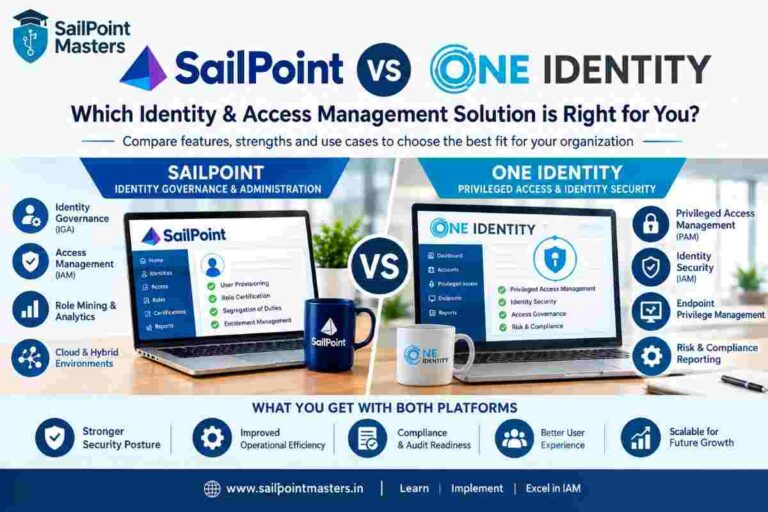
Identity and Access Management (IAM) has become one of the most important pillars of enterprise security. As organizations move workloads to the cloud, manage remote workforces, and face increasing regulatory scrutiny, the question of who has access to what has never mattered more. Two of the most frequently discussed platforms in this space are SailPoint and One Identity, and the comparison SailPoint vs One Identity comes up constantly among security architects, IT decision-makers, and IAM professionals.
What is SailPoint? SailPoint is an identity security platform best known for its strength in Identity Governance and Administration (IGA). It helps organizations manage identity lifecycles, automate access certifications, and enforce compliance across cloud and on-premises systems — see SailPoint’s own product overview for its official positioning.
What is One Identity? One Identity is a broader IAM and security vendor offering identity governance, privileged access management, and Active Directory management tools, giving organizations a wide set of building blocks to secure identities across complex environments — full details are available on One Identity’s official governance and administration page.
Identity and Access Management matters because every breach, insider threat, or compliance failure usually traces back to an identity that had access it shouldn’t have had. Modern organizations — from banks to healthcare providers to global technology firms — rely on IAM platforms to reduce this risk, meet audit requirements, and support Zero Trust security models.
This is exactly why enterprises spend so much time comparing SailPoint and One Identity: both promise to solve similar problems, but they approach governance, provisioning, and scalability differently. For IT buyers, understanding these differences is essential before making a multi-year investment.
At the same time, this comparison matters just as much for individuals. IAM has become a genuinely strong career track in India, with dedicated roles for SailPoint developers, One Identity engineers, and IAM consultants opening up across Hyderabad, Bengaluru, Pune, Chennai, Mumbai, Noida, and Gurugram. Learning SailPoint or One Identity — even at a foundational level — can be a meaningful stepping stone into a long-term cybersecurity or identity governance career.
This guide breaks down the SailPoint vs One Identity comparison in detail, covering governance, provisioning, cloud capabilities, security, pricing considerations, and the career paths available to professionals in this space.
SailPoint Latest Version
What is SailPoint?
SailPoint is an identity security company that specializes in Identity Governance and Administration (IGA). Its platforms are designed to give organizations visibility and control over who has access to which systems, applications, and data — and why.
Key SailPoint capabilities include
- Identity lifecycle management – Automating how identities are created, updated, and removed as employees join, move within, or leave an organization.
- Access governance – Ensuring that access granted to any identity aligns with business policy and least-privilege principles.
- Provisioning – Automatically granting or revoking access to applications and systems based on role or policy.
- Role management – Defining and maintaining roles that bundle together the access an employee needs for a given job function.
- Access certifications – Periodic reviews where managers or application owners confirm that existing access is still appropriate.
- Segregation of Duties (SoD) – Preventing conflicting access combinations that could enable fraud or error, such as a single user being able to both create and approve a payment.
- Compliance and audit – Providing the reporting and evidence organizations need to satisfy regulations like SOX, HIPAA, or GDPR.
- Identity Security Cloud – SailPoint’s SaaS-based identity security platform built for cloud-first organizations.
- SailPoint IdentityIQ – SailPoint’s on-premises and hybrid-capable IGA product, widely used in large, regulated enterprises.
SailPoint is generally regarded as one of the strongest pure-play IGA vendors, which is why so many identity governance-focused job postings specifically mention it. For a deeper, standalone breakdown of the platform, see our complete guide on what SailPoint is.
What is One Identity?
One Identity is a broader identity security vendor that offers a portfolio spanning identity governance, privileged access management (PAM), and Active Directory account management. Rather than focusing narrowly on governance alone, One Identity positions itself as a full-spectrum IAM provider.
Its approach typically includes
- Identity governance through its dedicated governance products, covering access certification, entitlement management, and policy enforcement.
- Privileged access management, helping organizations control, monitor, and audit access for administrator and service accounts — a category where One Identity has a particularly strong reputation. If you’re unclear on how PAM differs from broader IAM, our IAM vs PAM guide breaks down the distinction.
- Active Directory and Azure AD management, simplifying account administration, group policy, and hybrid directory environments.
- Unified identity security, aiming to bring governance, privileged access, and directory management under a more consolidated umbrella than some competitors.
Because One Identity’s portfolio is broader, organizations sometimes choose it when they want governance and privileged access capabilities from a single vendor relationship, rather than integrating separate point solutions.
SailPoint vs One Identity: What is the Difference?
At a high level, SailPoint is more narrowly focused on identity governance, while One Identity spans governance, privileged access, and directory management. Here’s how they compare across key dimensions
- IAM approach: SailPoint centers its architecture around governance-first identity security. One Identity takes a modular approach, combining governance with PAM and directory tools.
- Identity governance: Both platforms offer mature governance capabilities, though SailPoint is often cited as having deeper governance-specific tooling given its IGA-first heritage.
- Access management: Both support access requests and workflows; the depth of native access management (versus governance) varies by deployment and licensing.
- Provisioning: Both support automated provisioning and deprovisioning through connectors, though the connector ecosystems and configuration approaches differ.
- Role management: Both support role-based access control (RBAC) and role mining, with different tooling for building and maintaining role models.
- Compliance: Both are used to support SOX, HIPAA, GDPR, and similar frameworks through certification campaigns and audit reporting.
- Automation: Both platforms support workflow automation, though the extent of no-code/low-code configuration differs by product line.
- Integration capabilities: Each maintains a library of connectors for common enterprise applications, directories, and cloud platforms.
- Cloud support: SailPoint’s Identity Security Cloud is a SaaS-native product; One Identity offers cloud and hybrid deployment options across its portfolio.
- On-premises support: SailPoint IdentityIQ is well suited to on-premises and hybrid needs; One Identity also supports on-premises deployments, particularly for its AD management and PAM tools.
- Enterprise scalability: Both are used by large, complex enterprises, though the right fit depends on existing infrastructure.
- Ease of implementation: Implementation complexity for both platforms depends heavily on the size of the environment and the number of connected applications.
- Administration: Ongoing administration requirements differ based on which modules are deployed and how customized the configuration is.
- Reporting: Both provide governance and compliance reporting, with different dashboard and analytics capabilities.
- Pricing considerations: Both are enterprise-priced platforms; actual cost depends on user count, modules licensed, and deployment model, so organizations should request tailored quotes rather than relying on public list pricing.
SailPoint vs One Identity: Feature Comparison
|
Factor |
SailPoint |
One Identity |
|
Primary Focus |
Identity governance and administration (IGA) |
Broader IAM: governance, PAM, and AD management |
|
Identity Governance |
Strong, IGA-first design |
Strong, part of a wider portfolio |
|
Provisioning |
Connector-based automated provisioning |
Connector-based automated provisioning |
|
Access Certification |
Mature certification campaigns |
Certification and entitlement reviews |
|
Role Management |
RBAC and role mining tools |
RBAC support within governance modules |
|
Compliance |
Strong audit and compliance reporting |
Strong audit and compliance reporting |
|
Cloud Capabilities |
SaaS-native (Identity Security Cloud) |
Cloud and hybrid options across products |
|
On-Premises Support |
Strong (IdentityIQ) |
Strong, especially for AD/PAM tools |
|
Integrations |
Broad connector ecosystem |
Broad connector ecosystem |
|
Automation |
Workflow automation and AI-assisted features |
Workflow automation across modules |
|
Enterprise Scalability |
Suited to large, complex enterprises |
Suited to large, complex enterprises |
|
Best Fit |
Organizations prioritizing deep governance |
Organizations wanting governance + PAM + AD in one vendor |
SailPoint vs One Identity for Enterprise IAM
Neither platform is universally “better” — the right fit depends on the organization’s environment
- Large enterprises with complex compliance needs often value SailPoint’s governance depth or One Identity’s combined governance-and-PAM approach.
- Mid-sized organizations may prioritize ease of implementation and total cost of ownership over sheer feature breadth.
- Hybrid environments benefit from either platform’s on-premises and cloud support, depending on which systems need to be connected.
- Cloud-first organizations may lean toward SailPoint’s Identity Security Cloud for a SaaS-native governance experience.
- Highly regulated industries (finance, healthcare, government) typically need strong certification, SoD, and audit trail capabilities — both platforms are built with this in mind.
- Organizations with complex identity infrastructures, including many legacy directories and applications, should evaluate connector coverage carefully before choosing either platform.
The right choice ultimately depends on business requirements, existing architecture, budget, and security objectives — not on a generic “best overall” ranking.
SailPoint vs One Identity: Identity Governance
Both platforms support the core governance lifecycle
- Identity lifecycle management: Automating identity creation, changes, and removal as employees join, move, or leave (Joiner-Mover-Leaver, or JML, processes).
- Access requests: Employees can request access to applications or systems through a governed workflow.
- Access reviews and certifications: Managers and application owners periodically confirm that access remains appropriate.
- Role-based access control: Access is tied to defined roles rather than granted ad hoc.
- Policy enforcement: Both platforms can enforce policies such as segregation of duties.
- Compliance and audit requirements: Both generate the evidence auditors expect for frameworks like SOX and HIPAA.
The JML process, in particular, is where governance platforms deliver the most tangible risk reduction — ensuring access is granted quickly when needed and removed promptly when it’s not.
SailPoint vs One Identity: Provisioning and Access Management
Provisioning is the operational backbone of any IAM platform. Both SailPoint and One Identity support
- User provisioning and deprovisioning through automated workflows tied to HR or identity source changes.
- Application access management, granting or revoking access to specific business applications.
- Account management, including creation, modification, and disabling of accounts.
- Automated workflows that reduce manual IT tickets for routine access changes.
- Connectors for common systems, including databases, SaaS applications, and enterprise software.
- Active Directory integration, a common requirement in most enterprise environments.
- Cloud application integration, supporting SaaS platforms alongside traditional on-premises systems.
The practical difference often comes down to how mature and well-documented the connector for a specific application is, which is why organizations typically pilot both platforms against their real application landscape before committing. If you want a closer look at how this works on the SailPoint side, we cover it in detail in our SailPoint connectors list and setup guide and our breakdown of SailPoint provisioning vs deprovisioning.
SailPoint vs One Identity: Cloud Capabilities
As organizations shift more infrastructure to the cloud, IAM platforms must keep pace. When evaluating SailPoint and One Identity for cloud readiness, consider
- SaaS deployment: SailPoint’s Identity Security Cloud is built as a SaaS product; One Identity also offers SaaS and cloud-hosted options.
- Cloud identity governance: Both support governance for cloud applications and infrastructure identities.
- Hybrid IAM: Organizations with a mix of on-premises and cloud systems can use either platform, though configuration approaches differ.
- Integration with cloud applications: Both maintain connectors for widely used SaaS platforms.
- Scalability: Cloud-native deployments generally scale more easily than heavily customized on-premises installations.
- Automation: Cloud deployments often unlock more frequent updates and built-in automation features.
- Security controls: Cloud deployments shift some security responsibilities to the vendor, which organizations should factor into their risk assessments.
SailPoint vs One Identity: Security and Compliance
Security and compliance are core to why organizations invest in IAM platforms at all. Both SailPoint and One Identity support
- Identity security: Reducing risk from over-provisioned or orphaned accounts.
- Access governance: Ensuring access decisions are documented and reviewable.
- Compliance: Supporting frameworks such as SOX, HIPAA, GDPR, and industry-specific regulations.
- Audit readiness: Providing reports and logs auditors can review.
- Least privilege: Helping enforce that users only have the access they genuinely need.
- Segregation of Duties: Preventing risky combinations of access.
- Risk management: Flagging high-risk access combinations or anomalies.
- Access certification: Periodic sign-off on existing access grants.
- Regulatory requirements: Supporting the specific evidence needs of regulated industries, including region-specific rules such as the EU’s General Data Protection Regulation (GDPR).
Neither platform eliminates the need for sound governance policy — both are tools that enforce and automate policies an organization must still define.
SailPoint vs One Identity: Which is Better?
There is no universal winner in the SailPoint vs One Identity comparison. Instead, organizations should use a decision framework based on
- Organization size – larger, more complex organizations may need deeper governance tooling.
- IAM maturity – organizations early in their IAM journey may prefer a platform with more guided, out-of-the-box workflows.
- Existing technology stack – compatibility with current directories, HR systems, and applications matters significantly.
- Deployment model – cloud-first vs hybrid vs on-premises priorities will point toward different configurations of each platform.
- Governance requirements – organizations needing deep certification and SoD capabilities should evaluate governance depth closely.
- Compliance requirements – regulated industries should map platform capabilities directly to their specific audit needs.
- Budget – total cost of ownership, including implementation and ongoing administration, should be compared, not just license cost.
- Integration requirements – the number and type of applications needing connectors will influence the right fit.
- Internal IAM expertise – teams with existing SailPoint or One Identity experience may prefer to build on that familiarity.
SailPoint vs One Identity: Pros and Cons
SailPoint
Pros:
- Strong, governance-first heritage and deep IGA capabilities
- SaaS-native Identity Security Cloud for cloud-first organizations
- Widely recognized in the IAM job market, especially for governance-focused roles
- Mature certification and SoD capabilities
Cons:
- Primarily governance-focused, so some organizations may need additional tools for privileged access management
- Implementation can require significant planning for large, complex environments
- Licensing and total cost of ownership should be evaluated carefully for smaller organizations
One Identity
Pros:
- Broader portfolio spanning governance, privileged access, and Active Directory management
- Useful for organizations wanting to consolidate vendors across multiple IAM categories
- Strong reputation in privileged access management
- Flexible deployment options across cloud and on-premises
Cons:
- Breadth of portfolio can mean more modules to learn and administer
- Governance-only buyers may find some capabilities beyond their immediate needs
- Integration complexity can increase when using multiple modules together
SailPoint vs One Identity for Beginners
For someone starting an IAM career, either platform can be a reasonable entry point, but the better starting point often depends on the learning resources and job opportunities available locally.
Beginners should first focus on foundational concepts that apply to both platforms:
- Basic IAM terminology (identity, entitlement, role, provisioning)
- Active Directory and LDAP fundamentals
- Understanding of the Joiner-Mover-Leaver lifecycle
- Basic SQL for querying identity data
- An understanding of access certification and compliance concepts
Once these fundamentals are solid, learning either SailPoint or One Identity becomes significantly easier, since both platforms build on the same underlying IAM concepts. If you’re just starting out, our SailPoint course for beginners walks through exactly where to begin.
SailPoint vs One Identity for IAM Professionals
For established IAM professionals, career relevance often comes down to which platform is more widely used by prospective employers in their target industry and region. Technical skills that translate well across both platforms include
- Connector configuration and troubleshooting
- Workflow design and automation
- Role modeling and RBAC design
- Certification campaign design
- SoD policy configuration
- Experience with REST APIs for custom integrations
Professionals with implementation experience on either platform, along with relevant certifications, are typically well positioned for consulting and engineering roles. If you’re already working and considering a shift into IAM, see our guide on the SailPoint course for working professionals.
SailPoint vs One Identity Jobs in India
The IAM job market in India has grown substantially as global enterprises expand their Global Capability Centers (GCCs) and security operations in the country. Common roles include
- SailPoint Developer – builds and customizes SailPoint workflows, connectors, and rules.
- SailPoint Consultant – leads implementation and configuration for client organizations.
- SailPoint Administrator – manages day-to-day operations of an existing SailPoint deployment.
- Identity Governance Engineer – designs and maintains governance policies across IAM platforms.
- IAM Engineer – works broadly across IAM tools, not limited to a single vendor.
- One Identity Engineer – implements and manages One Identity governance, PAM, or AD management modules.
- IAM Consultant – advises organizations on IAM strategy and platform selection.
- Identity Security Specialist – focuses on identity-related risk and security operations.
These roles are concentrated in India’s major technology hubs, including Hyderabad, Bengaluru, Pune, Chennai, Mumbai, Noida, and Gurugram, where global consulting firms, IT services companies, and enterprise security teams maintain large IAM practices. For a closer look at the SailPoint side of this job market, see our dedicated guides on SailPoint careers and how to become a SailPoint developer.
SailPoint Salary in India
Salary figures for SailPoint professionals vary based on experience, certifications, employer, and location. The table below offers an indicative range
|
Experience Level |
Typical IAM Experience |
Indicative Salary Range |
|
Fresher / Entry Level |
0–2 Years |
₹4–₹8 LPA |
|
Mid-Level |
3–5 Years |
₹8–₹18 LPA |
|
Senior |
6–10 Years |
₹18–₹30 LPA |
|
Lead / Architect |
10+ Years |
₹30 LPA+ |
These figures are indicative only. Actual salaries vary according to experience, skills, certifications, employer, location, and project complexity, and should not be treated as guaranteed figures. For a more detailed, city-specific breakdown, see our full SailPoint course salary in Hyderabad guide.
One Identity Career Opportunities in India
Professionals specializing in One Identity can pursue roles similar to those in the SailPoint ecosystem, including engineering, consulting, and administration positions. Because One Identity’s portfolio spans governance, privileged access management, and Active Directory tools, professionals with broader IAM exposure — not just governance — often find strong demand for their skills, particularly in organizations that have standardized on the One Identity suite for multiple IAM functions.
Skills Required for a SailPoint Career
Building a SailPoint career typically requires a mix of IAM concepts and technical skills, including
- Identity and Access Management fundamentals
- Identity Governance concepts
- SailPoint IdentityIQ configuration
- SailPoint Identity Security Cloud administration
- Workflow design
- Provisioning and deprovisioning logic
- Connector configuration
- Role-Based Access Control (RBAC)
- Role mining techniques
- Access certification campaign design
- Segregation of Duties (SoD) policy setup
- Java programming (commonly used for IdentityIQ customization) — though it’s worth noting you can start learning SailPoint without prior Java knowledge and pick it up alongside the platform
- SQL for identity data queries
- REST APIs for integrations
- XML and JSON for configuration files
- Active Directory fundamentals
- LDAP protocol basics
- Git for version control
- Troubleshooting skills
- Broader IAM security concepts
SailPoint vs One Identity Career Path
|
Level |
Skills to Learn |
Career Focus |
|
Beginner |
IAM fundamentals, LDAP, Active Directory, SQL |
IAM fundamentals |
|
Intermediate |
SailPoint/One Identity, provisioning, workflows, connectors |
IAM implementation |
|
Advanced |
Governance, RBAC, SoD, integrations, automation |
IAM engineering/consulting |
|
Expert |
Architecture, security strategy, large-scale IAM |
IAM Architect/Lead |
Certifications That Boost IAM Careers
Relevant certifications and learning paths can strengthen an IAM career alongside hands-on experience, including
- SailPoint’s own certification tracks for IdentityIQ and Identity Security Cloud
- One Identity certification and training programs
- Vendor-neutral IAM and identity governance training
- Cloud security certifications relevant to identity (such as those covering AWS, Azure, or GCP identity services)
- Broader cybersecurity certifications
- Microsoft identity-focused certifications, given how common Active Directory and Azure AD integration are in real deployments
Certifications work best when paired with hands-on project experience — employers typically look for both credentials and demonstrated implementation skills. If you’re preparing for a SailPoint exam specifically, see our SailPoint IIQ exam preparation guide, and for what comes afterward, after SailPoint certification, what next.
SailPoint vs One Identity: Architecture Comparison
At a high level, both platforms share a similar conceptual architecture, even though implementation details differ
- Identity sources: HR systems or directories that feed identity data into the platform.
- Applications: Target systems where access is granted or reviewed.
- Connectors: Software components that link the IAM platform to identity sources and applications.
- Identity repositories: Central stores holding consolidated identity and entitlement data.
- Governance layers: Policy engines that define certification, SoD, and access rules.
- Provisioning engines: Components responsible for executing access changes on target systems.
- Workflows: Automated sequences that route approvals and execute changes.
- Policies: Rules governing access decisions and compliance requirements.
- Reporting: Dashboards and exports used for audits and management visibility.
- Integrations: APIs and connectors linking the platform to the broader IT ecosystem.
For a deeper technical walkthrough of how this looks specifically on SailPoint’s side, see our dedicated posts on SailPoint IdentityIQ architecture and aggregation in SailPoint.
SailPoint vs One Identity: Use Cases
Both platforms are commonly used for
- Employee onboarding, automatically provisioning access based on role
- Employee offboarding, ensuring access is revoked promptly to reduce risk
- Application access requests, letting employees request access through a governed process
- Access reviews, periodically validating that existing access remains appropriate
- Compliance audits, generating evidence for regulators and internal audit teams
- Role management, maintaining accurate role definitions as the organization evolves
- Privileged access governance, particularly relevant for One Identity’s PAM capabilities
- Hybrid identity environments, connecting on-premises directories with cloud applications
SailPoint vs One Identity vs Other IAM Solutions
Beyond SailPoint and One Identity, the broader IAM market includes other governance, access management, and privileged access vendors. Organizations sometimes evaluate SailPoint and One Identity alongside these alternatives when running a formal RFP process, and the core evaluation criteria remain similar: governance depth, connector coverage, cloud readiness, and total cost of ownership.
This guide keeps its primary focus on SailPoint and One Identity rather than expanding into a broader market survey. If you’re weighing SailPoint against other specific platforms, we’ve covered those comparisons separately: SailPoint vs Saviynt, SailPoint vs Okta, SailPoint vs CyberArk for Identity Governance, and Ping Identity vs SailPoint.
Why Identity Governance is Important in 2026
Several trends are reinforcing the importance of identity governance heading into 2026
- Zero Trust architectures assume no implicit trust, making identity verification and governance central to security design — a principle formalized in NIST’s Zero Trust Architecture publication (SP 800-207).
- Identity-first security treats identity, not the network perimeter, as the primary control point.
- Cloud adoption continues to expand the number of applications and services that need governed access.
- Hybrid environments require governance platforms that can span on-premises and cloud systems consistently.
- Identity threat detection is becoming a closer partner to traditional IGA, helping detect compromised or misused identities.
- Automation reduces manual effort and error in provisioning and certification processes.
- AI-assisted security is increasingly used to flag anomalous access patterns.
- Machine identities and non-human identities (service accounts, bots, API keys) are growing faster than human identities in many organizations, creating new governance challenges — a topic we explore further in SailPoint machine identity security.
- Compliance requirements continue to expand across industries and regions.
- Least-privilege access remains a foundational security principle that governance platforms help enforce.
Why SailPoint is a Strong IAM Career Choice
SailPoint’s strong position in enterprise IGA makes it a compelling skill to build for several reasons
- Enterprise IAM adoption continues to grow, especially among regulated industries
- Identity governance demand is rising as compliance requirements expand
- Cloud IAM growth favors platforms like SailPoint’s Identity Security Cloud
- Certification opportunities give professionals a structured way to validate their skills
- Consultant and developer roles are widely available across IT services firms
- Long-term cybersecurity relevance means IAM skills tend to remain valuable over time
If you’re ready to build these skills hands-on, our SailPoint certification training in Hyderabad covers IdentityIQ, Identity Security Cloud, and real-time governance projects from the ground up.
Why One Identity is a Valuable IAM Skill
Learning One Identity — and the broader IAM concepts it represents — can benefit professionals interested in
- Identity security roles that span governance and privileged access
- Organizations that have standardized on a single vendor for multiple IAM functions
- Administration and engineering roles focused on Active Directory-heavy environments
- Consulting roles that require breadth across governance, PAM, and directory management
Future Scope of SailPoint and One Identity
Looking ahead, both platforms are likely to evolve alongside broader IAM trends, including
- AI for smarter access recommendations and anomaly detection
- Machine identities requiring new governance models beyond traditional human identity lifecycles
- Cloud-native applications driving continued investment in SaaS-based governance
- SaaS delivery models becoming more dominant across the IAM market
- Zero Trust architectures embedding identity governance more deeply into security operations
- Identity threat detection converging with traditional IGA capabilities
- Automated governance reducing manual certification and review workloads
- Non-human identities becoming a larger governance priority
- Increasing compliance requirements across industries and geographies
How to Start a Career in IAM
For those looking to break into IAM, a practical step-by-step approach can help
- Learn IAM fundamentals.
- Understand Active Directory and LDAP.
- Learn SQL and basic programming.
- Understand identity lifecycle management.
- Learn provisioning and deprovisioning.
- Learn SailPoint or One Identity.
- Practice workflows and integrations.
- Learn REST APIs and connectors.
- Build hands-on projects.
- Prepare for IAM interviews.
- Consider relevant certifications.
- Apply for IAM jobs and consulting roles.
Career Comparison Table
|
Career Option |
Primary Focus |
Typical Skills |
Career Potential |
|
SailPoint Developer |
Building and customizing IGA workflows |
Java, SQL, REST APIs, IdentityIQ |
Strong, especially in regulated industries |
|
SailPoint Consultant |
Leading implementations for clients |
IAM strategy, stakeholder management, IdentityIQ/ISC |
Strong, consulting-driven demand |
|
One Identity Engineer |
Implementing governance/PAM/AD modules |
AD, PAM concepts, workflow configuration |
Strong, especially in AD-heavy environments |
|
IAM Engineer |
Cross-platform IAM implementation |
IAM fundamentals, multiple vendor tools |
Strong and vendor-flexible |
|
IAM Architect |
Designing enterprise IAM strategy |
Architecture, governance, security strategy |
High, senior-level demand |
Comparison With Other IT Roles
|
Career |
Primary Focus |
Main Skills |
|
IAM Engineer |
Identity and access |
IAM, SailPoint, AD, APIs |
|
Cybersecurity Engineer |
Security infrastructure |
Security, networking, SIEM |
|
Cloud Engineer |
Cloud infrastructure |
Azure/AWS/GCP |
|
Data Engineer |
Data platforms |
SQL, Python, Spark |
|
Software Developer |
Application development |
Programming, APIs, frameworks |
Statistics and Market Demand
Identity governance and IAM have become priority investment areas for enterprise security budgets, driven largely by cloud adoption and regulatory pressure. Analyst firms such as Gartner have repeatedly highlighted identity as a top security spending priority in recent years, and industry bodies like NASSCOM have tracked rising cybersecurity investment and hiring trends across India’s IT sector alongside broader cybersecurity hiring growth. Because market figures shift year to year, readers evaluating specific numbers — such as exact job counts or salary benchmarks — should consult current reports from sources like Gartner, NASSCOM, or dedicated cybersecurity job portals for the most up-to-date data specific to their region and year.
Key Takeaways
- SailPoint is governance-focused, while One Identity offers a broader mix of governance, privileged access management, and Active Directory tools.
- There is no universal “winner” in the SailPoint vs One Identity comparison — the right choice depends on organizational size, infrastructure, and compliance needs.
- Both platforms support core IAM functions like provisioning, certification, RBAC, and compliance reporting.
- IAM careers in India are growing across major hubs, with dedicated roles for SailPoint developers, One Identity engineers, and IAM consultants.
- Building foundational IAM skills — Active Directory, LDAP, SQL, and governance concepts — is the best starting point regardless of which platform you specialize in later.
Conclusion
The SailPoint vs One Identity comparison ultimately comes down to fit, not superiority. SailPoint’s strength lies in deep, governance-first identity security, making it a strong choice for organizations that prioritize certification, compliance, and cloud-native governance. One Identity’s broader portfolio — spanning governance, privileged access management, and Active Directory administration — appeals to organizations that want multiple IAM functions from a single vendor. Neither platform is a one-size-fits-all answer; the right decision depends on your organization’s existing infrastructure, compliance obligations, budget, and long-term security strategy.
For professionals, this comparison also opens a door: Identity and Access Management continues to be one of the more resilient and in-demand areas of cybersecurity, with strong career opportunities across India’s major technology hubs. Whether you choose to specialize in SailPoint, One Identity, or broader IAM fundamentals, building hands-on skills in identity governance, provisioning, and compliance will position you well for a long-term career in identity security. Start with the fundamentals, get hands-on with either platform — through a structured program like SailPoint Masters’ certification training in Hyderabad, for example — and keep building. The demand for skilled IAM professionals isn’t slowing down anytime soon.
FAQ
- What is the difference between SailPoint and One Identity?
SailPoint is primarily an identity governance and administration (IGA) platform, while One Identity offers a broader portfolio spanning governance, privileged access management, and Active Directory administration.
- Is SailPoint better than One Identity?
Neither is universally better. SailPoint is often favored for deep governance capabilities, while One Identity is favored when organizations want governance, PAM, and AD management from one vendor.
- Is SailPoint a good career in India?
Yes. SailPoint skills are in demand across IT services firms, consulting companies, and enterprise security teams in cities like Bengaluru, Hyderabad, and Pune.
- Is One Identity a good IAM tool?
Yes. One Identity is a well-established IAM vendor, particularly strong in privileged access management and Active Directory administration.
- Which is easier to learn, SailPoint or One Identity?
Both require similar foundational IAM knowledge. Ease of learning often depends on available training resources and hands-on lab access rather than the platform itself.
- What is SailPoint IdentityIQ?
SailPoint IdentityIQ is SailPoint’s on-premises and hybrid-capable identity governance product, widely used by large, regulated enterprises.
- What is SailPoint Identity Security Cloud?
SailPoint Identity Security Cloud is SailPoint’s SaaS-based identity security platform designed for cloud-first identity governance.
- What skills are required for a SailPoint job?
Common skills include IAM fundamentals, Java, SQL, REST APIs, Active Directory, LDAP, and hands-on experience with IdentityIQ or Identity Security Cloud.
- What is the salary of a SailPoint professional in India?
Salaries vary by experience, ranging roughly from entry-level packages to significantly higher compensation for senior architects, depending on skills, certifications, and employer.
- Which IAM technology should beginners learn in 2026?
Beginners should first build core IAM fundamentals — Active Directory, LDAP, and identity lifecycle concepts — before specializing in either SailPoint or One Identity based on local job market demand.
SailPoint Trainer
SailPoint Masters Editorial Team | 15+ Articles Published
We specialize in SailPoint Certification Training in Hyderabad, helping aspiring professionals and IT experts develop in-demand Identity and Access Management (IAM) skills. Our training covers SailPoint IdentityIQ, Identity Security Cloud, certification preparation, real-world projects, and career guidance to support success in cybersecurity and identity governance careers.
Share